


Normands Parallel Of The Orders Of Artchitecture - Greek Roman And Renaissance
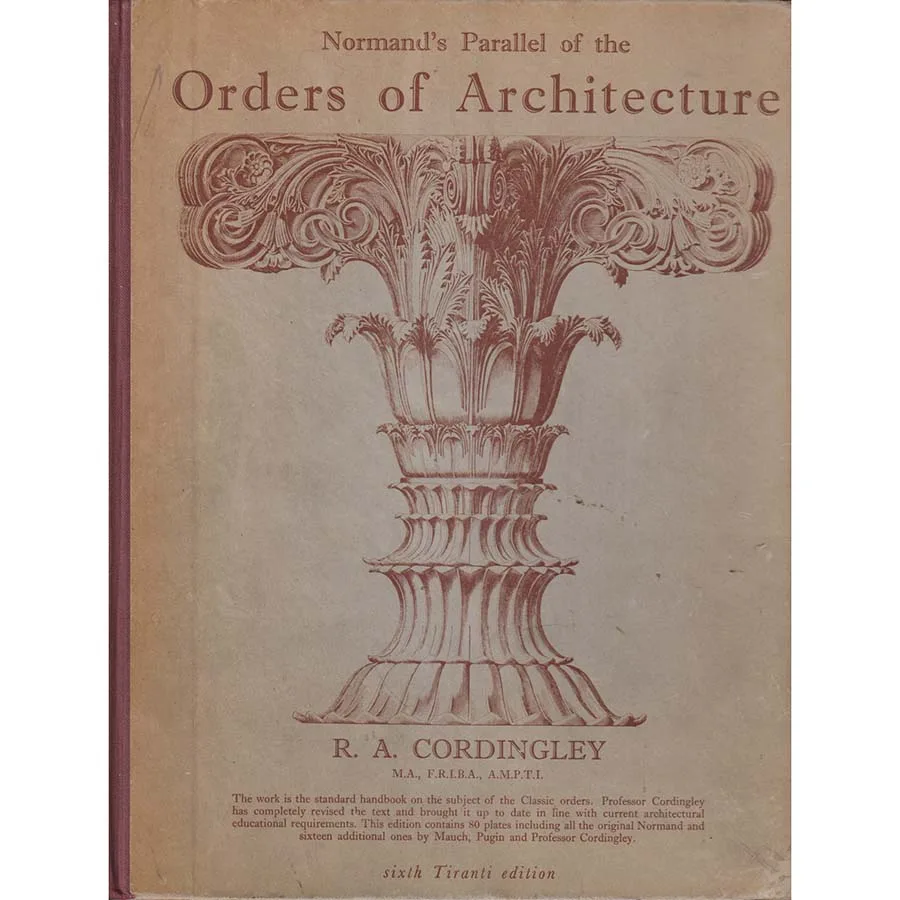
Publisher: Alec Tiranti Ltd
Format: Hardback
ISBN: none
Normand’s Parallel of the Orders of Architecture - Greek, Roman and Renaissance, by R. A. Cordingley and published by Alec Tiranti Ltd in 1959, is the sort of architectural book produced in the days when a column was not merely a vertical object holding something up, but an opportunity for several thousand years of argument.
This is a study of the classical architectural orders — Doric, Ionic, Corinthian and their assorted relatives, descendants and Renaissance interpretations — presented through measured drawings and comparative plates showing how generations of architects decided that the precise width of a capital, the profile of a moulding and the number of diameters in a column were matters deserving serious attention.
And, to be fair, they were.
The classical orders formed one of the great visual languages of Western architecture. Temples, palaces, churches, banks, civic buildings and enormous houses belonging to people with more land than modesty all borrowed from the same basic vocabulary.
Columns.
Capitals.
Entablatures.
Pediments.
And enough proportional theory to make a modern builder quietly leave the room.
The great strength of a book like Normand’s Parallel is comparison.
Rather than merely telling the reader that Greek, Roman and Renaissance architects treated the classical orders differently, it places examples alongside one another so that the differences can actually be seen.
A Greek Doric column is not quite the same creature as a Roman Doric one.
Renaissance architects then studied both, measured them, interpreted them, regularised them and occasionally disagreed with one another about what the ancients had obviously intended.
Which is one of the enduring pleasures of architectural history: everybody claims to be following tradition, but somehow the details keep changing.
The original work by Charles Normand became an important reference for architects and draughtsmen, and this later edition, associated with R. A. Cordingley, continued that tradition for a twentieth-century readership.
It belongs to a world in which architectural students were expected to understand proportion through actual measured drawings rather than by typing “classical column” into an image search and hoping for the best.
Published by Alec Tiranti Ltd, a name strongly associated with architectural and artistic reference books, this volume has the satisfyingly practical air of something intended to be used rather than merely admired.
It is a book for looking closely.
Very closely.
Possibly with a ruler.
The plates reward anyone interested in the mechanics of classical design: how bases are constructed, how capitals develop, how mouldings relate to one another and how the entire system is governed by proportion.
To the uninitiated, some of this may look like several pages of very similar columns.
To the architecturally inclined, it is the difference between civilisation and somebody putting a decorative post outside a bungalow.
There is also something wonderfully old-fashioned about the confidence of the subject.
Classical architecture assumes that beauty can, to some extent, be measured.
That there are proportions worth studying.
That a building can be improved by understanding what people were doing two thousand years ago.
Modern architecture has occasionally responded to this by constructing a large glass box.
Debate continues.
For students of architecture, classical design, historic buildings, draughtsmanship or architectural ornament, Normand’s Parallel of the Orders of Architecture remains an attractive reference work.
It is also ideal for anyone who has ever stood in front of a grand building, looked up at the columns and thought: “Yes, but are those really Corinthian?”
Now you can go home and check.
Condition: Good. A sound vintage copy with normal signs of age and handling appropriate to a book published in 1959. It has survived more than six decades while remaining considerably straighter than many modern buildings.
No ISBN stated.
A detailed and beautifully technical comparison of Greek, Roman and Renaissance architectural orders, packed with the kind of measured drawing that makes designers happy and everyone else suddenly aware that columns are much more complicated than they look.
Sold by Crappy Old Books — where even the columns come with provenance.
And for your catalogue, I’d correct “Artchitecture” to “Architecture” in the title.
Keep browsing: See more Architecture books Other books by RA Cordingley
