The Great Tradition
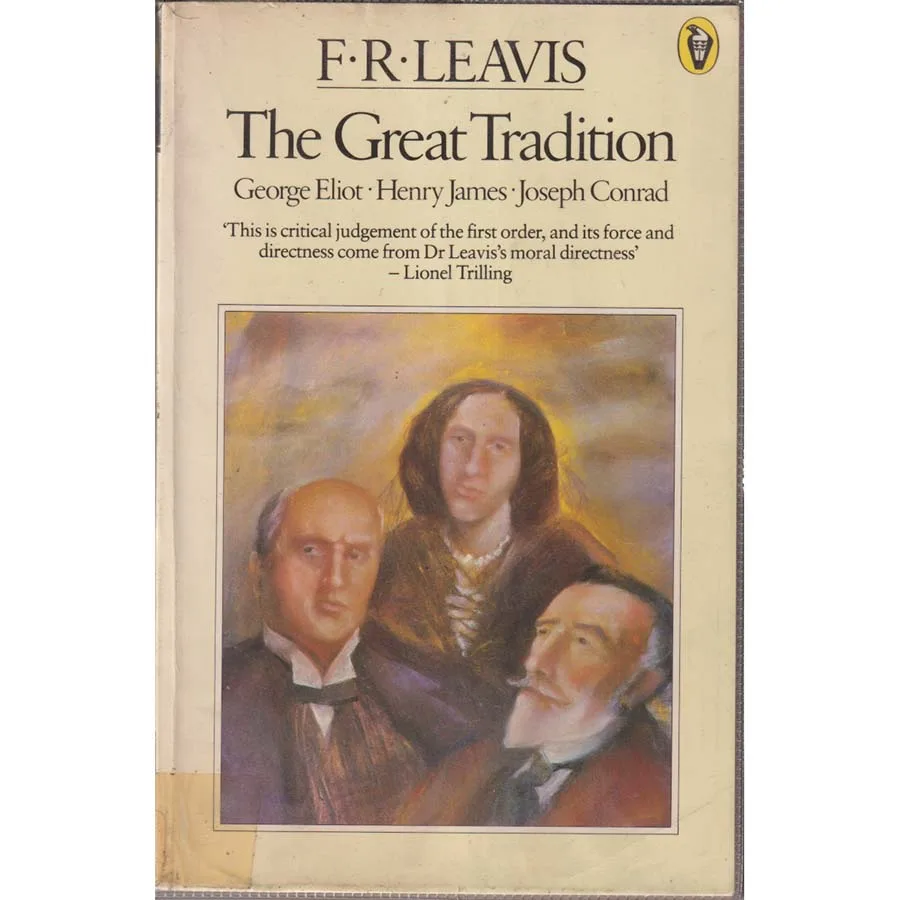
Publisher: Peregrine Books
Format: Paperback
ISBN: 0140550208
The Great Tradition by F. R. Leavis, published by Peregrine Books in 1983, is one of the great monuments of twentieth-century English literary criticism: a book in which Leavis surveys the English novel, identifies the writers he considers truly important, and proceeds with the serene confidence of a man who has no intention whatsoever of pretending everybody is equally good.
First published in 1948, The Great Tradition became famous partly because of the writers Leavis championed and partly because of the writers he did not. His central line of descent runs through Jane Austen, George Eliot, Henry James and Joseph Conrad, whom he regarded as representing the highest achievements of the English novel.
This was criticism from an age before every opinion required three disclaimers and a panel discussion.
Leavis believed literature mattered enormously. Not in the vague sense that books are “good for you”, but because serious novels could embody moral intelligence, subtle perception and a deep understanding of human relationships. Reading, in his view, was not a decorative hobby to be undertaken beside a tasteful lamp. It was an activity requiring discrimination, attention and occasionally the courage to decide that a celebrated writer was not actually very good.
This naturally made him influential.
It also made him excellent company for arguments.
Leavis’s style is rigorous, demanding and sometimes gloriously uncompromising. He does not stroll gently through literary history pointing out things the reader might like. He builds a case. Writers are examined, compared and judged according to standards which he assumes matter, whether or not the rest of the literary establishment has been consulted.
The result is one of those books that became important enough for later critics to spend decades agreeing with it, attacking it, revising it or explaining why Leavis had missed somebody.
Which is usually a sign that a critical book has done its job.
For students of English literature, The Great Tradition became a touchstone. It helped shape the way the English novel was taught and discussed for generations, and its influence can still be felt even among readers who have never opened it.
The title itself entered the critical vocabulary.
What, exactly, constitutes a “great tradition”? Who belongs in it? Who gets left out? And who gets to decide?
Leavis had answers.
Other people had other answers.
Universities subsequently obtained several decades of seminars from the disagreement.
Published in this 1983 Peregrine Books edition, the volume is itself a nice piece of academic publishing history. Peregrine editions were designed to make serious works of literature, criticism and thought widely available in paperback form, back when publishers apparently believed members of the general public might voluntarily purchase books about literary judgement.
This copy is also ex-library, so it has had a proper working life.
Rather than spending forty years untouched on somebody’s decorative bookshelf, it has actually been catalogued, borrowed, returned, shelved, possibly overdue, and subjected to the full bureaucratic machinery of institutional reading.
That may mean the usual library markings, stamps, labels or evidence of former ownership associated with an ex-library copy. In return, you get a book with provenance of the least glamorous but perhaps most appropriate kind: this is literary criticism that has actually been in a library.
Which seems right.
Condition: Good. A sound used copy with normal signs of age and handling, together with ex-library markings and associated evidence of previous library use. It remains perfectly suitable for reading, study or for placing conspi
Keep browsing: See more Fiction books Other books by FR Leavis