


Poems By Eliah Wheeler Wilcox
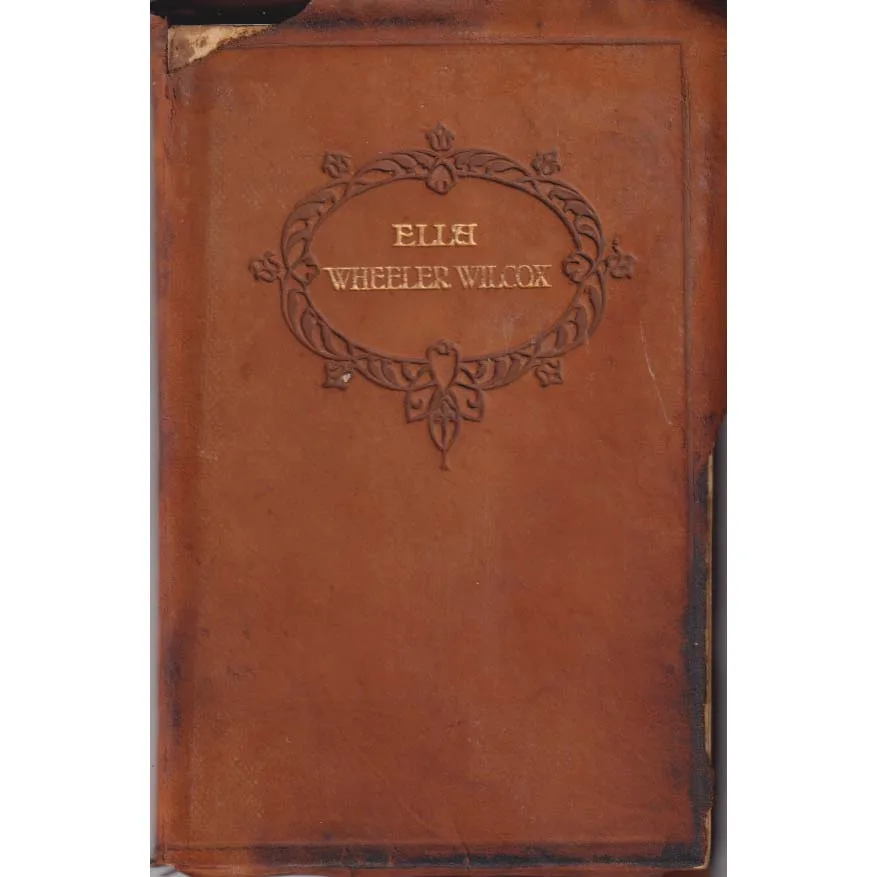
Publisher: Collins
Format: Paperback
ISBN: none
Poems by Ella Wheeler Wilcox, published by Collins around 1914, is one of those wonderfully tactile old poetry books that makes modern paperbacks seem slightly underdressed.
Bound in a soft suede-type cover, with gilt lettering and decorative tooling, it has the appearance of a book intended to be given to somebody, treasured for years, placed carefully beside a bed, and eventually inherited by someone who had absolutely no idea who originally bought it.
Ella Wheeler Wilcox was one of the most widely read American poets of her day, famous for verses dealing with love, sorrow, optimism, disappointment, fate, morality and the exhausting general business of being human. Her poetry was enormously popular with ordinary readers, which naturally led certain literary critics to regard it with suspicion.
Wilcox had a gift for writing lines that were memorable, direct and emotionally immediate. She was not generally interested in making readers spend three weeks wondering what a poem might possibly mean. If the subject was love, grief, hope or misery, you normally knew about it fairly quickly.
Her best-known line, “Laugh, and the world laughs with you”, became so firmly embedded in popular culture that generations of people have quoted it without necessarily knowing where it came from. This is the curious fate of highly successful poetry: eventually everyone knows the words and nobody remembers the poet.
This Collins volume gathers a selection of Wilcox’s verse in the sort of attractive gift-book format that was enormously popular in the early twentieth century. The inclusion of colour illustrations adds considerably to its charm and places it firmly in an era when publishers understood that poetry might occasionally benefit from looking beautiful as well as sounding meaningful.
But this particular copy has acquired something publishers could not have planned.
Inside are two pressed botanical specimens — apparently flowers or clover — left between the pages by a previous owner.
They have presumably been there for many decades.
Who placed them there, why they chose those particular pages, and whether the specimens commemorated a walk, a garden, a friendship, a romance or simply somebody thinking “this clover might flatten nicely in here” is now impossible to know.
And that is really rather wonderful.
Old books occasionally accumulate small pieces of somebody else’s life. Receipts, train tickets, inscriptions, postcards and pressed flowers survive because somebody put them inside a book and then forgot about them. A century later they become accidental historical artefacts, vastly more interesting than the supermarket receipt most of us would leave behind today.
The suede-style binding adds to that sense of age and personality. It has the softness and wear of something that has actually been handled rather than preserved untouched in a warehouse. It is the sort of binding that invites picking up, although after more than a century it probably deserves slightly more respectful treatment than it received in 1914.
The approximate date is itself appealing. Around 1914, Europe was entering a period that would transform society completely, yet books like this still belonged to the Edwardian world of gift volumes, sentimental verse and illustrated literary collections. Someone may have received this copy when the poetry was contemporary reading rather than antique literature.
That makes the surviving pressed flowers particularly evocative. They may have been placed there before the First World War, during it, or years afterwards. There is no sensible way of knowing, so naturally the imagination is free to become completely unreasonable.
Condition: Good. This is an antique book dating from around 1914, with the expected signs of age, handling and wear. The suede-type cover remains attractive, with age-related marks and rubbing consistent with a book well over a century old. The book also contains colour illustrations and, unusually, two pressed flowers or clover specimens left inside by a previous owner.
The botanical additions are included exactly as found. Crappy Old Books accepts no responsibility for any century-old romantic significance they may possess.
No ISBN, naturally. The ISBN system would not arrive for another half-century, and books were somehow bought, sold and read without thirteen-digit identification numbers.
An especially characterful copy for collectors of antique poetry, decorative bindings, Ella Wheeler Wilcox, early twentieth-century gift books, illustrated literature or simply old books that have acquired a little mystery of their own.
Sold by Crappy Old Books — where occasionally you buy the book and discover somebody from 1914 has left you the flowers.
Keep browsing: See more Poetry books Other books by Eliah Wheeler Wilcox
