


Furtwangler - Die Grossen Interpreten
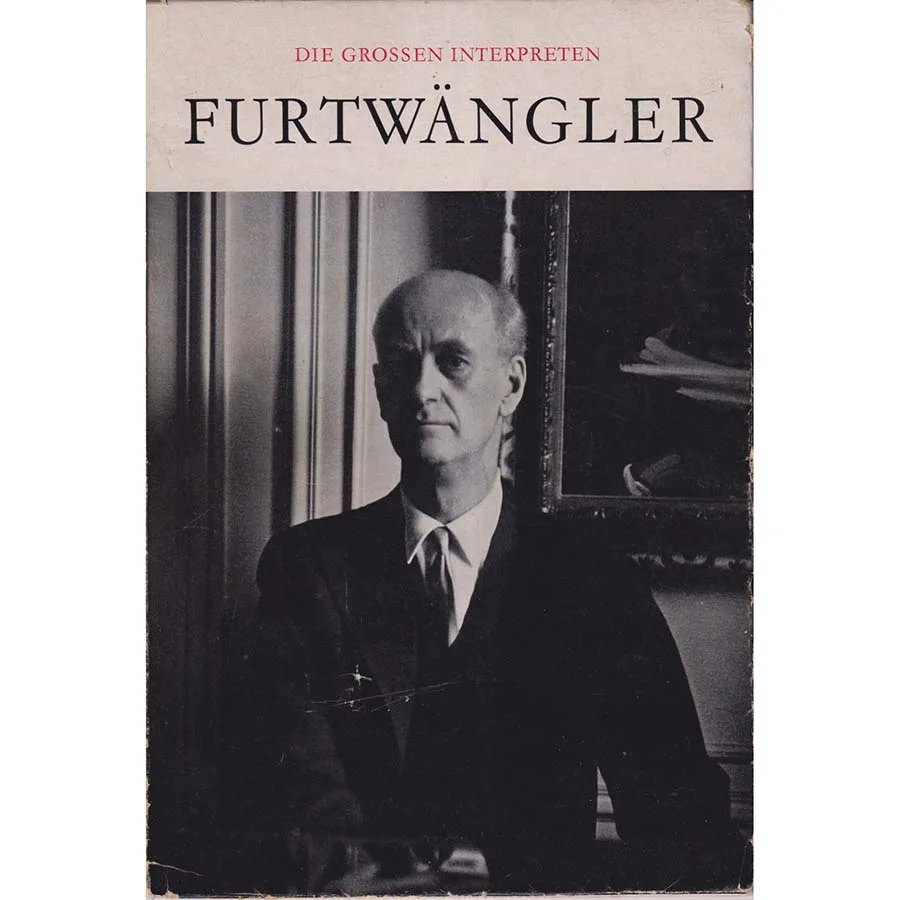
Publisher: Verlag R Kister
Format: Paperback
ISBN: none
Furtwangler - Die Grossen Interpreten by Roger Hauert and Bernard Gavoty, published by Verlag R. Kister in 1954, is a German-language study of Wilhelm Furtwängler, one of the towering and frequently debated conductors of the twentieth century.
Furtwängler belonged to an age when conductors were expected to possess not merely technique but presence: the ability to walk onto a platform, raise a baton and persuade a hundred highly trained musicians that, for the next hour or two, they were all going to breathe at exactly the same moment.
His reputation rests particularly on his interpretations of the great Austro-German repertoire, and his performances of composers such as Beethoven, Brahms, Bruckner and Wagner acquired almost legendary status. Recordings of Furtwängler are still listened to, discussed and compared by people who can spend an entire evening arguing about the tempo of a symphonic transition and regard this as an excellent use of time.
This 1954 volume forms part of the Die Grossen Interpreten tradition of books devoted to major performers and interpreters. Rather than treating music simply as a collection of works on paper, books of this kind concentrate on the people who actually turned those notes into performances: conductors, instrumentalists and singers whose individual styles could make the same score sound completely different.
Furtwängler is an especially suitable subject because his approach was intensely personal. His conducting was associated with flexibility, broad musical architecture and a willingness to allow a performance to breathe rather than proceed with the cheerful regularity of a metronome. To admirers this produced extraordinary depth and spontaneity. To anyone expecting every bar to arrive exactly where the stopwatch predicted, it could presumably be rather alarming.
The historical background inevitably gives the subject additional weight. Furtwängler’s career stretched across one of the most turbulent periods in German history, and his decision to remain professionally active in Germany during the Nazi era has continued to generate discussion about music, politics, personal responsibility and the difficult position of artists working under dictatorships. It is a reminder that cultural history rarely has the decency to remain simple.
Published in 1954, the year of Furtwängler’s death, this book also has the particular interest of being contemporary with the final period of his career. It is therefore not a retrospective assessment written generations later, but a piece of musical publishing produced when Furtwängler was still very much part of the living musical world.
The book is in German, which will either make it considerably more authentic or considerably less readable depending on your linguistic abilities. For German-speaking readers, music students and collectors, this adds to its appeal. For everyone else, there is always the traditional method of recognising the words “Beethoven”, “Berlin” and “Orchester” and proceeding confidently from there.
There is something pleasingly appropriate about a 1950s German book devoted to one of the great German conductors. No glossy streaming recommendations, no algorithmically generated “Essential Furtwängler” playlist and no comments section underneath arguing that somebody else conducted the Ninth better. Just print, photographs, musical history and the expectation that the reader might actually sit down and pay attention.
Condition: Good. A sound vintage copy showing normal signs of age and handling appropriate to a book published in 1954. It has now survived long enough to become an historical object in its own right, which is considerably easier than conducting the Berlin Philharmonic.
Language: German.
No ISBN stated.
An appealing item for collectors of classical music books, conducting history, German-language music literature, Furtwängler enthusiasts, or anyone who believes that choosing between different recordings of Beethoven is a perfectly legitimate way to lose an afternoon.
Sold by Crappy Old Books — where even the conductors are old, the books are older, and nobody insists that you clap between movements.
Keep browsing: See more Music books Other books by Roger Hauert and Bernard Gavoty
