


In Love And War
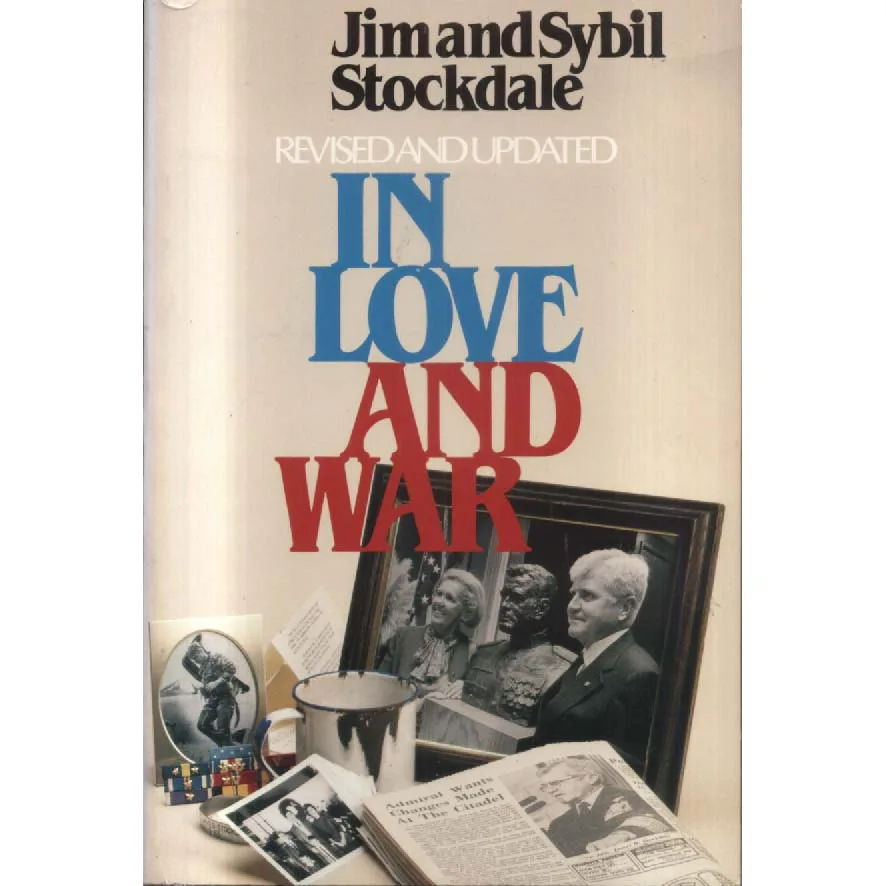
Publisher: Naval Institute Press
Format: Paperback
ISBN: 9781557507846
In Love and War by Jim Stockdale and Sybil Stockdale is the extraordinary joint memoir of a marriage conducted, for several appalling years, with one partner imprisoned in North Vietnam and the other attempting to keep a family together in America while simultaneously discovering that being a dutifully quiet Navy wife was no longer an adequate response to events.
It is, in other words, a love story with rather more torture, diplomacy, military bureaucracy and international politics than is generally considered desirable.
James Stockdale was a senior US naval aviator when his aircraft was shot down over North Vietnam in 1965. Captured and badly injured, he became one of the highest-ranking American prisoners of war in Hanoi and spent more than seven years in captivity. Much of that time involved isolation, interrogation, torture and the constant effort to maintain discipline and resistance among fellow prisoners under conditions designed precisely to destroy both.
Sybil Stockdale, meanwhile, was back in the United States with their children and almost no useful information about what was happening to her husband.
At first, the official expectation placed upon POW families was essentially to remain discreet, trust the authorities and avoid doing anything awkward. Sybil eventually concluded that this was an excellent policy if the objective was to ensure that absolutely nothing changed.
So she became awkward.
She helped organise other wives and families of American prisoners and missing servicemen, pressed officials for answers, challenged the policy of silence surrounding the treatment of POWs and became an important figure in the campaign to draw public attention to their conditions.
It is one of the book’s great strengths that these two experiences are told alongside one another. Jim’s chapters describe captivity from inside the prison system; Sybil’s describe the strangely parallel struggle taking place thousands of miles away in homes, offices, government meetings and Washington corridors.
One partner is wondering whether he can survive another interrogation.
The other is wondering whether the State Department will return a telephone call.
Both, in their different ways, are fighting the same war.
Stockdale’s account of imprisonment is particularly striking because he was not simply trying to survive as an individual. As a senior officer he felt responsible for maintaining an organised system of resistance among the prisoners: devising rules of conduct, methods of communication and ways of preserving morale when prisoners were deliberately isolated from one another.
This required an extraordinary combination of courage, discipline and ingenuity, particularly when the consequences of being caught communicating could be extremely unpleasant.
The famous image of prisoners tapping messages through walls acquires a rather different meaning when one remembers that the tapping was not a quaint wartime curiosity but a lifeline — a means by which isolated men could remain part of a community when their captors were trying to convince each of them that he was alone.
Stockdale also drew heavily upon Stoic philosophy, particularly Epictetus, whose central distinction between what lies within our control and what does not turned out to be rather more useful in a Hanoi prison than most university philosophy students have reason to discover.
There is something almost absurdly stark about that application of ancient philosophy: Epictetus writes about maintaining control over one’s own choices in adversity; two thousand years later an American naval officer thinks, essentially, well, we are certainly going to test that proposition properly.
Sybil’s story is no less compelling, partly because it reveals another kind of wartime courage which tends to receive fewer medals. She had children to raise, uncertainty to endure, official assurances to interpret and the persistent possibility that her husband might never return.
Yet she moved steadily from waiting to organising.
The POW wives became a political force precisely because they were initially assumed not to be one. Respectable military spouses were expected to cooperate quietly with official policy; when they instead began demanding action, publicity and accountability, they proved considerably harder to dismiss.
There is considerable irony in the fact that a group of women whose social role was largely expected to consist of supporting their husbands’ careers ended up confronting senior officials and influencing national policy.
Never underestimate somebody who has spent several years being politely told not to make a fuss.
And running through both narratives is the marriage itself. Jim and Sybil are separated for years, often unable to communicate and uncertain about what the other knows. Their relationship survives largely through memory, faith, determination and the occasional fragment of information passed through highly restricted channels.
There is very little sentimental prettification of the experience. War does not become romantic merely because two people love one another. It remains exhausting, frightening, bureaucratic, violent and frequently ridiculous.
That makes the moments of affection all the more powerful.
The book is also valuable historically because it gives two unusually complementary perspectives on the Vietnam War: the experience of American POWs inside North Vietnam and the experience of families at home confronting the political machinery surrounding them.
This is not primarily a battlefield memoir. There are aircraft and military operations at the beginning, certainly, but the central battles take place elsewhere — in prison cells, inside individual minds, around family dining tables and across desks occupied by people wearing extremely serious suits.
First published in the 1980s and issued here by the Naval Institute Press in 1997, In Love and War remains a remarkable account of endurance without turning endurance into something simple or glamorous.
It is inspiring, certainly, although anyone reading it principally in search of inspirational quotations may find themselves receiving rather more North Vietnamese prison administration than anticipated.
Above all, this is the story of two people enduring the same historical catastrophe from opposite sides of the world: Jim trying not to allow captivity to determine who he became, and Sybil refusing to allow official silence to determine what she was permitted to do.
One fought from a prison cell.
The other fought from America.
Both proved exceptionally difficult people to defeat.
This copy is in Near Fine condition, making it a particularly attractive example for readers interested in military history, the Vietnam War, naval aviation, POW memoirs, twentieth-century American history, Stoicism or remarkable true stories of marriages subjected to circumstances rather more demanding than disagreements about whose turn it is to empty the dishwasher.
Jim Stockdale and Sybil Stockdale — In Love and War. Naval Institute Press, 1997. ISBN 9781557507846. Condition: Near Fine.
Sold by Crappy Old Books — where most marital difficulties encountered in stock thankfully involve nothing worse than trying to agree which shelf a book belongs on.
Keep browsing: See more War books Other books by Jim Stockdale and Sybil Stockdale
