


The Art Of Heraldry
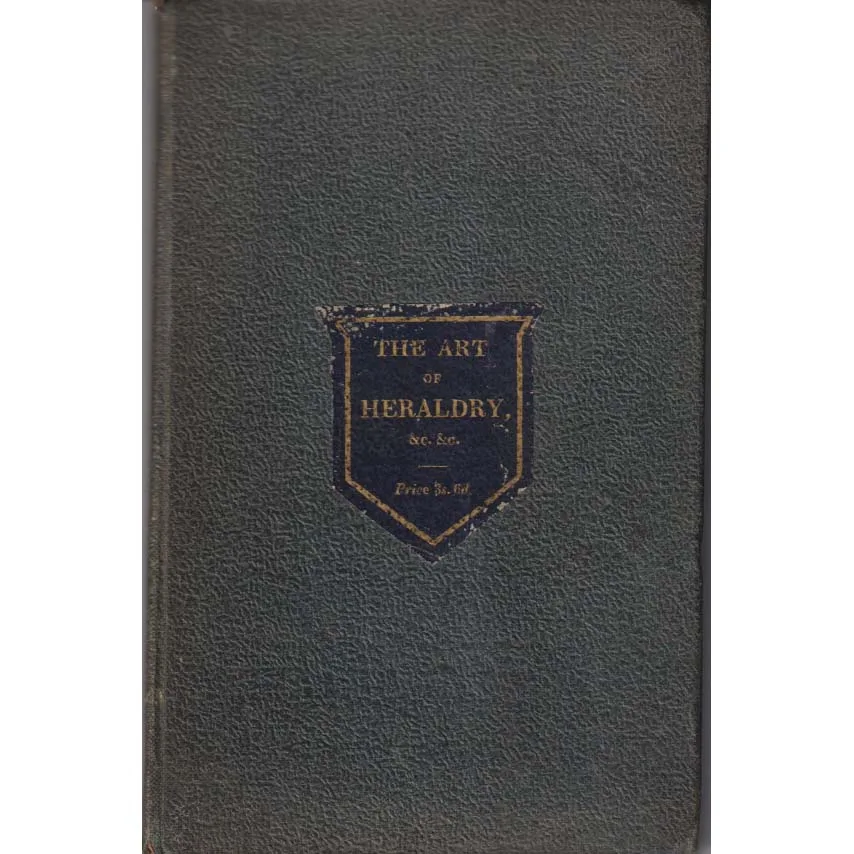
Publisher: Harding and King
Format: Paperback
ISBN: none
The Art of Heraldry (1834) by Anonymous – Harding and King – Good Condition
Before logos, brand guidelines and corporate identity manuals, there was heraldry: a magnificently elaborate system for announcing who you were, who your ancestors were, who you had married, what land you owned and, ideally, which nearby families you considered socially inferior.
The Art of Heraldry, published in 1834 by Harding and King, is an early nineteenth-century guide to the language, structure and symbolism of coats of arms — that wonderfully formal world of shields, crests, supporters, tinctures, quarterings, beasts, helmets and mottos in which absolutely nothing is allowed to be merely decorative if it can instead be governed by several centuries of rules.
The author is Anonymous, which is slightly unfortunate for a book devoted to identifying people by elaborate visual systems of ancestry and status.
Still, perhaps modesty was considered a virtue.
Heraldry developed as a practical means of identification in medieval Europe, particularly when knights were wearing enough armour to make ordinary facial recognition somewhat difficult. Over time, however, it became an extraordinarily sophisticated visual language of genealogy, rank, inheritance and social distinction.
A lion was rarely just a lion.
It might be rampant, passant, couchant or regardant.
It might be gold on red, red on gold, divided, crowned, armed, langued or positioned in some manner requiring a specialist vocabulary before anyone was allowed to describe it properly.
This book belongs to the long tradition of manuals attempting to make sense of all that.
Readers encounter the principles behind the composition and interpretation of arms: the shield and its divisions, colours and metals, heraldic charges, crests, helmets and the various devices through which families represented lineage and status.
To the uninitiated, an heraldic shield can look like somebody has assembled several lions, birds, stripes and pieces of medieval furniture because there happened to be some empty space.
To the herald, however, every detail matters.
One cannot simply place a blue lion wherever one fancies.
Civilisation would collapse.
Published in 1834, during the reign of William IV, this particular volume is itself now approaching two centuries old. That gives it an appeal beyond the subject matter alone: it is not merely a modern book explaining historical heraldry, but a genuine nineteenth-century publication produced when coats of arms, family lineage and inherited social status were considerably closer to everyday public life.
There is something pleasingly circular about owning an old book on heraldry.
A new reproduction can explain what an eighteenth-century or medieval coat of arms means.
An 1834 copy has itself become an artefact.
It has passed through generations of owners, shelves, houses and storage conditions while the families whose arms it discusses have risen, fallen, married, inherited, divided estates and occasionally discovered that maintaining a country house is considerably more expensive than the ancestors had anticipated.
The book is in Good condition, especially considering its age, although there is one notable binding issue.
The front inner hinge is cracked between the front endpapers and the first text gathering, exposing the binding. Importantly, however, the text block remains attached.
So this is not a case of the book having dramatically separated into competing dynastic branches.
The hinge has opened.
The kingdom remains united.
It appears to be the sort of fault that should be readily repairable by somebody with suitable bookbinding skills, although we leave actual restoration to people who know the difference between repairing an antique book and accidentally gluing it permanently to the table.
Collectors should therefore regard it as a sound old volume with a repairable weakness rather than a pristine example. At nearly two hundred years old, it has arguably earned the right to have one troublesome joint.
There is no ISBN, because in 1834 books had titles, publishers and perhaps the occasional armorial bookplate, but nobody yet imagined that every publication would one day be identified by a thirteen-digit number and scanned by a laser at the point of sale.
Ideal for collectors of heraldry, genealogy enthusiasts, students of aristocratic history, antique book collectors, designers interested in historical symbolism, or anyone who has ever looked at a coat of arms and wondered why a unicorn is chained to one side while a lion stands on the other wearing what appears to be a crown.
Also useful for discovering that almost every apparently simple heraldic image has a correct technical description and that using the wrong word will probably cause somebody in the College of Arms to sigh deeply.
Sold by Crappy Old Books — where the arms may be ancient, the author is anonymous, the front hinge has seen better days, and the text block is still loyally attached to the realm.
Keep browsing: See more History books Other books by Anonymous
