


Governing Britain - Parliament Ministers And Our Ambiguous Constitution
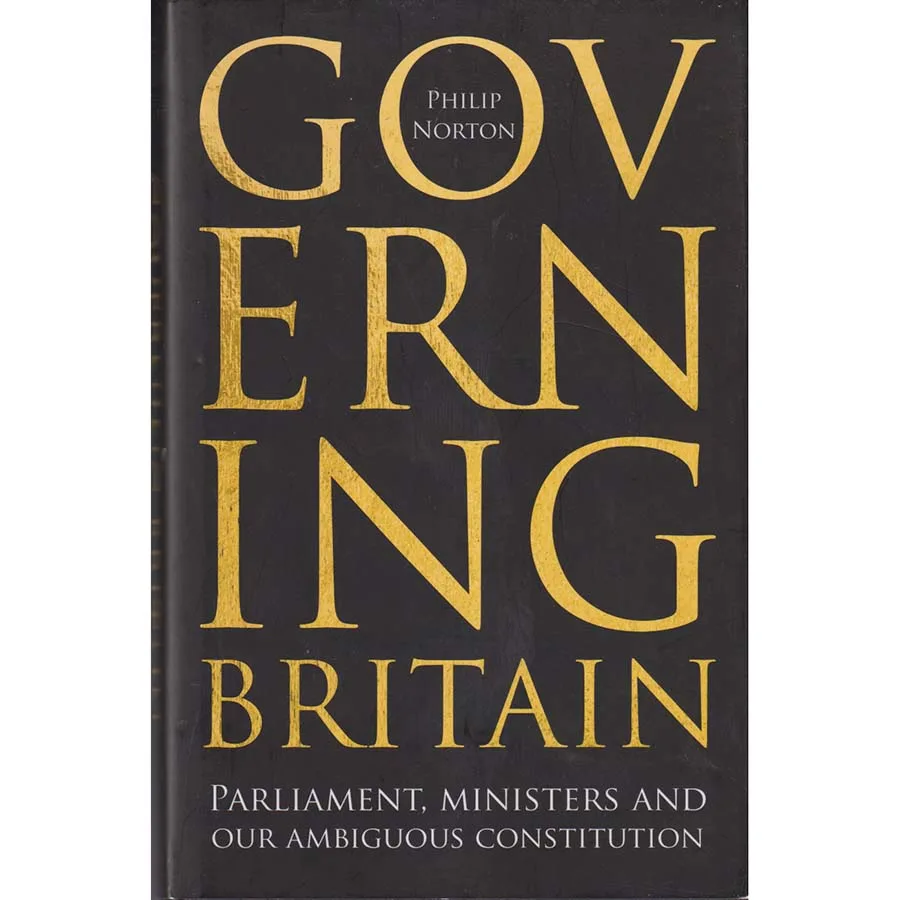
Publisher: Manchester University Press
Format: Hardback
ISBN: 9781526145451
Governing Britain – Parliament, Ministers and Our Ambiguous Constitution (2020) by Philip Norton – Manchester University Press – As New Condition
Britain has a constitution.
Probably.
It is just not all written down in one place, nobody entirely agrees where some of it begins or ends, and quite a lot of it appears to rely on everyone continuing to behave roughly as expected.
In Governing Britain – Parliament, Ministers and Our Ambiguous Constitution, political scientist Philip Norton examines the wonderfully British arrangement by which a modern state is governed through a mixture of statutes, conventions, precedent, institutions, traditions, political habits and the occasional firm assurance that “this is simply not how things are done”.
Published by Manchester University Press in 2020, the book looks closely at the relationship between Parliament, ministers and the constitution, asking who actually possesses power, how that power is exercised, and what happens when political actors begin testing rules which were previously assumed to be understood rather than explicitly enforced.
This is particularly interesting in Britain because the constitution is famously uncodified. Unlike countries with a single grand constitutional document that can be dramatically waved during political arguments, the British system has evolved over centuries and is scattered through legislation, court decisions, conventions and institutional practices.
This gives it flexibility.
It also gives constitutional lawyers something to do.
Norton explores how government works in practice rather than simply how textbooks say it ought to work. Parliament may technically be sovereign, ministers may technically be accountable to Parliament, and MPs may technically scrutinise the executive, but politics has an unfortunate tendency to complicate neat diagrams.
Governments usually command majorities. Party discipline matters. Prime ministers accumulate influence. Ministers control substantial resources. Parliament alternates between asserting itself dramatically and appearing to have mislaid the instruction manual.
The result is a constitutional system that can be simultaneously robust, flexible, vague and alarming depending on which bit is being tested at the time.
The timing of the book is especially significant. Published in 2020, it emerged after years in which Brexit, parliamentary deadlock, prorogation disputes, changing governments and fierce arguments over executive authority had turned constitutional questions from something mainly discussed by academics into matters capable of causing shouting on the evening news.
Suddenly phrases such as “parliamentary sovereignty”, “ministerial responsibility” and “constitutional convention” were no longer confined to university seminars.
People were arguing about them in pubs.
That is when you know things have become serious.
Norton is particularly well placed to examine these matters. A long-established scholar of Parliament and British politics, he writes from deep familiarity with the institutions involved, making this a useful study for anyone wanting to understand not simply the ceremonial surface of Westminster but the machinery beneath it.
The book therefore asks some deceptively simple questions.
Who governs Britain?
How much control does Parliament really exercise?
How powerful are ministers?
What constrains a prime minister?
What happens when conventions are ignored?
And perhaps most importantly: if everybody says something is unconstitutional but nobody can point to the precise paragraph where it says so, what happens next?
The answer, as with many things in British government, is usually complicated.
This is not a breathless political exposé promising to reveal that Westminster is secretly controlled from a basement beneath Whitehall. It is a serious academic examination of institutions, authority and constitutional ambiguity — although the reality is often strange enough without needing conspiracies.
The great charm of the British constitution is that much of it developed organically.
The great problem with the British constitution is also that much of it developed organically.
It is rather like inheriting an enormous old house which has been extended continuously since the Middle Ages. The plumbing works, mostly. Nobody has the original plans. Several rooms were added for reasons nobody remembers. There is a staircase leading somewhere unexpected. And whenever anyone suggests rebuilding the entire thing properly, everybody becomes extremely nervous.
This copy is in As New condition, which is unusually respectable by Crappy Old Books standards and means it has apparently survived without acquiring the political wear and tear experienced by the constitutional system described inside.
ISBN 9781526145451.
Ideal for students of politics, constitutional history enthusiasts, Westminster watchers, civil servants, political journalists, law students, and anyone who has ever heard the phrase “constitutional crisis” on the news and wondered whether Britain technically has enough constitution available to have one.
Also recommended for readers who enjoy discovering that institutions which look magnificently ancient and certain from the outside are sometimes held together internally by precedent, convention, good manners and the sincere hope that nobody decides to push too hard on the walls.
Sold by Crappy Old Books — where the constitution remains unwritten, Parliament remains sovereign, and this particular copy is inconveniently close to pristine.
Keep browsing: See more Politics books Other books by Philip Norton
