


Vergil - Aeneid - Book Two
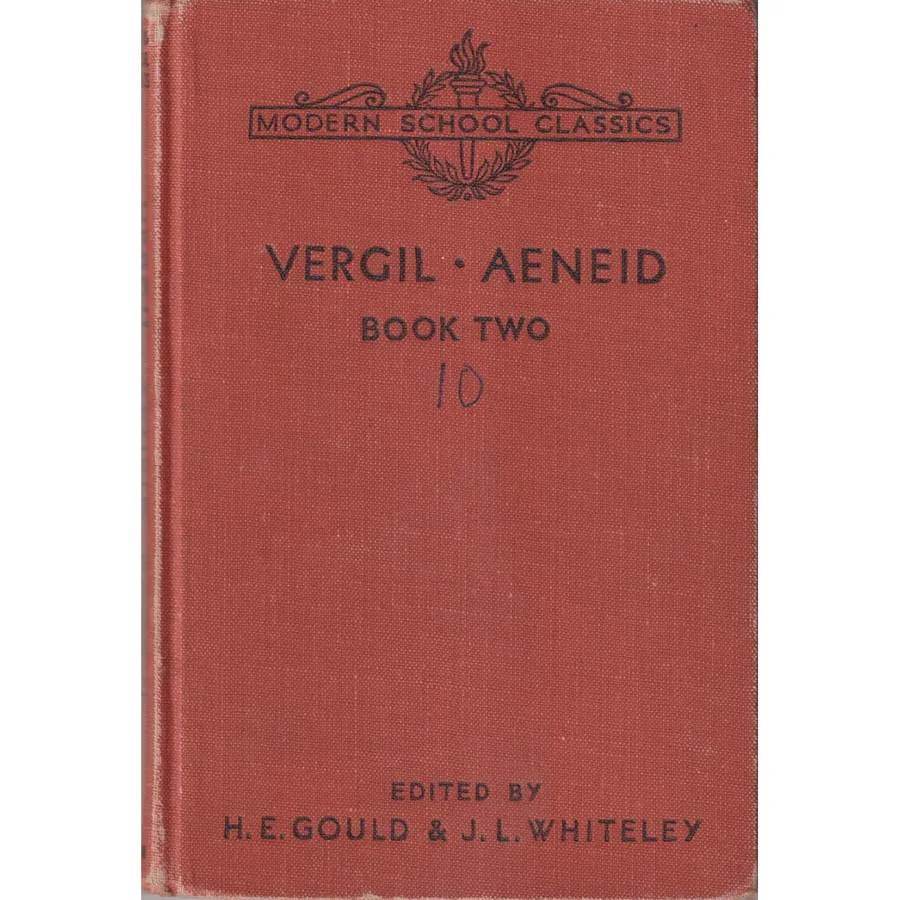
Publisher: MacMillan
Format: Hardback
ISBN: none
Vergil – Aeneid – Book Two (1961) by H. E. Gould and J. L. Whiteley – Macmillan – Good Condition
If you have ever thought, “That enormous wooden horse left outside the city by the enemy looks perfectly harmless,” then Book Two of the Aeneid may have an important message for you.
Vergil – Aeneid – Book Two, edited by H. E. Gould and J. L. Whiteley, presents one of the most famous episodes in classical literature: the fall of Troy, told by Aeneas himself as he recalls the catastrophic final night of the city.
The Greeks appear to have sailed away. Troy has survived ten years of war. Everybody is understandably delighted.
Then they find a giant wooden horse.
At this point several Trojans display the sort of judgement that history tends to punish severely.
Despite warnings — most famously from Laocoön, who is extremely suspicious of Greeks bearing gifts — the horse is brought inside the city. Unfortunately, it contains armed Greeks rather than commemorative furniture, and during the night the hidden soldiers emerge, open the gates and allow the Greek army back into Troy.
Things deteriorate quickly.
Virgil turns the destruction of Troy into a vivid, tragic and often brutal sequence of confusion, fighting and loss. Aeneas rushes into the chaos, initially determined to fight, but gradually comes to understand that Troy cannot be saved and that his duty lies elsewhere.
There are dreams, omens, divine interventions and some memorable examples of why ignoring prophetic warnings is rarely a strong policy in ancient literature.
Among the most striking scenes is the death of Priam, the aged king of Troy, killed during the sack of his own city. The fall of the royal household mirrors the destruction happening outside, as an entire civilisation that once seemed permanent collapses in the course of a single night.
Aeneas eventually escapes carrying his elderly father Anchises on his shoulders while leading his young son Ascanius away from the burning city. His wife Creusa, however, is lost during the flight and later appears to him as a shade, telling him that a different future awaits him elsewhere.
It is not exactly a cheerful departure.
Book Two is therefore much more than simply the story of the Trojan Horse. It is about defeat, duty, memory and the destruction of home — the disaster that sets Aeneas on the long journey which will ultimately connect the legendary survivors of Troy with the future rise of Rome.
This 1961 Macmillan edition, edited by Gould and Whiteley, comes from the formidable tradition of school Classics texts, when generations of pupils were expected to encounter Troy’s destruction not through a film, podcast or helpful animation, but by translating Virgil’s Latin one sentence at a time.
No skipping ahead.
No subtitles.
Just syntax.
The editors provide the sort of notes and guidance intended to help readers navigate Virgil’s language, imagery and historical background, although there remains no protection against the poet deciding to place a perfectly important word somewhere entirely unexpected for dramatic effect.
This copy is in Good condition, with the normal signs of age and previous ownership one would expect from a book published in 1961. It has survived more than six decades, which already puts it comfortably ahead of Troy’s performance once the horse was admitted.
There is no ISBN, because this book dates from the period before every volume required a numerical identity, barcode and online product record in order to convince the world that it existed.
Ideal for students of Latin, collectors of vintage Classics editions, admirers of Virgil, readers interested in the Trojan War, or anyone who would like several hundred pages of ancient literature reinforcing the basic principle that suspiciously large wooden objects left behind by departing enemies should probably remain outside the walls.
Sold by Crappy Old Books — where Greeks may bear gifts, Trojans may ignore sensible advice, and all unusually large wooden horses are inspected before being allowed into the warehouse.
Keep browsing: See more Ancient Classics books Other books by HE Gould and JL Whiteley
