


Flat-Racing Since 1900
Publisher: Andrew Dakers Limited
Format: Hardback
ISBN: none
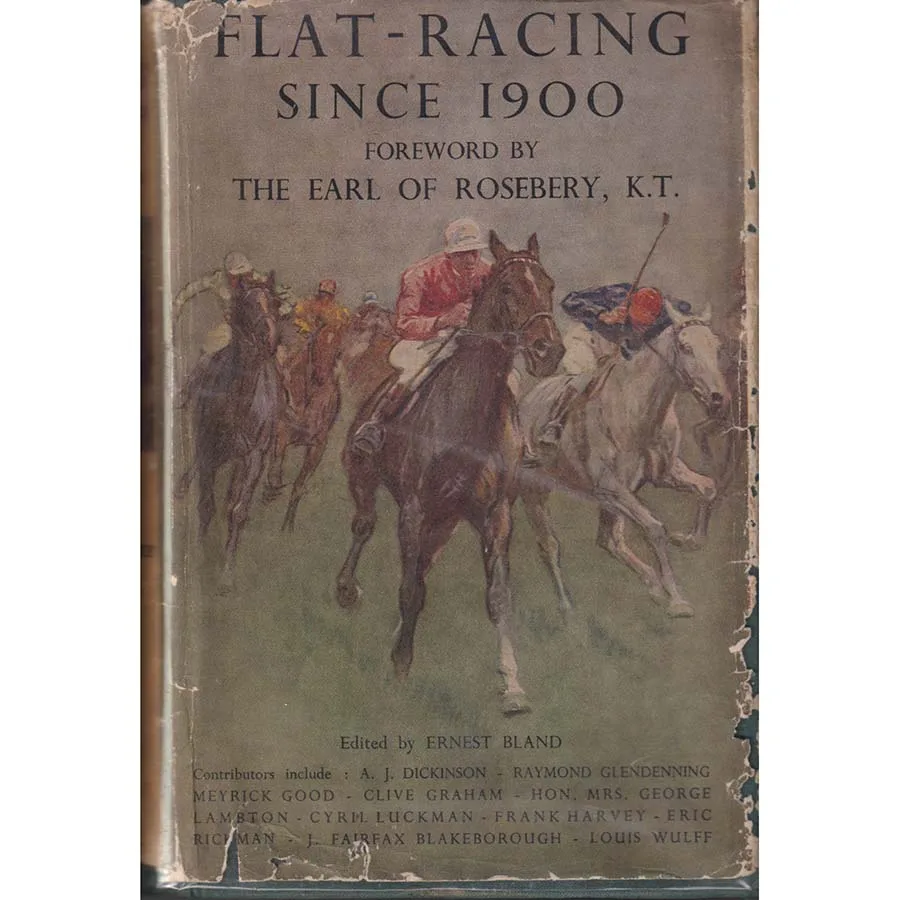
Flat-Racing Since 1900 (1950) by Ernest Bland – Andrew Dakers Limited
First Edition
ISBN: None
Condition: Fair
Horse racing, 1950. The bookmakers had pencils, the punters had newspapers, the horses had names considerably more dignified than most modern racehorses, and nobody could check the odds on a telephone while standing three deep at the bar.
Ernest Bland’s Flat-Racing Since 1900 is a substantial period history of British flat racing during the first half of the twentieth century, published in 1950 by Andrew Dakers Limited and offered here in its first edition.
And what a fifty years it had been.
The sport had entered the twentieth century with Edwardian elegance, aristocratic owners, enormous crowds and racing already deeply embedded in British life.
Then came two world wars.
Economic depression.
Social upheaval.
Changes in transport.
Changes in betting.
Changes in ownership.
And enough memorable horses, jockeys, trainers and great races to fill rather more than one respectable volume.
Fortunately, Ernest Bland seems to have been willing to try.
Flat racing has always occupied a peculiar position in British culture.
It is sport.
It is business.
It is breeding.
It is gambling.
It is fashion.
And, on certain race days, it is an elaborate national experiment to discover how many people can drink champagne before lunchtime while maintaining formal dress.
The horses, meanwhile, are expected to remain professional.
This book looks back across the first half of the twentieth century, when names associated with the turf were followed with the same intensity later generations would apply to footballers, Formula One drivers or celebrities who have become famous without anyone being entirely certain why.
The great meetings mattered.
Ascot.
Epsom.
Newmarket.
Goodwood.
Doncaster.
Places where fortunes could be won, reputations established and perfectly respectable adults could spend several minutes shouting at an animal approximately half a mile away.
The Derby naturally occupies a central place in the story.
Few sporting events accumulated quite the same mixture of prestige, spectacle and national obsession.
Derby Day once attracted enormous crowds from every level of society.
Aristocrats arrived in style.
Ordinary racegoers poured in by train and road.
Bookmakers did business.
Vendors sold everything imaginable.
And somewhere in the middle of the chaos, a group of very expensive horses ran around Epsom Downs for a few minutes.
Everything else was preparation.
Racing before television depended heavily on newspapers, radio, racecourses and the remarkable human ability to become passionately invested in an event one had not actually seen.
Results travelled by telegraph and telephone.
Racing correspondents mattered.
Form books mattered.
Tips mattered.
And the man in the pub who claimed to know somebody at the stable had already developed into a highly resilient institution.
Technology changes.
Reliable inside information remains permanently just around the corner.
The book also comes from an age when the racing world was still strongly associated with class.
Owners could include aristocrats, industrialists and wealthy businessmen.
Royal involvement added glamour.
Trainers operated famous yards.
Jockeys became national figures.
And racing journalism frequently possessed a wonderfully ceremonial tone, as though describing a horse winning by two lengths required approximately the same gravity as announcing a constitutional development.
There was money involved, naturally.
There has always been money involved.
Nobody breeds thoroughbreds entirely for the exercise.
The bloodstock side of racing is itself a magnificent combination of science, tradition and optimism.
Study pedigrees.
Analyse form.
Choose stallions.
Breed carefully.
Wait several years.
Then discover the horse has absolutely no interest in running faster than the others.
Nature retains veto power.
But when it works, the results can be spectacular.
Great racehorses become names remembered decades after the people who owned them have faded from public memory.
That is one of the strange beauties of racing history.
A horse runs for only a few seasons.
Perhaps only a handful of truly important races.
Yet enthusiasts may still discuss the performance fifty or a hundred years later.
Humans have been remarkably successful at constructing immortality out of two minutes at Epsom.
The period covered by Bland also includes the enormous disruption caused by the First World War.
Racing continued in restricted forms, but the sport was inevitably transformed by wartime conditions.
Courses were closed or repurposed.
Transport became difficult.
Resources were limited.
People and horses were required elsewhere.
Then racing resumed, because societies have a remarkable instinct for restoring their preferred forms of entertainment once catastrophe allows.
The inter-war years brought new champions, new personalities and fresh prosperity for sections of the sport.
Motor transport changed how people reached courses.
Radio began bringing racing into homes.
Newspapers expanded their coverage.
Betting remained enormously popular.
And racecourses became part sporting venue, part social theatre and part financial laboratory.
Then history interfered again.
The Second World War brought another period of disruption.
Britain had slightly more pressing matters than whether the favourite should be opposed in the third at Newmarket.
Yet racing survived once again.
By the time this book appeared in 1950, Britain was still recovering from war.
Rationing remained.
Cities were being rebuilt.
The country was changing rapidly.
And racing provided a link with a pre-war world that had not entirely disappeared.
This gives Flat-Racing Since 1900 an especially interesting perspective.
It is not a later historian looking back across a safely completed century.
It was written at the midpoint.
For Ernest Bland, the first fifty years of twentieth-century racing were not ancient history.
Many of the people involved were still alive.
Some were still active.
Horses remembered as legends may have been seen by readers with their own eyes.
That immediacy matters.
There is no sixty or seventy years of hindsight separating writer from subject.
This is racing history written while much of that history remained within living memory.
Which makes a first edition from 1950 particularly pleasing.
It is itself now part of the period it describes.
The book has crossed the finishing line from “current sporting history” into “collectable old racing book” without requiring any further effort.
An impressive second career.
The illustrations and period detail, where present, also carry the accidental historical appeal common to old sporting books.
Clothes.
Grandstands.
Racecourse signage.
Cars.
Bookmakers’ boards.
Crowd scenes.
The horses were intentionally photographed.
Everything else has since become interesting as well.
A grandstand may have been demolished.
A bookmaker may have vanished.
A car parked in the background may now be worth more than the prize money.
This is the danger of leaving photographs alone for long enough.
Eventually every detail becomes collectible.
For racing enthusiasts, the names and results offer obvious appeal.
For social historians, however, the book also records something broader.
Horse racing reveals a surprising amount about British society.
Class.
Leisure.
Money.
Transport.
Newspapers.
Gambling.
Fashion.
Royalty.
Regional identity.
Even working patterns.
A racecourse crowd is a miniature society temporarily organised around the belief that Horse A will reach a post before Horse B.
Entire economies have been built on less.
The bookmakers deserve their place in the story too.
Before betting apps and online accounts, wagering required rather more human contact.
You went to a bookmaker.
You wrote things down.
You handled cash.
Someone shouted odds.
Boards changed.
Information travelled.
And if you wanted to lose money at speed, you generally had to leave the house.
Modern convenience has solved that inefficiency.
The vocabulary of racing is itself wonderfully resistant to outsiders.
Furlongs.
Handicaps.
Stayers.
Milers.
Going.
Weights.
Form.
Declarations.
Each-way.
Non-runners.
Draw.
To the initiated, perfectly normal.
To everybody else, a conversation overheard at a racecourse can sound like coded military communications.
Bland writes for readers who take racing seriously, but the historical sweep means the book can be enjoyed by anyone interested in the development of British sport.
And there is something rather refreshing about a sporting history published before modern sports marketing existed.
No sponsorship names inserted into every event.
No corporate hospitality packages advertised every six feet.
No official betting partner appearing during the commentary.
No QR code.
Just racing.
Horses.
People.
Money.
Quite enough complexity already.
The physical book itself has also acquired a little character over its seventy-plus years.
Condition: Fair. This first edition comes in an ill-fitting but effective plastic protective jacket.
The plastic covering may not have been designed by Savile Row.
It does not fit with perfect elegance.
It has not transformed the book into a thing of aerodynamic beauty.
But it has done the important job of helping protect it.
Think less bespoke tailoring, more raincoat borrowed from a slightly larger relative.
Function has triumphed over fashion.
The underlying book shows the normal signs of age and previous ownership expected from a first edition published in 1950, but remains a serviceable and appealing copy for reading or collecting.
The protective jacket could presumably be removed or replaced by a future owner if greater sartorial standards are required.
We have left it in place because it works.
Horse racing itself is full of equipment selected for practical reasons rather than visual perfection.
This seems entirely appropriate.
As a first edition, the book has particular appeal for collectors of racing literature.
It belongs to the period it documents and offers a contemporary summary of the first half-century of modern flat racing.
Not retrospective nostalgia assembled from digital archives.
Not a modern coffee-table history.
A 1950 book looking back at racing since 1900 while the turf was still inhabited by people who remembered much of it personally.
That gives it character.
It also makes it an excellent shelf companion for old form books, racing annuals, biographies of jockeys and those mysterious volumes inherited from grandfathers containing pencil notes beside horses that ran before most of us were born.
For collectors of horse racing, flat racing, sporting history, turf memorabilia, vintage sports books or first editions, this is a pleasing survivor.
It would also suit anyone who believes modern racing has become too commercial, too technological or insufficiently populated by men wearing hats.
Obviously, it should not be used for current betting advice.
Any horse tipped within these pages has now retired.
Very retired.
The bookmakers will almost certainly refuse the bet.
And if they do accept it, further questions should probably be asked.
But as a history of British flat racing during an extraordinary half-century, it remains a fascinating piece of sporting literature.
Condition: Fair, with the book protected by an effective though somewhat ill-fitting plastic jacket and showing the expected signs of age associated with a first edition from 1950.
Still standing.
Still readable.
Still in the race.
Which, after more than seventy-five years, is more than can be said for most of the horses.
Sold by Crappy Old Books, where the favourites do not always win, the plastic jackets do not always fit, and every book is guaranteed to finish ahead of anything already pulped.
Keep browsing: See more Sports books Other books by Ernest Bland
