


How To Complain
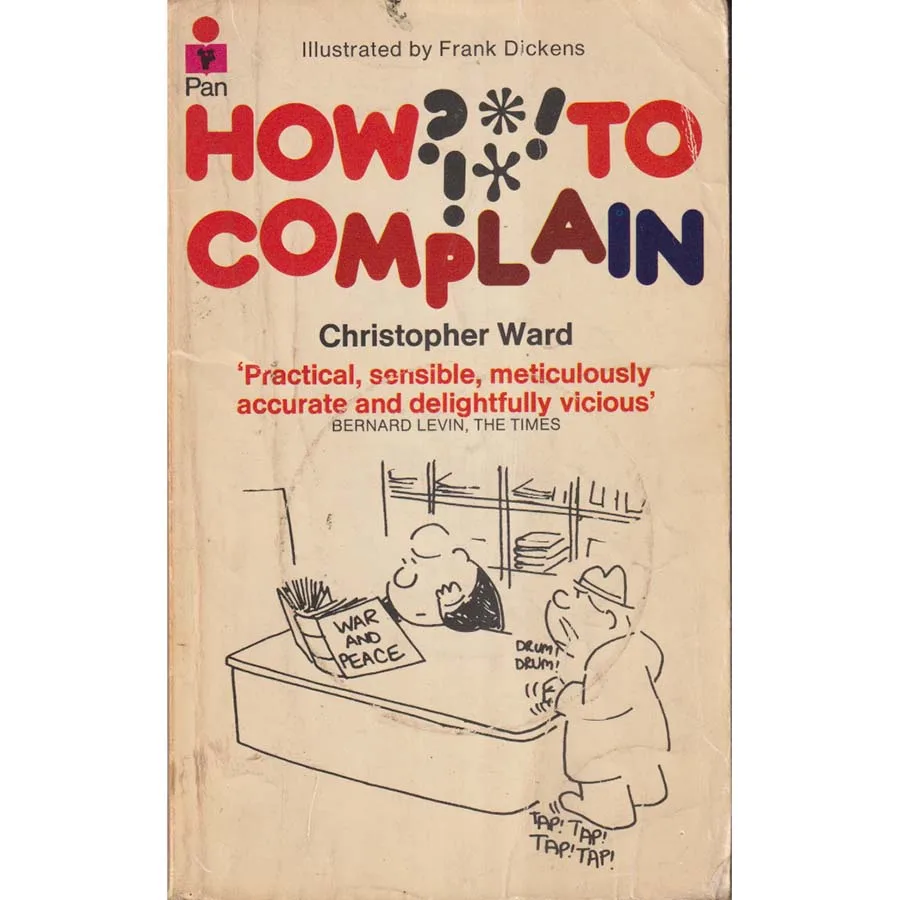
Publisher: Pan Books
Format: Paperback
ISBN: 033024650X
How To Complain (1976) by Christopher Ward – Pan Books
ISBN: 033024650X
Condition: Good
There are people who suffer silently.
There are people who shrug, sigh and accept that the toaster has exploded, the hotel room overlooks a brick wall and the new washing machine appears to have been assembled by somebody working from memory.
And then there are people who know how to complain properly.
Christopher Ward’s How To Complain is a gloriously practical relic from 1976, dedicated to that most enduring of human activities: being dissatisfied with something and attempting to make somebody else do something about it.
This is not, importantly, a book about simply becoming angry.
Anybody can do that.
True complaining is an art.
It requires timing.
Evidence.
Persistence.
The correct tone.
And, ideally, the name of somebody slightly more senior than the person currently explaining that “there’s nothing we can do”.
Published by Pan Books in the mid-1970s, How To Complain belongs to an age before email, online reviews, live chat, social media and the modern ability to announce to several thousand strangers that your takeaway chips were disappointingly lukewarm.
In 1976, dissatisfaction required effort.
You had to write a letter.
A proper letter.
On paper.
Possibly using carbon copies.
Then you found an envelope.
Then a stamp.
Then you posted it.
And then you waited.
People today complain that customer service takes twenty minutes to answer.
In 1976, your complaint might spend two days travelling in a sack.
This encouraged discipline.
If you were going to complain, you made it count.
Christopher Ward’s book is effectively a field manual for the consumer who has had enough.
Faulty goods.
Bad service.
Disappointing holidays.
Tradesmen.
Retailers.
Public services.
Companies that ignore correspondence.
People who promise to telephone and then vanish into administrative mist.
The fundamental problems have not changed very much.
Only the methods have become faster.
The sentence “I’m afraid that is company policy” was presumably already fully operational in 1976.
The genius of a book like this is that complaining sits somewhere between confrontation and bureaucracy.
You cannot merely shout.
That may be emotionally satisfying, but it often results in security being called.
Instead, the successful complainant must remain calm enough to explain precisely what has gone wrong while simultaneously communicating that they have absolutely no intention of disappearing.
This is harder than it sounds.
Especially when someone has just told you that the faulty refrigerator is behaving “within normal parameters”.
Ward guides the reader through the mechanics of making complaints effectively: who to contact, what to say, how to present the facts and when to escalate the matter.
The underlying principle remains timeless.
Do not rant.
Document.
A receipt is more powerful than outrage.
A date is more useful than indignation.
A name is better than “that woman I spoke to on Tuesday”.
And a calm letter beginning “Dear Sir” could, in the right hands, carry the emotional force of a naval bombardment.
The 1970s were also an excellent decade in which to publish a book about complaining.
Britain was coping with inflation, industrial disputes, shortages, unreliable services and a general sense that somewhere, somehow, something had gone wrong administratively.
The consumer movement was becoming more powerful.
People were increasingly aware that buying something did not necessarily require accepting whatever happened afterwards.
Consumer rights were developing.
Organisations were being held to higher standards.
And the customer was beginning to discover that “you’ve bought it now” was not always the end of the discussion.
This was revolutionary stuff.
Previously, a defective kettle might simply become part of the family.
Now there were options.
There is something charmingly analogue about the advice from today’s perspective.
No screenshots.
No online dispute portal.
No tracking number.
No automated email saying:
YOUR CASE IS IMPORTANT TO US.
followed by six weeks of complete silence.
Instead there were letters, telephone calls, managers and organisations with physical addresses.
You could write to head office.
Head office was a real building.
Somewhere inside was a person whose desk might eventually acquire your letter.
Theoretically.
This gave complaints a tangible quality.
A sufficiently persistent customer could create an actual pile of correspondence.
Nothing says determination like a lever-arch file.
The book also comes from the era when telephone complaining involved a landline.
There was no option to wander around the supermarket while arguing with customer services through wireless headphones.
You sat beside the telephone.
Possibly with notes.
Possibly having already waited long enough to become emotionally invested in the hold music, assuming there was any.
And if the line went dead, that was it.
You started again.
People were stronger then.
There is a whole social skill contained in the traditional complaint letter too.
Too polite and nobody takes it seriously.
Too aggressive and everybody becomes defensive.
Too long and the recipient quietly loses the will to live.
Too short and the facts disappear.
The ideal complaint therefore occupies a narrow diplomatic territory somewhere between:
“Would you terribly mind looking into this?”
and
“I have already notified my solicitor, the newspapers and possibly Parliament.”
Knowing when to move from one to the other is the essence of the craft.
Modern readers may discover that surprisingly much of Ward’s advice still works.
Technology changes.
Human beings do not.
Companies still lose things.
Deliveries still fail.
Products still break shortly after purchase.
Hotels still occasionally provide rooms containing features that were not visible in the brochure.
And somebody, somewhere, will always explain that your issue is being dealt with by another department.
There is always another department.
No organisation has ever successfully located the final department.
The title itself is wonderfully direct.
How To Complain.
No euphemism.
No lifestyle branding.
No The Empowered Consumer.
No Unlocking Your Customer-Service Potential.
No promise to transform your life in seven steps.
You have a complaint.
Here is how to make it.
Books used to possess a refreshing confidence about knowing why they existed.
The illustrations, examples and advice also make this a pleasing piece of social history.
What people complained about in 1976 tells us quite a lot about everyday life.
Different products.
Different services.
Different expectations.
Different bureaucracy.
Yet the underlying irritation remains instantly recognisable.
A badly handled complaint from half a century ago can still produce the reaction:
“Yes. Exactly.”
That may be the most durable form of human communication.
The book is particularly appealing now because we live in the golden age of public complaining.
In 1976, if a restaurant served a disappointing meal, perhaps eight people heard about it.
Today, within three minutes, somebody can upload a photograph, leave a one-star review and explain the entire incident to the population of the planet.
This has not necessarily improved the quality of complaints.
Ward’s approach reminds us of a forgotten truth: complaints are most effective when directed towards somebody who can actually fix the problem.
This is less emotionally satisfying than shouting into the internet.
But considerably more likely to result in a replacement toaster.
The old-fashioned written complaint has another advantage.
You have to think before sending it.
There is no instant button.
No furious midnight review typed immediately after discovering the hotel pillow was too soft.
You draft.
You reconsider.
You possibly remove the paragraph comparing the managing director to a criminal organisation.
Then you post the civilised version.
Time was a natural moderation system.
The book also predates today’s customer-service language.
No “customer journey”.
No “touchpoints”.
No “service recovery”.
No “we value your feedback”.
If something had gone wrong, you simply told them what had gone wrong.
There is something almost moving about the simplicity.
And while the legal and consumer-rights details should obviously be treated as historical rather than current advice, the psychology of complaining remains remarkably fresh.
Be specific.
Know what outcome you want.
Keep records.
Escalate sensibly.
Avoid becoming so furious that the substance of the complaint disappears beneath the performance.
In other words, complain like somebody who intends to win.
Not merely somebody who intends to be heard from three streets away.
As a vintage book, How To Complain also makes an excellent gift for certain personality types.
You know who they are.
The person who asks for the manager before anything has actually happened.
The person who keeps receipts from 2008.
The person who can detect a billing discrepancy of 14p from across a room.
The person who says, “It’s not the money, it’s the principle,” immediately before devoting six hours to recovering £2.40.
This is their literature.
It may also make an excellent humorous present for anyone who works in customer service, although whether they find it amusing will depend heavily on what happened at work that day.
Condition: Good. A vintage paperback showing the normal signs of age and previous ownership expected from a book published in 1976, but remaining in good overall condition and entirely suitable for reading, collecting or keeping close at hand in case the next thing you buy turns out to be unacceptable.
No formal complaint regarding the condition has yet been received.
Should one arise, please submit it in writing, include the relevant evidence, state clearly the remedy sought and allow up to 28 working days for us to pretend we have passed it to the appropriate department.
A splendid little piece of 1970s social history, consumer advice and British everyday life, and a reminder that while fashions, technology and consumer law may change, somebody will always need to speak to the manager.
Sold by Crappy Old Books, where complaints are welcomed, feedback is valued, and all correspondence is carefully forwarded to a department that almost certainly exists.
Keep browsing: See more Humour books Other books by Christopher Ward
