


A Singular Man
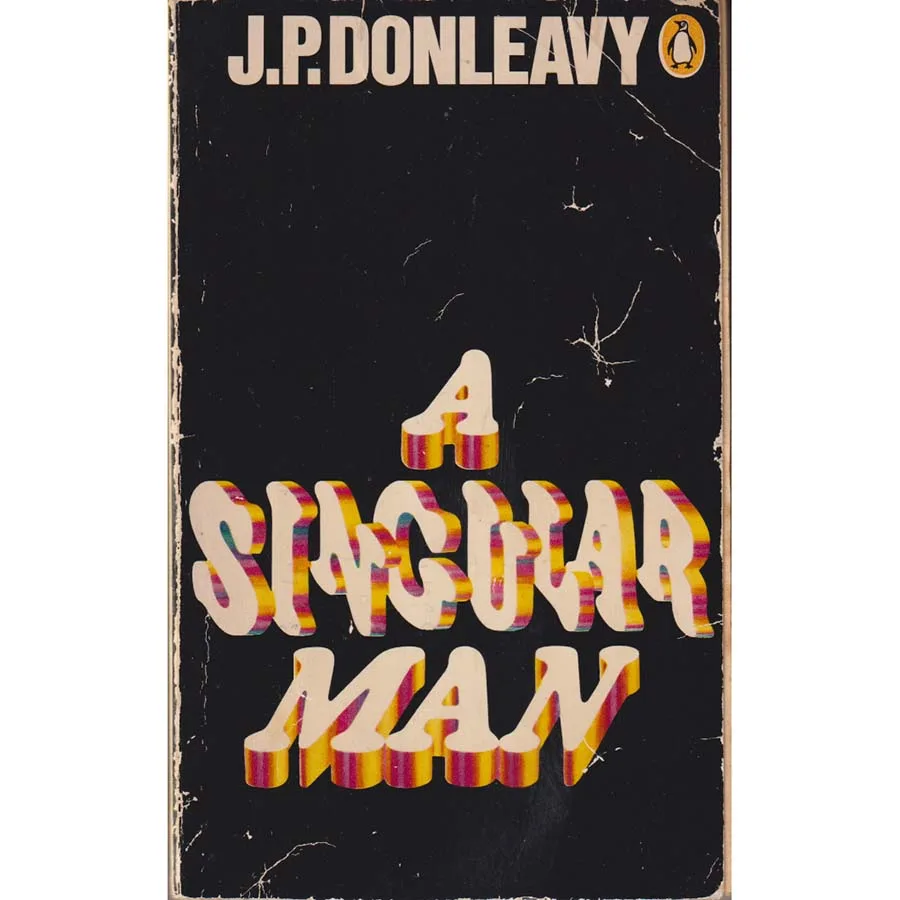
Publisher: Penguin Books
Format: Paperback
ISBN: 0140024476
A Singular Man (1979) by J. P. Donleavy – Penguin Books
ISBN: 0140024476
Condition: Good
George Smith is rich.
Very rich.
The sort of rich where money has ceased to be a practical concern and instead becomes a rather elaborate background condition, like weather or gravity.
Unfortunately, this has not made him especially happy.
J. P. Donleavy’s A Singular Man is a darkly comic, eccentric and thoroughly Donleavy-esque novel about wealth, loneliness, sex, death, social absurdity and the peculiar problem of having almost everything one might reasonably want while remaining fundamentally dissatisfied with the whole arrangement.
Originally published in the 1960s and issued here in this 1979 Penguin edition, the novel follows George Smith, an American millionaire living in New York whose fortune allows him access to comfort, privilege and considerable quantities of expensive inconvenience.
Smith inhabits a world of lawyers, undertakers, mistresses, servants, businessmen, hangers-on and assorted characters who seem permanently poised either to sell him something, seduce him, sue him or bury him.
Sometimes possibly all four.
He is wealthy enough to purchase almost anything but not, apparently, a straightforward existence.
Which is reassuring for the rest of us.
The novel opens into a world where death is never far away, although Donleavy treats mortality with the same mixture of melancholy and comic absurdity that he applies to practically everything else.
Smith becomes preoccupied with funerals, burial arrangements and the uncomfortable administrative details surrounding the eventual disposal of oneself.
This may sound gloomy.
It frequently is.
It is also very funny.
There is something inherently comic about a wealthy man attempting to impose order on death through proper planning, paperwork and expenditure, as though mortality might ultimately be persuaded to provide a more satisfactory service if one speaks firmly to management.
Money can buy an impressive funeral.
It cannot make the guest of honour enjoy it.
Around this runs Smith’s complicated personal life.
Women appear.
Relationships develop.
Relationships deteriorate.
Desire competes with loneliness.
People misbehave.
And Donleavy demonstrates his customary suspicion that romantic relationships might have been invented primarily to ensure that otherwise peaceful people always have something additional to worry about.
Smith is not a conventional hero.
He can be selfish, ridiculous, lonely, pompous, vulnerable and occasionally oddly sympathetic.
In other words, recognisably human, except with more money.
His wealth magnifies everything.
Ordinary anxieties become elaborate anxieties.
Personal failures occur in better rooms.
Loneliness takes place behind more expensive doors.
And existential despair benefits from significantly improved upholstery.
This is one of the novel’s recurring jokes: prosperity has solved the problems associated with not having money while leaving most of the other problems irritatingly intact.
There are servants to deal with daily needs.
There are businesses and investments generating wealth.
There are large houses and impressive surroundings.
And yet George Smith remains George Smith.
Apparently the self is one of the few things money cannot successfully outsource.
Donleavy’s prose is unmistakable.
Readers familiar with The Ginger Man will recognise the same anarchic energy, abrupt shifts, comic exaggeration and mixture of the poetic with the profane.
Sentences can swing from melancholy reflection to farce with barely enough warning to fasten a seat belt.
Characters speak with their own eccentric rhythms.
Respectable society continually threatens to collapse into chaos.
And underneath the comedy sits a persistent awareness of solitude.
Donleavy has always been particularly good at the strange territory where sadness becomes funny because it has been allowed to continue slightly too long.
A man experiences a minor humiliation.
Then another.
Then something goes disastrously wrong.
And somewhere around the fourth catastrophe, tragedy quietly changes departments and becomes comedy.
The New York setting gives the book additional atmosphere.
This is a world of money, property, social ambition and people with business to conduct.
Everyone seems to require an appointment.
Everyone knows somebody important.
Everyone has a problem.
And inevitably someone somewhere wants payment.
Smith moves through this environment as both participant and outsider.
His wealth places him near the top of the social machinery, but his emotional life remains strangely disconnected from it.
He can command attention without necessarily obtaining affection.
Which is one of the less advertised features of being rich.
The novel also has that wonderfully unfashionable quality possessed by much twentieth-century literary fiction: it is not terribly interested in making its characters admirable.
People drink.
They lust.
They lie.
They behave badly.
They think uncharitable things.
They make terrible decisions despite having had ample opportunity to make better ones.
No one arrives from the future to explain the correct emotional response.
The reader is trusted to cope.
Civilisation survived.
There is also something magnificently old-fashioned about the title.
A Singular Man.
Not The Man Who Had Everything But Happiness.
Not Millionaire Problems.
Not Seven Lessons George Smith Learned About Himself.
Just A Singular Man.
Publishers once believed readers could tolerate ambiguity without having the entire plot explained on the front cover.
A dangerous age.
Donleavy’s humour is especially effective because it rarely arrives wearing a flashing sign saying THIS IS THE JOKE.
The comedy lies in behaviour.
In social convention.
In embarrassment.
In the gap between how people imagine themselves and how they actually appear.
A serious person behaves absurdly.
An absurd situation is treated with total seriousness.
Human dignity struggles onwards despite accumulating evidence that dignity may have been a clerical error.
Smith’s dealings with death bring this into particularly sharp focus.
Death is the ultimate leveller.
It does not particularly care about bank balances.
It accepts no premium membership.
There is no first-class section.
However carefully one plans, the eventual destination remains stubbornly non-negotiable.
For a millionaire accustomed to exercising control, this represents a disappointing level of customer service.
That tension between control and helplessness runs throughout the novel.
Smith can organise his surroundings.
He can employ people.
He can acquire property.
He can make financial decisions affecting other lives.
But relationships, desire, ageing and mortality remain gloriously resistant to management.
Which is probably why humanity invented accountants.
They give us something manageable to concentrate on.
Readers looking for a tidy, conventional plot may therefore find A Singular Man somewhat unwilling to cooperate.
Donleavy is interested less in moving efficiently from Point A to Point B than in watching his characters become distracted, embarrassed, intoxicated, amorous, melancholy and occasionally appalling on the journey.
This is not fiction constructed like a railway timetable.
It is closer to travelling with somebody who keeps insisting they know a shortcut.
You will eventually arrive somewhere.
Probably.
The pleasure is in the detours.
And the language.
And wondering what fresh social disaster is waiting around the next corner.
The Penguin edition itself comes from 1979, when paperbacks were expected to survive handbags, train journeys, cigarette smoke, coffee tables and being lent to somebody who promised faithfully to return them.
This particular survivor has apparently made it through.
No charging cable required.
No software updates.
No digital rights management.
Nobody can remotely remove it from your shelf because the licensing agreement has changed.
Once purchased, it exhibits the radical twentieth-century feature of continuing to belong to you.
For collectors of J. P. Donleavy, literary fiction, black comedy, post-war American writing or vintage Penguin paperbacks, this is a pleasing copy of one of his characteristically strange and entertaining novels.
It would also suit readers who enjoy books populated by flawed people behaving badly in expensive surroundings.
Which, fortunately, is a literary genre with considerable historical depth.
If your preference is for wholesome characters learning valuable lessons while communicating openly about their feelings, there may be trouble ahead.
If you prefer eccentric millionaires, questionable relationships, gallows humour, existential anxiety and prose that periodically appears to have escaped adult supervision, you are in safer territory.
Condition: Good. A used copy showing the normal signs of age and previous ownership expected from a paperback edition published in 1979, but remaining in good overall condition and perfectly suitable for reading, collecting or leaving beside a decanter so visitors assume you have sophisticated literary tastes and complicated financial affairs.
A wonderfully odd mixture of comedy and melancholy from a writer with a particular talent for demonstrating that money may improve the catering considerably without necessarily improving the human condition.
Sold by Crappy Old Books, where you do not need to be a millionaire, no undertaker has yet been consulted, and existential dissatisfaction is included in the purchase price at no extra charge.
Keep browsing: See more Fiction books Other books by JP Donleavy
