


Greece - Life World Library
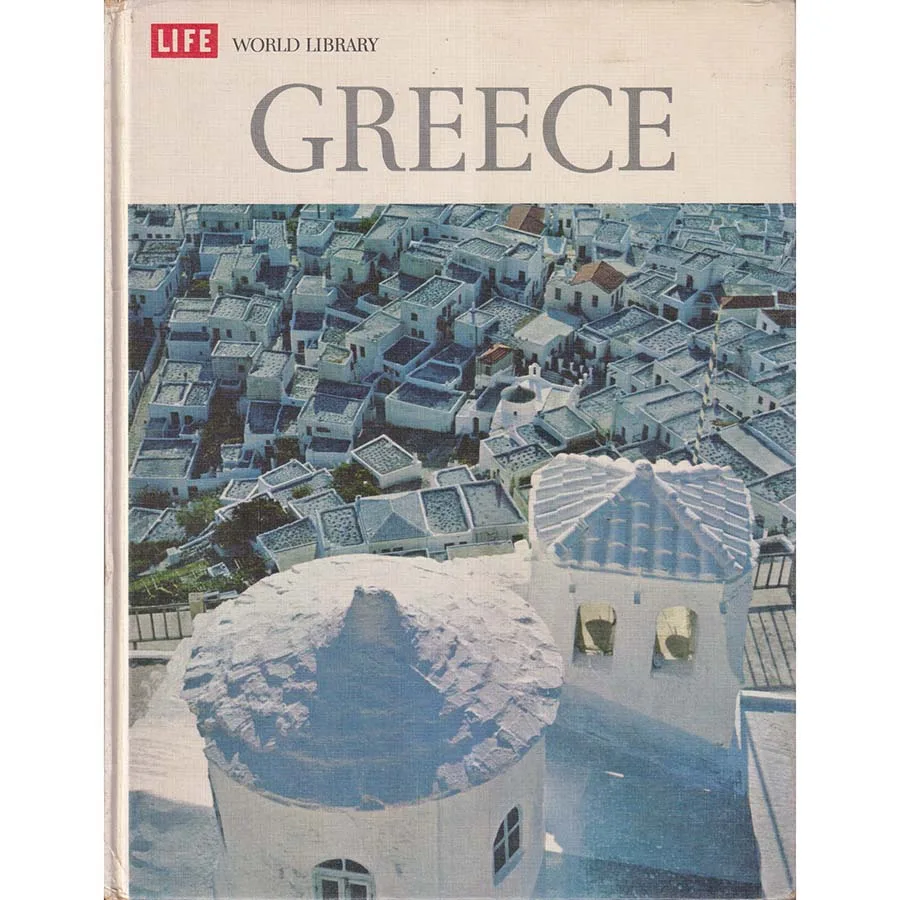
Publisher: Time-Life International
Format: Hardback
ISBN: none
Greece - Life World Library (1964) by Alexander Eliot – Time-Life International
ISBN: None
Condition: Good
Greece, 1964. Ancient temples, whitewashed islands, rugged mountains, olive groves, Orthodox churches, energetic politics and several thousand years of civilisation attempting to coexist with buses, concrete, tourism and the twentieth century.
Published by Time-Life International as part of its celebrated Life World Library series, Alexander Eliot’s Greece is a richly illustrated portrait of a country whose historical reputation is so enormous that modern Greece has occasionally had to work rather hard to be noticed underneath it.
This is, after all, the place that gave the world democracy, philosophy, theatre, classical architecture, the Olympic Games and a considerable number of men whose names now appear on university reading lists.
The inheritance is intimidating.
Imagine trying to open a modest municipal office when your ancestors invented Western political thought.
By 1964, Greece was a very different country from the ancient world tourists arrived hoping to find, but the past remained everywhere.
The Acropolis still dominated Athens.
Ruined temples stood among modern settlements.
Ancient theatres continued to cling magnificently to hillsides.
And archaeology was never very far away.
In Greece, digging a foundation can become an academic emergency surprisingly quickly.
Athens in the early 1960s was expanding rapidly.
Post-war migration from rural areas was swelling the capital, apartment blocks were multiplying and modern traffic was beginning its long campaign against the romantic image of classical civilisation.
It is one thing to contemplate Socrates.
It is another to contemplate Socrates while somebody behind you leans continuously on a car horn.
That, perhaps, is the authentic modern Mediterranean experience.
Politically, the Greece captured here stood at a particularly interesting point.
The country had endured occupation during the Second World War and then a brutal civil war that ended in 1949.
Those conflicts were still recent memories.
King Paul was monarch when 1964 began, but he died in March of that year and was succeeded by Constantine II.
George Papandreou became prime minister in 1964, during a period of political tension that would eventually lead to the military coup of 1967.
None of that later history had happened when this volume appeared.
There is no helpful footnote saying, “Things become rather complicated shortly.”
That absence of hindsight is one of the pleasures of old reference books.
The present is still genuinely uncertain.
The Colonels have not seized power.
The monarchy has not yet fallen.
Greece has not yet joined the European Economic Community.
The drachma still rules the wallet.
And nobody has yet tried to sell you an airline seat to Santorini for £24.99 plus twelve mysterious charges.
The islands naturally provide some of the finest photography.
The Cyclades.
Crete.
Rhodes.
Corfu.
The Dodecanese.
The Ionian islands.
Each has its own history, architecture and character, despite the later tourist industry’s heroic attempt to summarise them all as “sun, sea and tavernas”.
In 1964, mass tourism was growing, but many islands were still far less developed than they would become.
There were fewer hotels.
Fewer swimming pools.
Fewer hire scooters.
Far fewer people attempting to photograph exactly the same sunset.
Santorini had not yet become a global ceremony in which several thousand visitors collectively hold telephones towards the horizon.
Mykonos was becoming fashionable, but had not fully developed into the international kingdom of designer sunglasses and improbable bar bills that came later.
The Greek island experience still involved boats, local transport and a certain amount of acceptance that timetables represented aspiration rather than binding contract.
Crete offers an entire civilisation by itself.
Minoan ruins.
Venetian towns.
Mountain villages.
Second World War history.
Distinctive food and music.
And enough rugged interior to remind visitors that Greece is not simply beaches attached to archaeological sites.
Indeed, much of mainland Greece is mountainous.
Very mountainous.
The landscape rises and falls with such enthusiasm that flat ground can occasionally seem like a special amenity.
This geography shaped settlement, agriculture, communication and regional identity for centuries.
Villages developed in valleys and on slopes.
Roads wound around mountains.
Communities remained relatively isolated.
And travellers discovered that something apparently six miles away on the map might require the better part of an afternoon.
The sea, meanwhile, has always been central to Greek life.
Shipping became one of modern Greece’s great industries, continuing a maritime tradition extending back thousands of years.
Greek shipowners built enormous commercial fleets.
Ports connected the islands and mainland.
Fishing supported coastal communities.
And generations of Greeks looked at the surrounding Mediterranean and concluded, quite reasonably, that the easiest way forward was probably by boat.
Time-Life naturally loved all this.
Ships.
Harbours.
Fishermen.
Mountain villages.
Ancient columns.
Men repairing nets.
Women carrying baskets.
Monks standing dramatically outside monasteries.
The photographic possibilities were endless.
And because these pictures are now more than sixty years old, the supposedly ordinary scenes have acquired as much interest as the famous monuments.
A street in Athens.
A village shop.
A bus.
A café.
A ferry.
A roadside petrol pump.
All the things nobody thought would become historical eventually do.
That is one of the great pleasures of vintage illustrated books.
The photographer thinks the subject is the Parthenon.
The modern reader notices the parked car.
The Parthenon has survived for roughly two and a half thousand years.
The car was scrapped in 1978.
Naturally, the car deserves our immediate attention.
Religion is another major part of the portrait.
The Greek Orthodox Church remained deeply woven into national and everyday life.
Churches, monasteries, festivals and religious observance connected contemporary Greece with traditions extending back through the Byzantine world.
Mount Athos alone seems almost deliberately designed to frustrate any attempt to describe Greece as straightforwardly modern.
Monasteries perched on cliffs elsewhere provide similar evidence that medieval monks were considerably less concerned about building regulations than today’s planning departments.
Meteora is perhaps the ultimate example.
Monasteries sit on extraordinary pillars of rock in central Greece, apparently constructed after somebody looked at an inaccessible cliff and thought:
“Yes. Perfect. Let’s carry everything up there.”
One can only admire the commitment.
Greek food also appears in a world before international tourism standardised expectations.
Olives.
Cheese.
Fish.
Lamb.
Bread.
Vegetables.
Wine.
Regional dishes.
Simple ingredients treated with the confidence of people who have been cooking with olive oil for rather longer than fashionable restaurants have been charging extra for it.
In 1964, nobody described a village salad as “rustic”.
It was just lunch.
Nobody called grilled octopus “authentic”.
It was merely octopus.
And feta did not require a lifestyle photograph.
There are advantages to being early.
The country’s ancient heritage is, of course, unavoidable.
Athens.
Delphi.
Olympia.
Corinth.
Mycenae.
Epidaurus.
Knossos.
Names that have wandered out of Greek geography and into the general vocabulary of Western civilisation.
The philosophers alone cause trouble.
Socrates.
Plato.
Aristotle.
People who asked questions sufficiently difficult that humanity is still discussing them more than two thousand years later.
This seems unnecessarily thorough.
Then there are Homer, Herodotus, Sophocles, Euripides and a long list of other Greeks who somehow managed to establish major literary genres before most of Europe had organised the paving.
The weight of classical Greece inevitably shaped how outsiders saw the modern country.
Foreign visitors often arrived looking for antiquity.
Modern Greeks, understandably, still had to get to work in the morning.
One of the strengths of a volume like this is that it shows both.
Ancient monuments alongside modern industry.
Traditional villages alongside expanding cities.
Donkeys alongside cars.
Fishing boats alongside commercial shipping.
The past is present, but the present refuses to stay still.
Alexander Eliot was a writer and editor with a strong interest in art, mythology and world cultures, making him particularly suited to a subject where mythology has an inconvenient habit of appearing around every corner.
Greece can be difficult to describe without eventually encountering Zeus.
Mount Olympus itself is a real mountain.
Delphi is a real place.
Mycenae exists.
Knossos exists.
The landscape is littered with locations where ancient stories, archaeology and geography overlap so completely that separating them becomes almost rude.
This gives the book an additional charm.
A mountain is rarely just a mountain.
Some god did something there.
A cave usually has history.
An island probably appears in an epic.
If nobody has been turned into an animal nearby, you may simply be in the wrong chapter.
The 1960s context is equally fascinating.
Greece was still a relatively poor country by Western European standards.
Large numbers of Greeks emigrated in search of work, particularly to Germany, Australia, the United States and elsewhere.
Rural communities were losing population.
Cities were growing.
The economy was modernising.
Tourism was becoming increasingly important.
This was the Greece that stood between post-war hardship and the dramatic social and economic changes of the later twentieth century.
Again, the book cannot know what happens next.
It does not know that dictatorship is coming in 1967.
It does not know that democracy will be restored in 1974.
It does not know that the monarchy will be abolished.
It does not know that Greece will join the European Community.
It certainly does not know about the euro.
A 1964 drachma remains blissfully unaware of monetary union.
That makes the book not merely descriptive but suspenseful in a peculiar historical way.
We know the next chapter.
It does not.
The physical production is pure Life World Library too.
Substantial.
Illustrated.
Serious.
Designed for the age when knowledge came in objects large enough to require shelves.
A row of these books gave the owner immediate intellectual credibility.
Greece beside China.
Canada beside Tropical Africa.
The Low Countries beside Israel.
A whole planet arranged neatly at shoulder height.
Modern civilisation has produced vast online encyclopedias.
But none of them makes a bookcase look nearly as impressive.
There are no loading screens either.
No password.
No subscription.
No privacy settings.
No advert for somewhere you looked at once three weeks ago.
Open the cover and Greece appears instantly.
An astonishing user interface.
For today’s reader, Greece works beautifully as history, geography, travel, politics, archaeology, social history and vintage photography.
It captures the country immediately before a period of major political upheaval and before mass tourism transformed many of its best-known destinations.
It is also a reminder that Greece is far more than the convenient mixture of ancient ruins and beach holidays through which it is sometimes viewed abroad.
This is a country of mountains, islands, villages, great cities, religious traditions, migration, shipping and a modern history every bit as complicated as its ancient one.
Obviously, this is not a current travel guide.
Do not rely on the ferry timetables.
Do not attempt to spend drachmas.
Do not assume the quiet island photographed in 1964 remains quiet.
And if the book describes a beach as almost deserted, perhaps check Instagram before setting out.
But that is precisely why the volume has become so appealing.
It preserves a Greece before many of the developments now taken for granted.
A Greece where tourism was growing but had not yet swallowed whole coastlines.
A Greece still working through the aftermath of war.
A Greece unknowingly approaching dictatorship and then democracy.
And a Greece where a photographer could apparently point a camera at the Acropolis without thirty-seven people holding selfie sticks in the foreground.
Condition: Good. A vintage copy showing the usual signs of age and previous ownership expected from a book published in 1964, but remaining in good overall condition and perfectly suitable for reading, collecting or leaving conspicuously on a table beside a bowl of olives while pretending you are engaged in serious classical scholarship.
A splendid addition to a collection of Greek history, classical civilisation, Time-Life books, vintage geography, Mediterranean travel or 1960s photography.
Also ideal for anyone who has ever wanted to explore Greece without airport queues, sunburn, ferry delays or having to climb 147 ancient stone steps immediately after lunch.
Sold by Crappy Old Books, where the civilisation may be ancient, the politics may be out of date, and the only thing requiring an oracle is whether there is still room on the bookshelf.
Keep browsing: See more Travel books Other books by Alexander Eliot
