


Spain - Life World Library
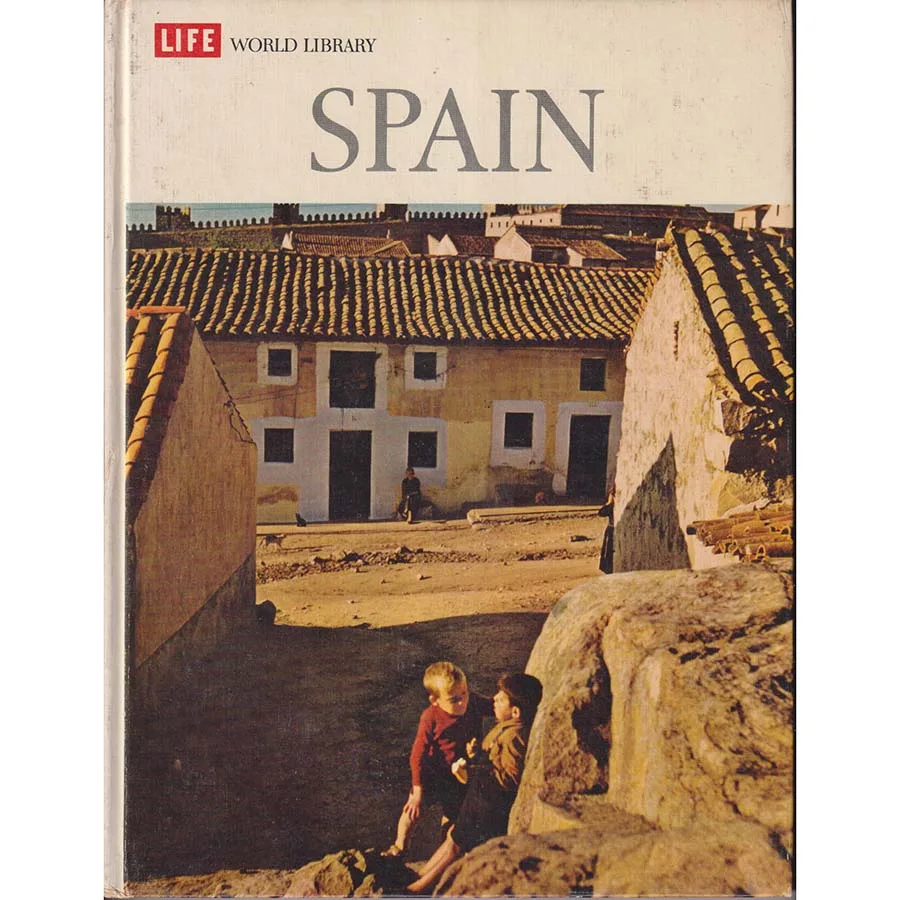
Publisher: Time-Life International
Format: Hardback
ISBN: none
Spain - Life World Library (1964) by Hugh Thomas – Time-Life International
ISBN: None
Condition: Good
Spain, 1964. Sunshine, bullfights, cathedrals, olive groves, flamenco, dusty villages, rapidly multiplying package tourists and General Franco still very firmly installed in Madrid.
Published by Time-Life International as part of its superb Life World Library series, Hugh Thomas’s Spain captures the country at a particularly fascinating moment: twenty-five years after the end of the Spanish Civil War, still under dictatorship, but rapidly modernising and beginning to discover that northern Europeans were prepared to travel astonishing distances in search of reliable sunshine and inexpensive alcohol.
This was not quite the Spain we know today.
There was no constitutional monarchy.
No European Union membership.
No high-speed railway network.
No Ryanair flight depositing sixty people from Luton in Málaga for the price of a moderately ambitious sandwich.
Spain in 1964 was still ruled by Francisco Franco, whose nationalist forces had won the Civil War in 1939 and who would remain in power until his death in 1975.
So although the photographs may contain beaches, fishing boats and agreeable-looking cafés, there is a decidedly serious political background to the scenery.
The Civil War itself remained a very recent memory.
For someone aged fifty in 1964, it was something they had personally lived through.
Cities had been bombed.
Families had been divided.
Hundreds of thousands had died.
Many Spaniards had gone into exile.
And the victorious regime had spent the following decades establishing a tightly controlled authoritarian state.
This was not yet something safely contained in documentaries and history books.
It was living memory.
Which makes Hugh Thomas a particularly interesting author for the volume.
Thomas was a British historian whose monumental work The Spanish Civil War had first appeared only a few years earlier, in 1961, establishing him as one of the best-known English-language historians of modern Spain.
He therefore knew considerably more about Spain than somebody who had spent a fortnight in Benidorm and learned how to order another beer.
That gives the book rather more historical weight than your average illustrated country guide.
But Spain in the early 1960s was also changing astonishingly quickly.
After years of economic isolation and hardship, the country had begun opening its economy during the late 1950s.
Industrial production increased.
Foreign investment arrived.
Cities expanded.
Millions of Spaniards moved from rural areas towards Madrid, Barcelona and the industrial regions.
And tourism took off with the enthusiasm of an aeroplane full of sun-starved Britons escaping February.
The result was the beginning of the Spanish economic miracle.
Spain was becoming wealthier.
Cars appeared in increasing numbers.
Household appliances spread.
Roads improved.
Hotels multiplied along the Mediterranean coast.
And entire fishing villages began the long transformation into places containing swimming pools, apartment blocks and laminated menus in seven languages.
This is therefore Spain caught somewhere between the old rural society and the modern European country that would emerge over the following decades.
And visually, that makes it wonderful.
You have traditional villages where donkeys and carts are still part of ordinary life.
Farmers working landscapes that had changed little for generations.
Fishing communities.
Religious processions.
Markets.
Old city streets.
Alongside factories, motorways, apartment blocks and new tourist developments confidently announcing that the future would involve significantly more concrete.
Few countries provide such dramatic geographical variety either.
There are the green landscapes of Galicia.
The mountains of the north.
The enormous central plateau.
The Pyrenees.
The Mediterranean coast.
Andalusia.
Dry regions where the scenery begins to suggest that somebody has forgotten to turn the irrigation on.
Spain is sometimes imagined abroad as one enormous sunny beach.
It is not.
Parts of northern Spain receive enough rain to make a Welshman feel at home.
Meanwhile, portions of the interior can look as though precipitation has become a philosophical rather than meteorological concept.
Madrid sits roughly in the middle of all this, high on the central plateau and functioning as the political heart of the country.
The photographs of early-1960s Madrid are particularly interesting today.
Cars.
Buses.
Advertising.
Clothing.
Street furniture.
Shops.
People conducting normal lives with absolutely no idea that several decades later strangers would stare at the background of the photograph saying:
“Look at that Seat 600.”
The SEAT 600 deserves a special mention because few objects symbolised Spain’s economic transformation more effectively.
Small, affordable and produced under licence from Fiat, it helped put ordinary Spanish families on the road.
Millions were built.
Suddenly people who had previously travelled by train, bus, bicycle, mule or whichever relative happened to own something with an engine could go somewhere under their own power.
This changed holidays.
Shopping.
Work.
Family visits.
And, eventually, traffic.
Progress always comes with a queue.
Barcelona supplies another side of Spain entirely.
Industrial, commercial and culturally distinct, it was already one of the country’s great cities.
Catalonia had its own language and traditions, although under Franco the public use and official recognition of regional languages such as Catalan had been heavily restricted.
Again, this gives seemingly ordinary photographs additional historical significance.
Modern Spain celebrates regional identity much more openly.
The Spain captured here existed under a political system determined to emphasise national unity instead.
Then there is Andalusia.
Seville.
Córdoba.
Granada.
A region where Roman, Islamic, Jewish and Christian histories have accumulated in layers.
The Alhambra alone could justify an entire photographic book.
Few buildings manage to be simultaneously fortress, palace, work of art and proof that somebody in medieval Granada had considerably more patience with decorative plaster than anyone possesses today.
The centuries of Muslim rule left Spain with an architectural and cultural inheritance unlike anywhere else in Western Europe.
Mosques became cathedrals.
Palaces survived.
Language absorbed Arabic words.
Agricultural techniques travelled.
History refused to remain conveniently separated into labelled boxes.
And then came the Reconquista, imperial expansion, the Americas and several centuries during which Spain was one of the most powerful countries on Earth.
For a country attempting to explain itself in the twentieth century, there was therefore quite a lot of previous material to get through.
Time-Life, fortunately, was never intimidated by this.
These books were produced during the great age of publishing confidence.
Spain?
Certainly.
History from the Romans onwards?
Fine.
Civil War?
Of course.
Agriculture, religion, industry, politics and regional identity?
We’ll need another twenty pages.
There is something wonderfully reassuring about the whole operation.
Nobody asks whether you want notifications.
Nobody interrupts with a video.
No banner covers half the photograph asking you to accept cookies.
You turn the page.
Another page appears.
Publishing had clearly reached an extraordinary level of technological sophistication by 1964.
Tourism provides some of the most entertaining hindsight.
Spain was already becoming enormously popular with British, German and Scandinavian holidaymakers seeking sunshine at affordable prices.
The Costa Brava and Costa del Sol were developing rapidly.
Hotels were appearing.
Air travel was becoming cheaper.
Package holidays were growing.
And Spain was beginning a relationship with British tourism that would eventually result in millions of visitors annually and the mysterious establishment of English-language pubs in places several thousand miles from England.
Benidorm was already developing dramatically.
But it had not yet reached its final form.
The skyline was comparatively modest.
The enormous towers came later.
There were fewer mobility scooters.
And finding an establishment serving a full English breakfast may still have required genuine effort.
We were pioneers once.
The growth of tourism also created one of the stranger contradictions of Franco’s Spain.
The regime remained politically conservative and authoritarian while simultaneously welcoming millions of foreigners bringing money, bikinis, new fashions and social attitudes that did not always fit comfortably with official morality.
It is difficult to keep society completely insulated from outside influence while inviting several million outsiders to spend fortnight-long holidays in it.
Sunshine proved ideologically porous.
The religious life of the country naturally receives considerable attention too.
Catholicism occupied a central position in Franco-era Spain.
Churches, processions, saints’ days and religious traditions were deeply embedded in public life.
For the Time-Life photographer this was excellent news.
Few things make better photographs than a large Spanish religious procession involving elaborate statues, ancient streets and several hundred extremely serious participants.
The food, meanwhile, was still largely regional.
Before international restaurant chains homogenised city centres, local cuisine depended heavily on what actually grew, grazed or swam nearby.
Olive oil.
Fish.
Rice.
Pork.
Vegetables.
Cheese.
Wine.
Seafood.
And enough garlic to render international diplomacy unnecessary at close range.
Paella had not yet been internationally transformed into the vaguely yellow mixture occasionally presented under its name in British pubs.
Tapas existed without requiring the word “concept”.
Wine was drunk without somebody explaining the tasting notes for six minutes beforehand.
There are advantages to the past.
The photographs throughout a book such as this have also acquired tremendous accidental value.
Time-Life might photograph a village because it demonstrated traditional agriculture.
Today we inspect the buildings.
They photograph an industrial centre because it represented modernisation.
Today we examine the machinery.
They photograph an ordinary road.
Today someone is desperately trying to identify the bus.
This is why vintage illustrated books improve with age.
Almost everything eventually becomes interesting.
Leave a petrol station alone for sixty years and somebody will want a photograph of it.
Spain itself would undergo enormous changes shortly after the period captured here.
Franco died in 1975.
King Juan Carlos I became head of state.
Spain moved rapidly towards democracy.
A new constitution was approved in 1978.
Regional autonomy expanded.
Spain joined the European Economic Community in 1986.
Living standards rose dramatically.
Infrastructure was transformed.
And eventually the country acquired high-speed trains so efficient that British travellers could experience the unfamiliar sensation of a railway timetable being regarded as a commitment.
None of that had happened when this book was published.
And that is precisely the appeal.
There is no hindsight.
Nobody knows that dictatorship will end peacefully.
Nobody knows exactly what democratic Spain will look like.
Nobody knows how enormous tourism will become.
Nobody knows that sleepy coastal settlements will acquire apartment towers visible from orbit.
The future remains off the page.
For today’s reader, Spain consequently functions on several levels at once: Spanish history, Franco-era politics, social history, geography, tourism history, architecture and superb mid-century photography.
It is a portrait of a country standing midway between its traumatic recent past and the modern European society it would eventually become.
Obviously, it is not a modern travel guide.
Do not rely upon it for hotel recommendations.
Do not attempt to obtain pesetas before departure.
Do not expect border procedures to remain unchanged.
And if the book tells you about an undiscovered Mediterranean fishing village, there is a fair chance somebody has subsequently put twelve thousand apartments around it.
But as a historical snapshot, it is splendid.
Condition: Good. A vintage copy displaying the normal signs of age and previous ownership expected from a book published in 1964, but remaining in good overall condition and perfectly suitable for reading, collecting or placing prominently beside a bottle of Rioja while pretending the evening has an educational purpose.
An excellent addition to a collection of Spanish history, Franco-era material, Time-Life books, vintage geography, European social history or 1960s photography.
It is also ideal for anyone nostalgic for the days when visiting Spain required rather more effort than opening an airline app at 11pm and discovering you can apparently be in Alicante tomorrow morning for £27.
Sold by Crappy Old Books, where Spain is still ruled by Franco, Benidorm has not entirely escaped upwards, and every holiday comes with complimentary historical perspective.
Keep browsing: See more Travel books Other books by Kugh Thomas
