


The Low Countries - Life World Library
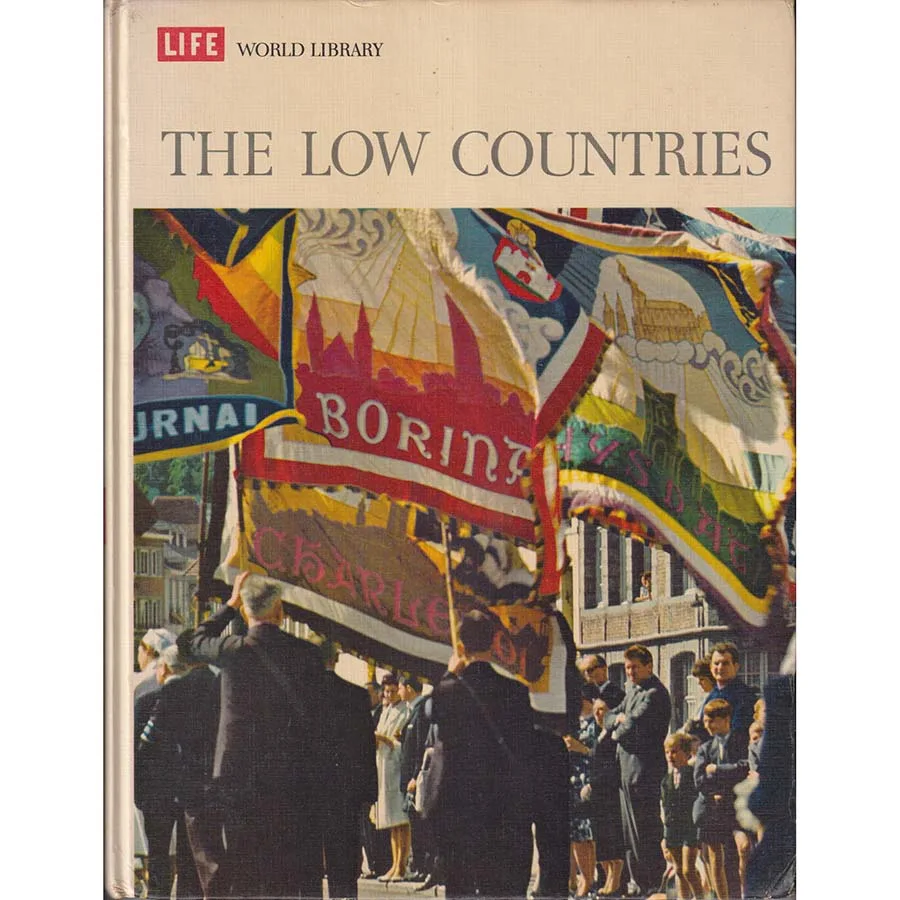
Publisher: Time-Life International
Format: Hardback
ISBN: none
The Low Countries - Life World Library (1965) by Eugene Rachlis – Time-Life International
ISBN: None
Condition: Good
The Low Countries, 1965. Belgium, the Netherlands and Luxembourg: three relatively modest pieces of Europe containing an unreasonable quantity of history, commerce, painting, canals, bicycles, beer, diplomacy and extremely determined attempts to prevent the North Sea from reclaiming the premises.
Published by Time-Life International as part of its superb Life World Library series, Eugene Rachlis’s The Low Countries takes on the wonderfully ambitious task of explaining this compact but remarkably complicated corner of Europe in one generously illustrated volume.
And "Low Countries" is not merely a poetic description.
Large areas of the Netherlands really are low. Impressively low. Alarmingly low. In places, the sea is effectively upstairs.
The Dutch response to this geographical inconvenience has historically been not to move somewhere higher, but to construct dikes, canals, pumping stations and enormous engineering works and inform the water that it will be staying over there.
This arrangement has mostly worked.
By 1965 the region was also undergoing one of the great transformations of post-war Europe. The destruction and austerity of the Second World War were receding, economies were expanding, living standards were rising and the countries of Western Europe were becoming increasingly economically interconnected.
The modern European project was already taking shape. Belgium, the Netherlands and Luxembourg had been pioneering regional cooperation through Benelux, and all three were founding members of the European Economic Community.
This therefore captures the Low Countries at a fascinating moment: firmly modern, increasingly prosperous, yet still visibly connected to a much older Europe.
And there is a lot of older Europe.
For relatively small countries, Belgium and the Netherlands have spent an impressive amount of history appearing in everybody else’s history books.
Spanish rule.
Religious wars.
Merchant empires.
Napoleon.
Two World Wars.
Colonial adventures.
Revolutions.
Royal families.
International treaties.
And approximately six centuries during which various European powers seem to have looked at the region and thought, "We should probably march an army through there."
Geographical position is not always an advantage.
The Netherlands naturally supplies some of the most immediately recognisable imagery: canals, windmills, flat landscapes, bicycles and towns apparently constructed after somebody discovered bricks and became extremely enthusiastic about them.
Amsterdam is particularly photogenic, although its modern reputation as an international centre of tourism, nightlife and stag weekends was not quite what a respectable Time-Life photographer in 1965 was generally attempting to document.
Instead we get the older city: canals, merchants’ houses, bridges, ports and the extraordinary legacy of the Dutch Golden Age.
There is also Rotterdam, rebuilt dramatically after the devastation of the Second World War and developing into one of the world’s great ports.
This is the Netherlands as a trading nation, something it has been remarkably good at for centuries.
When your country contains few mountains, limited natural resources and quite a lot of water where the land ought to be, apparently the sensible response is to become extremely efficient and sell things to everybody else.
Belgium presents another wonderfully complicated national story.
Dutch-speaking Flanders.
French-speaking Wallonia.
Brussels sitting in the middle trying to keep everybody organised while simultaneously becoming one of the principal centres of European diplomacy.
For a small country, Belgium has achieved the impressive feat of possessing several languages, multiple layers of government and enough institutional complexity to make outsiders wonder whether anyone actually knows who is responsible for collecting the bins.
Yet Belgium also possesses magnificent medieval cities, extraordinary architecture, major industrial regions and an artistic heritage that would embarrass countries several times its size.
Bruges and Ghent provide the medieval grandeur.
Antwerp supplies trade, diamonds and one of Europe’s great ports.
Brussels supplies government, international institutions and the alarming discovery that putting mayonnaise on chips is actually rather good.
Then there is Luxembourg.
Tiny Luxembourg.
The country that tends to appear on maps only after you have zoomed in slightly.
It would be very easy to overlook Luxembourg beside its larger neighbours, except Luxembourg has spent much of the modern era politely refusing to be overlooked.
Strategically positioned, multilingual and increasingly important in European finance and institutions, it demonstrates that a country does not necessarily need large quantities of territory provided it knows what to do with the territory it has.
In 1965, of course, all three countries still looked noticeably different from today.
The cars were different.
The clothes were different.
The shops were different.
Factories that were then thriving may now have disappeared.
Ports have expanded enormously.
Cities have changed.
And many ordinary scenes photographed simply to illustrate contemporary life have since become historical records.
That is one of the joys of books like this.
A photographer carefully composes a picture of a cathedral.
Sixty years later somebody ignores the cathedral completely and says:
"LOOK AT THAT VOLVO."
The editors could never know which details future readers would find interesting.
A road sign.
A tram.
A petrol station.
A shop window.
A dockyard crane.
A man delivering something on a bicycle while wearing clothing nobody would now voluntarily cycle in.
Everything eventually becomes social history if you leave it alone long enough.
The book also comes from the golden age of Time-Life confidence.
No subject was too complicated.
No country was too historically tangled.
Give them a writer, several photographers, some maps and a sturdy binding and they would explain it.
There were no embedded videos.
No interactive maps.
No "You may also like..."
No popup asking whether you would permit 742 advertising partners to process your personal information.
If you wanted to discover why the Dutch built polders, you simply turned the page.
Extraordinary.
And the Low Countries are particularly well suited to this treatment because so much can be conveyed visually.
Canals.
Harbours.
Old towns.
Modern industry.
Farms.
Engineering works.
Cathedrals.
Markets.
Ships.
Art.
And, inevitably, bicycles.
The Netherlands appears to have concluded long ago that the bicycle was a perfectly adequate solution to transportation and has spent the intervening decades waiting patiently for everybody else to realise it.
The region’s artistic heritage also gives the volume an almost unfair advantage.
Rembrandt.
Vermeer.
Rubens.
Van Eyck.
Bruegel.
Van Gogh.
Mondrian.
For an area of Europe that could fit several times inside many larger countries, the Low Countries have produced an absurd proportion of the paintings now requiring enormous museums to contain them.
Even the landscape painting makes sense once you see the landscape itself.
Flat horizons.
Huge skies.
Water everywhere.
Windmills.
Cows apparently standing exactly where seventeenth-century painters left them.
For the modern reader, The Low Countries consequently works on several levels at once: geography, European history, social history, architecture, economics, photography and mid-century publishing.
It also captures Western Europe at a moment when today’s political and economic structures were still relatively new.
Nobody reading this book in 1965 could know quite what European integration would eventually become.
They certainly could not know that Brussels would eventually become shorthand in Britain for an enormous political argument lasting several decades.
At the time, people were mostly getting on with rebuilding Europe, expanding trade and trying very hard not to have another continental war.
Which, viewed against the previous few centuries, was already an ambitious programme.
Obviously, this is not a modern travel guide.
Do not rely on it for railway timetables.
Do not expect the hotel prices to remain valid.
Do not assume a Belgian factory photographed in 1965 is still producing anything.
And if it recommends somewhere to park in central Amsterdam, regard the information as historical fiction.
But as a portrait of Belgium, the Netherlands and Luxembourg more than sixty years ago, it has become considerably more interesting than its original publishers could have anticipated.
Condition: Good. A vintage copy showing the normal signs of age and previous ownership expected from a book published in 1965, but remaining in good overall condition and perfectly suitable for reading, collecting or strategically displaying beside a small model windmill until people assume you have extensive knowledge of Dutch hydraulic engineering.
A lovely addition to a collection of Time-Life books, European history, vintage geography, travel, Benelux material or mid-century photography.
It is also ideal for anyone who wants to tour three countries without passports, airport queues or discovering halfway through Belgium that the road signs have suddenly changed language.
Sold by Crappy Old Books, where the books are old, the countries have changed, and unlike the Netherlands we make absolutely no guarantees about keeping the water out.
Keep browsing: See more Travel books Other books by Eugene Rachlis
