


Mexico - The Sunday Times World Library
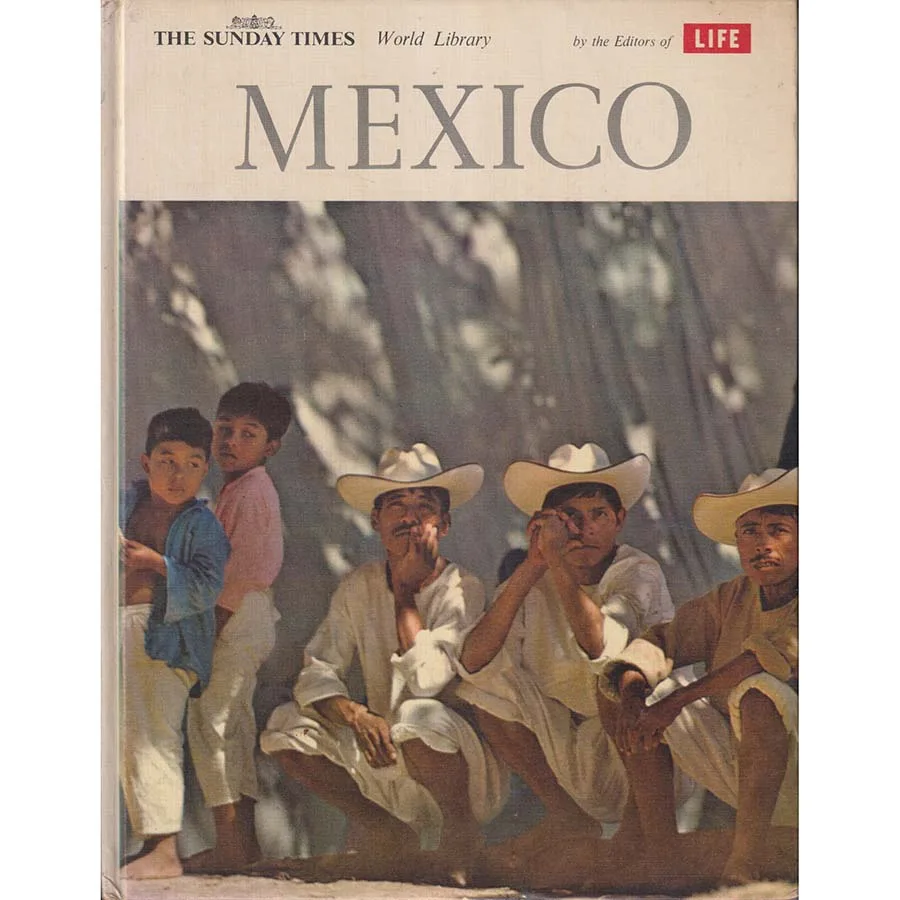
Publisher: The Sunday Times
Format: Hardback
ISBN: none
Mexico - The Sunday Times World Library (1963) by William Weber Johnson – The Sunday Times
ISBN: None
Condition: Good
Mexico, 1963. Ancient pyramids, colonial cities, enormous deserts, tropical coasts, revolutionary history, rapidly expanding industry, astonishing food and enough cultural complexity to make any attempt to summarise the entire country in one book seem admirably optimistic.
Naturally, The Sunday Times World Library had a go.
Written by William Weber Johnson, Mexico is one of those splendidly confident mid-century reference books that sets out to explain an entire nation to the reader with the assistance of maps, photographs, statistics and the firm conviction that several hundred pages ought to be enough for anybody.
And Mexico gives it rather a lot to work with.
This is a country containing the remnants of some of the great civilisations of the Americas, Spanish colonial architecture, vast mountain ranges, deserts, jungles, agricultural regions, modern cities and a twentieth-century political history shaped heavily by revolution.
It is also a Mexico very different from the one encountered today.
In 1963, Mexico City was already huge, but nowhere near its later scale. The country’s population was still heavily rural, the economy was undergoing rapid industrialisation, tourism was expanding and the great post-war period of economic growth often called the Mexican Miracle was in full swing.
There was confidence in development.
Roads were being built.
Industry was growing.
Cities were expanding.
And somewhere, almost certainly, a man in a suit was standing beside a hydroelectric project explaining that the future had arrived.
That was simply how progress was photographed in the 1960s.
The historical sections have plenty of material to cover before they even reach the modern country.
There are the Maya.
The Aztecs.
The Spanish conquest.
Colonial rule.
Independence.
Revolution.
Civil war.
Political upheaval.
And repeated occasions on which somebody announced a new political order shortly before somebody else arrived with a different one.
Few countries can provide quite so much history before breakfast.
The ruins alone give the book enormous visual appeal. Mexico contains some of the most spectacular archaeological sites in the world, and even in the early 1960s they were already among the country’s defining images.
Teotihuacan, Chichén Itzá and the remains of pre-Columbian civilisation offered the photographers something considerably more dramatic than another picture of a municipal office.
Although, being a serious reference book, there are probably municipal offices as well.
Mexico City naturally looms large.
Built over the site of the Aztec capital Tenochtitlan, it is one of those places where history appears to have been stacked in layers rather than placed politely beside itself.
Ancient civilisation underneath.
Spanish colonial city on top.
Modern metropolis spreading over everything.
Urban planning was always going to have a difficult afternoon.
Then there is the countryside, which destroys any simple notion of Mexico as one type of landscape.
There are deserts in the north.
High plateaus.
Volcanic mountains.
Tropical forests.
Pacific beaches.
Caribbean coastline.
Agricultural valleys.
And regions so geographically different from one another that they might reasonably object to appearing in the same chapter.
This is one reason vintage geography books are so enjoyable. They remind you that countries are far more complicated than the collection of clichés later used to sell holidays to them.
The photographs are also now historical documents in their own right.
A street scene that merely showed everyday life in 1963 may today contain old buses, vanished shops, hand-painted signs and cars now treated as classics.
A rural village photographed as something ordinary can become a record of architecture and customs that have since changed substantially.
Clothing becomes interesting.
Advertising becomes interesting.
Even petrol stations become interesting eventually.
Give almost anything sixty years and somebody will start collecting it.
The book’s treatment of Mexican society is particularly fascinating because it was produced before many of the political and social changes that would shape the later twentieth century.
The long dominance of the Institutional Revolutionary Party, or PRI, seemed deeply embedded in national life.
Mexico’s relationship with the United States was already enormously important, but the scale of later cross-border trade and manufacturing had not yet developed.
Cancún, now one of the world’s best-known tourist resorts, had not even been created as a major resort destination.
So anyone hoping to find advice about all-inclusive hotels, airport transfers or where to obtain the best Wi-Fi beside the swimming pool is going to be disappointed.
The 1963 traveller had more serious concerns.
Maps, perhaps.
Road conditions.
Whether the car would make it.
Whether there was petrol when it got there.
And whether the phrasebook had adequately prepared them for whatever happened next.
William Weber Johnson brings the accustomed mid-century mixture of travel observation, history and national portraiture to the subject. The result is not simply a collection of facts but an attempt to give the reader a sense of Mexico as a functioning society.
That makes it much more enjoyable today than a purely statistical reference work would be.
Statistics age.
Human observations tend to become history.
And there is something wonderfully revealing about the assumptions of a book written in the early 1960s. The things the author pauses to explain tell us almost as much about the expected reader as they do about Mexico itself.
This was international education before search engines.
If you wanted to know about Mexico, you obtained a book.
Then you opened it.
Then, astonishingly, you continued reading rather than being informed that somebody in another room had just reacted to a photograph.
The Sunday Times World Library volumes also belong to that pleasing era when books were designed to look as though knowledge had physical weight.
A shelf containing Mexico, Russia, Italy and Britain instantly suggests intellectual seriousness.
Nobody needs to know whether you have read all four.
You merely need to position them convincingly.
A globe nearby would help.
Possibly a leather chair.
For the modern reader, this volume is interesting on several levels at once: Mexican history, geography, politics, archaeology, social history, travel and vintage photography all appear through the particular lens of the early 1960s.
And because Mexico has changed so much since publication, the book has gained something its original editors never intended.
It has become a time capsule.
It captures Mexico before mass international tourism reached its later scale, before NAFTA, before the modern megacity expanded still further, and before many of today’s familiar assumptions about the country had developed.
Obviously, it should not be mistaken for current travel advice.
If a hotel recommendation dates from 1963, telephone first.
If a road is described as newly constructed, it may now need resurfacing.
And if the book gives the population of Mexico City, it is probably best not to use it in a pub quiz unless the question specifically includes the words "in 1963".
But that is not the point.
The point is seeing Mexico as contemporary readers encountered it more than sixty years ago.
A country looking forward while carrying an enormous amount of history behind it.
Condition: Good. A vintage copy showing the ordinary signs of age and previous ownership expected from a book published in 1963, but remaining in good overall condition and perfectly suitable for reading, collecting, research or strategic placement on a bookshelf beside something about tequila so visitors can see you have approached the subject academically.
A lovely period volume for collectors of Mexico, Latin American history, vintage geography, travel writing, archaeology or Sunday Times World Library books.
Also ideal for anyone who wants to visit Mexico without passports, baggage allowances, airport security or discovering that the person in front has brought six suitcases to the check-in desk.
Sold by Crappy Old Books, where international travel still costs roughly the price of second-class postage and nobody has ever lost your luggage.
Keep browsing: See more Travel books Other books by William Weber Johnson
