


Tides Of Light
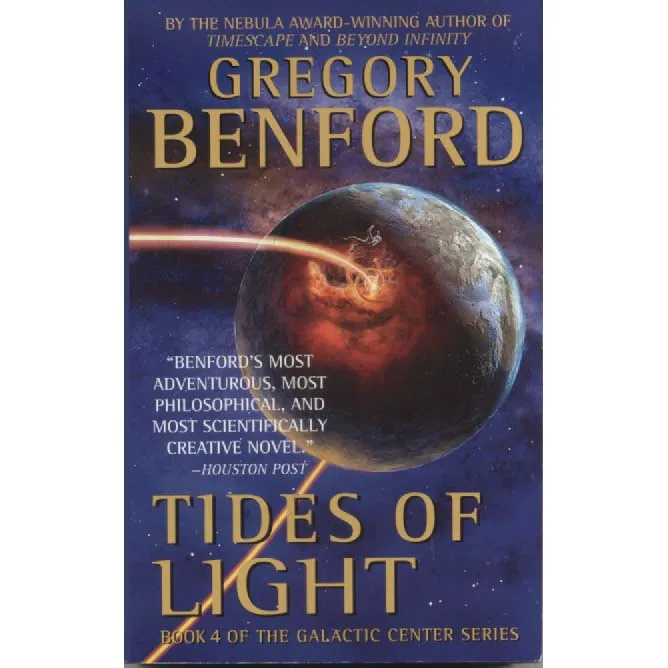
Publisher: Aspect Science Fiction
Format: Paperback
ISBN: 0446611549
Tides of Light (2004) by Gregory Benford
Aspect Science Fiction — ISBN 0446611549
Condition: Near Fine
Humanity has had a difficult time of things in Gregory Benford’s Galactic Center series. Having ventured confidently into the Galaxy, our descendants have discovered that it is already occupied by ancient machine intelligences, that these machines are considerably more powerful than we are, and that their attitude towards biological life falls somewhere between “unnecessary complication” and “pest-control problem.”
Tides of Light is the fourth novel in Benford’s vast Galactic Center sequence, and by this stage humanity’s distant descendants are not so much boldly exploring the universe as attempting to remain in it.
The story continues the struggle of the Bishop Family, a community of humans surviving on the planet Snowglade in the face of relentless pressure from the mechanical intelligences known as the mechs. Generations of conflict have transformed these people. Their language, culture and instincts have adapted to a world in which enormously sophisticated machines are trying to remove them from the evolutionary accounts.
This is inconvenient.
The mechs are not merely robots with glowing eyes and an unfortunate attitude. They are representatives of an ancient machine ecology: intelligent, evolving technological entities whose civilisation operates on a scale far beyond humanity’s own. To them, organic life is primitive, untidy and possibly something that should have been cleared away before the serious business of intelligence began.
Humanity, naturally, disagrees.
Led by Killeen Bishop, the surviving humans must navigate a landscape increasingly transformed by machine activity. Snowglade itself becomes part of the conflict as enormous technological forces reshape the environment. The planet is not merely where the battle takes place; it is becoming one of the things being fought over, altered and repurposed by intelligences with very different definitions of what constitutes a suitable world.
Benford, being both a novelist and an astrophysicist, has never been particularly interested in keeping his science fiction small. Tides of Light contains the sort of ideas that other novels might regard as sufficient material for an entire trilogy and then places them in the background while something even larger approaches.
Machine evolution, artificial intelligence, planetary engineering, biological adaptation and the long-term fate of intelligent life all become part of the story. The fundamental conflict is not simply humans versus robots. It is biology versus machinery as competing forms of life, played out across astronomical timescales.
Which rather puts disputes with your laptop into perspective.
One of the most distinctive aspects of the Galactic Center books is Benford’s portrayal of humanity after generations of survival under extreme conditions. The Bishops are not contemporary Americans who have accidentally been issued futuristic equipment. Their speech has changed. Their traditions have changed. Their understanding of technology has changed. They inhabit the distant future rather than merely visiting it for the duration of the plot.
This makes Tides of Light satisfyingly strange.
There are familiar human emotions — loyalty, fear, courage, rivalry and the stubborn refusal to become extinct merely because a superior intelligence considers it administratively convenient — but they exist within a culture shaped by centuries of danger. Humanity has survived partly by becoming something its ancestors would find increasingly unfamiliar.
The mechs, meanwhile, provide a wonderfully unsettling vision of machine intelligence. They are not simply evil because somebody forgot to install the Three Laws of Robotics. Their hostility emerges from an entirely different evolutionary history and set of priorities. They are old, powerful and disturbingly plausible as creatures which no longer regard biological intelligence as the obvious pinnacle of existence.
The universe, Benford keeps reminding us, does not necessarily have humanity pencilled in for the leading role.
This is hard science fiction with dirt under its fingernails. There are enormous concepts and cosmic implications, but much of the story remains rooted in physical survival. People run, fight, improvise and attempt to understand forces far beyond them. Technology can resemble magic, but somebody somewhere still has to survive long enough to use it.
Originally published in 1989, Tides of Light sits between Great Sky River and Furious Gulf in the Galactic Center sequence. Readers already following Killeen Bishop and his family will find the conflict expanding dramatically as the story moves towards the still greater mysteries of the Galactic Centre.
Those starting here may experience a sensation roughly equivalent to arriving halfway through an interstellar war and asking whether anyone has a spare programme.
It can certainly be read for its ideas and adventure, but the earlier volumes provide the background to the Bishops, the mechs and the extraordinary circumstances which have brought humanity to this point. Benford has constructed a genuinely large future history, and he does not stop every twenty pages to explain it again for anyone who has arrived late.
This 2004 Aspect Science Fiction edition is offered in Near Fine condition, meaning it has survived remarkably well and displays only very minor evidence that previous biological intelligences have interacted with it. The mechs appear not to have noticed it.
That is probably for the best.
Ideal for readers of hard science fiction, far-future adventures, artificial intelligence, machine civilisations, planetary engineering and stories which take seriously the possibility that humanity might one day encounter forms of intelligence vastly older and more capable than ourselves.
It is particularly recommended for anyone who finds conventional robot uprisings insufficiently ambitious. Why settle for one rebellious computer when you can have an ancient machine civilisation engaged in an evolutionary struggle with biological life across the Galaxy?
Crappy Old Books verdict: Humanity has reached the distant future and discovered that the machines have been extremely busy. They are ancient, intelligent, powerful and would rather we weren’t here. Fortunately, humans remain remarkably difficult to get rid of — a characteristic already well established by the 21st century.
Keep browsing: See more Science-Fiction books Other books by Gregory Benford
