


The Descent Of Anansi
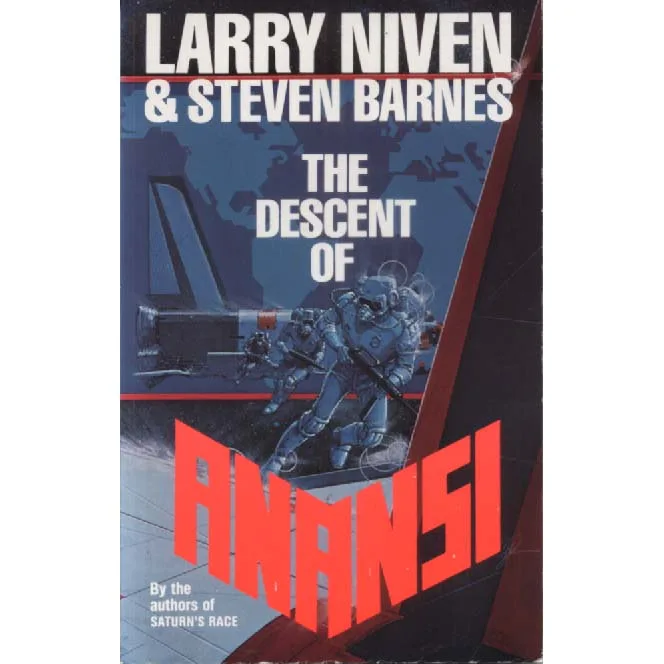
Publisher: Tor
Format: Paperback
ISBN: 0812512928
The Descent of Anansi (1982) by Larry Niven & Steven Barnes
Tor — ISBN 0812512928
Condition: Good
Space travel is complicated enough when everything is working properly. There are vacuum, radiation, orbital mechanics and the persistent inconvenience that if anything important falls off, there is rarely a branch of Halfords within several hundred kilometres. Larry Niven and Steven Barnes therefore begin The Descent of Anansi by making matters considerably worse.
The Anansi is an orbital spacecraft carrying an extraordinarily valuable cargo back towards Earth: a revolutionary material manufactured in space and possessing properties which could transform industry. Naturally, this makes it valuable. And because it is valuable, somebody wants it. Humanity may have conquered orbital manufacturing, but apparently nobody has yet invented a technological solution to greed.
Then sabotage strikes.
Suddenly the crew of Anansi are no longer conducting an orderly return to Earth. Their spacecraft is damaged, their options are limited and the enormous planet below has begun taking an increasingly personal interest in where they are going to land.
The resulting story is part hard science fiction, part disaster novel and part orbital thriller. Niven and Barnes take the pleasantly straightforward idea of “people stuck in a broken spacecraft” and subject it to the unforgiving laws of physics, where courage is useful but unfortunately cannot alter velocity.
At the heart of the crisis is Skyhook, the remarkable material being transported aboard Anansi. Manufactured in orbit, immensely strong and commercially priceless, it represents exactly the sort of technological breakthrough humanity dreams of producing in space. Unfortunately, possessing a cargo worth a fortune while trapped aboard a sabotaged spacecraft turns out to be rather like carrying a suitcase full of diamonds through a neighbourhood where everyone has been informed of your route.
What follows is an exercise in improvisation.
The crew must somehow use the resources available to them — including the extraordinary properties of their cargo — to survive their descent. This is very much science fiction from the school in which engineering is not decorative background material. Physics isn’t merely mentioned to make the spaceship sound convincing; it is actively trying to kill the characters.
Larry Niven is, of course, particularly at home in this territory. His fiction has long delighted in asking what happens if you invent one extraordinary piece of technology and then follow its consequences with unreasonable enthusiasm. Steven Barnes brings the human tension, action and thriller elements into the equation, producing a compact story in which technological ingenuity and human unpleasantness proceed simultaneously.
There is something wonderfully old-fashioned about the resulting adventure — and that is meant entirely as a compliment. Nobody has to save seventeen galaxies from a glowing purple portal. The stakes are understandable: a spacecraft is in serious trouble, people are aboard it, somebody caused the trouble deliberately, and Earth is approaching rather faster than would generally be considered reassuring.
Gravity makes an excellent villain because it cannot be reasoned with.
The novel also comes from that particularly enjoyable period of near-future science fiction when permanent human activity in orbit seemed not merely possible but imminent. Space factories, orbital industries and exotic materials manufactured in microgravity were expected to become part of the coming technological economy. The future was going to involve factories in space, enormous engineering projects and presumably a surprising number of accountants trying to establish whether something manufactured 300 kilometres above Earth was liable for import duty.
Some of those predictions remain stubbornly futuristic, but that only adds another layer of interest to the book. The Descent of Anansi is both an adventure and a snapshot of the technological optimism surrounding space development at the beginning of the 1980s — a period when the Space Shuttle had arrived and it seemed reasonable to assume that the next few decades might become considerably more orbital than they actually did.
And then, naturally, there is the name Anansi.
Named for the famous trickster spider of West African folklore, it is particularly appropriate for a story involving threads, ingenuity and survival through cleverness. The damaged spacecraft has effectively become caught in a web of physics, sabotage and competing interests, and getting out requires considerably more than pressing the large button marked EMERGENCY.
This 1982 Tor edition is offered in Good condition. It has some ordinary signs of previous ownership and use but remains structurally sound and ready for another descent through the atmosphere. Unlike the spacecraft in the novel, all major components of the book appear to have remained attached throughout its journey.
Crappy Old Books has also subjected it to our rigorous orbital safety inspection, consisting primarily of looking at it, turning it over and confirming that the pages do not immediately escape.
Ideal for readers who enjoy classic hard science fiction, plausible near-future technology, orbital engineering, survival stories, technological puzzles and thrillers in which the solution to a crisis depends less upon discovering mystical powers and more upon understanding what the equipment can actually do.
It is also refreshingly compact science fiction: a clever premise, a dangerous situation and a great deal of ingenuity packed into a novel which does not require a twelve-volume commitment, an accompanying encyclopaedia or the memorisation of six royal dynasties before Chapter Three.
Crappy Old Books verdict: Someone has sabotaged the spacecraft, the cargo is worth a fortune and gravity has noticed everybody. Fortunately, the crew have an astonishing new material and several very good ideas. Unfortunately, they are still falling towards Earth.
Keep browsing: See more Science-Fiction books Other books by Larry Niven and Steven Barnes
