


The Citadel Of The Autarch
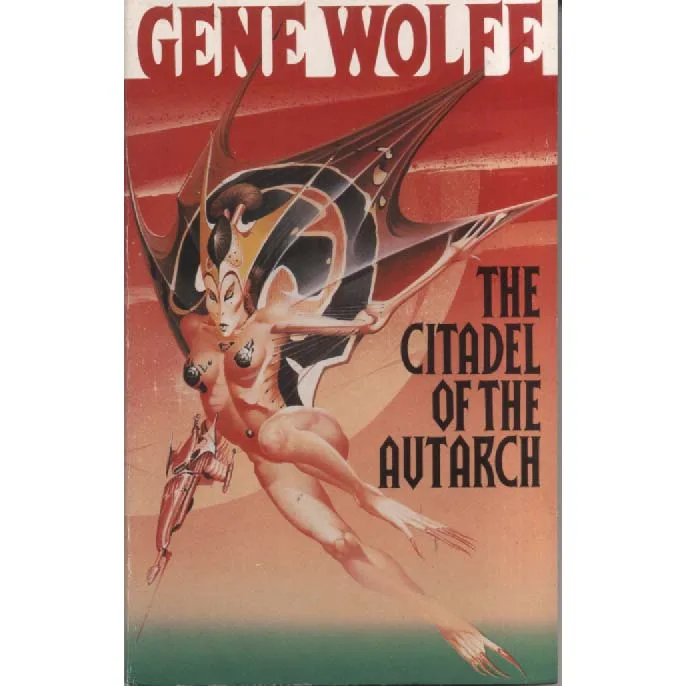
Publisher: Arrow
Format: Paperback
ISBN: 9780099320609
The Citadel of the Autarch (1986) by Gene Wolfe
Arrow — ISBN 9780099320609
Condition: Good — Ex-Library
There are science-fiction novels which explain themselves carefully. There are science-fiction novels which provide maps, glossaries and helpful introductory paragraphs so that nobody becomes unnecessarily alarmed. And then there is Gene Wolfe, who appears to regard explaining things to the reader as an outrageous infringement upon their personal liberty.
The Citadel of the Autarch is the fourth and concluding volume of The Book of the New Sun, Wolfe’s extraordinary chronicle of Severian, journeyman torturer, exile, traveller, occasional executioner and increasingly important participant in the fate of a world so ancient that history itself has begun to look a little worn around the edges.
That world is Urth, a fantastically distant future Earth beneath a dying sun. Civilisations have risen, fallen, been forgotten, been built over, fallen again and presumably had somebody put a municipal car park on top of them. Technology survives alongside superstition; creatures that appear mythical may have perfectly scientific origins; ancient machines are treated like magic; and words which seem to describe medieval objects frequently turn out to mean something considerably stranger.
Severian’s journey began when he committed the professionally inconvenient act of showing mercy to a prisoner. Since torturers traditionally regard compassion as something of a performance-management issue, he was expelled from his guild and sent away carrying Terminus Est, an enormous executioner’s sword whose name roughly translates as “This Is the End.” Subtle symbolism is occasionally permitted in Wolfe’s universe, provided it is surrounded by another seventeen layers of considerably less obvious symbolism.
By The Citadel of the Autarch, Severian’s wanderings have carried him into the war between the Commonwealth and the mysterious Ascians. Battlefield, hospital, wilderness and political intrigue combine as the apparently insignificant torturer edges ever closer to the centre of power. His strange experiences, extraordinary memory and encounters with people who may be considerably more important than they initially appear begin to converge.
“Begin” is perhaps the important word.
Because Gene Wolfe does not so much reveal his plot as quietly leave evidence around the premises and allow the reader to conduct the investigation. Severian is our narrator, but possessing a perfect memory does not necessarily make someone perfectly reliable. He remembers everything. Whether he understands everything is another matter. Whether he tells us everything is another matter still. The distinction has kept readers happily arguing for decades.
This is the sort of book where an apparently casual sentence can become enormously significant two hundred pages later, or possibly two books earlier. Characters disappear and reappear. Identities become questionable. Religious imagery mingles with science fiction. Time behaves suspiciously. Apparently supernatural events may have technological explanations, while apparently technological events may leave you wishing somebody had simply said “magic” and saved everyone the trouble.
And yet beneath all this magnificent complexity is an adventure story: a man travelling through a strange and decaying world, meeting monsters, soldiers, aristocrats, prisoners, performers and assorted people who generally know more than they are prepared to tell him. There are battles and journeys, mysteries and revelations, but Wolfe refuses to turn his universe into a convenient guided tour.
The result is science fiction for readers who rather enjoy being required to do some of the work themselves. Wolfe trusts you to notice things. Unfortunately, he also appears confident that you will fail to notice approximately half of them, thereby ensuring that the books can be read again with the disturbing sensation that somebody has secretly replaced your copy with a different novel.
The Citadel of the Autarch brings Severian’s original four-volume journey to its remarkable conclusion and helps reveal the scale of what has actually been happening. It does not, however, suddenly become conventional and spend fifty pages explaining everything with diagrams. This is still Gene Wolfe. You may finish it enlightened, astonished and immediately tempted to return to page one of The Shadow of the Torturer because you have just realised that something seemingly trivial back there probably wasn’t trivial at all.
This 1986 Arrow edition is offered in Good condition and is an ex-library copy. It therefore carries the expected evidence of its former institutional career but remains in good, perfectly respectable reading condition. Indeed, an ex-library copy of Gene Wolfe seems somehow appropriate. There is something pleasing about a book concerned with unreliable histories, ancient records and forgotten civilisations having itself escaped from an archive.
Presumably somebody once borrowed it, attempted to understand exactly what Severian was doing, returned it three weeks later looking thoughtful, and never quite recovered.
Please note that this is Book Four of The Book of the New Sun, and starting here is technically possible in much the same way that entering a maze through a hole in the middle is technically possible. New readers would be much better advised to begin with The Shadow of the Torturer, followed by The Claw of the Conciliator and The Sword of the Lictor. Readers already travelling with Severian, however, have reached the point where turning back would be cowardice.
Ideal for lovers of literary science fiction, dying-Earth stories, unreliable narrators, enormous forgotten histories, mysterious technology, philosophical puzzles and novels which quietly assume that their readers possess functioning brains and are prepared to deploy them.
Crappy Old Books verdict: The Sun is dying, civilisation is ancient, the war is worsening and a disgraced torturer is somehow becoming extremely important. Everything will eventually make sense — although possibly not until you’ve read the entire series twice and consulted a suspicious-looking man on the internet who has read it eleven times.
Keep browsing: See more Science-Fiction books Other books by Gene Wolfe
