


Downbelow Station
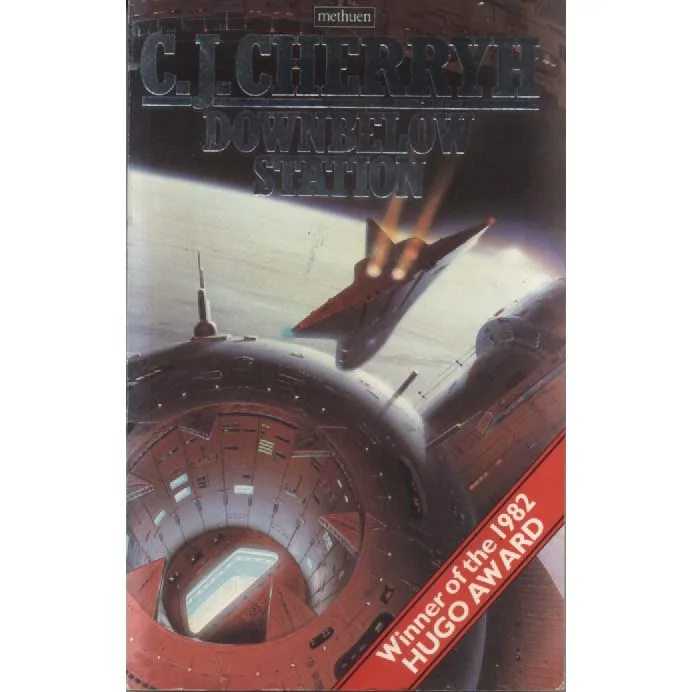
Publisher: Methuen
Format: Paperback
ISBN: 0413513106
Downbelow Station (1983) by C. J. Cherryh
Methuen — ISBN 0413513106
Condition: Good
Space, as Douglas Adams famously observed elsewhere, is rather large. C. J. Cherryh’s Downbelow Station adds another important observation: once humanity has filled some of it with colonies, corporations, military fleets, refugees and administrators, somebody is inevitably going to start an argument about who actually owns everything.
Welcome to Pell Station, an enormous orbital habitat circling the planet Pell — known rather dismissively as “Downbelow” — which has the considerable misfortune of being strategically important just as civilisation decides to have one of its periodic disagreements involving warships.
Humanity has expanded outward from Earth, establishing stations and colonies across interstellar space. Unfortunately, the further those colonies spread, the less enthusiastic some of them become about being managed from a planet which is now an extremely long commute away. The result is the Company Wars, a sprawling conflict between Earth’s interests, increasingly independent colonies and various military forces whose commanders have acquired the dangerous habit of making their own decisions.
Pell Station finds itself caught squarely in the middle.
This would already be inconvenient enough, but thousands of refugees are arriving from stations destroyed or abandoned during the fighting. Pell’s administrators must somehow feed them, house them and prevent the station descending into chaos while military forces manoeuvre outside and political factions manoeuvre inside. Anyone who has ever attended a committee meeting concerning the allocation of three parking spaces will appreciate that managing tens of thousands of frightened refugees aboard an orbital station may present certain administrative difficulties.
At the centre of events are the Konstantins, the family responsible for Pell Station, who are attempting to preserve both the station and something vaguely resembling civilisation while practically everyone around them develops alternative plans. Political intrigue, military strategy, personal ambition and sheer survival become increasingly tangled as Pell transforms from an outpost into one of the most important pieces on humanity’s interstellar chessboard.
And then there is Downbelow itself.
Pell’s planet is inhabited by the Hisa, an indigenous intelligent species generally called Downers by the humans, because apparently travelling across light-years does not necessarily improve our talent for imaginative naming. The Hisa are gentle, communal and profoundly different from humanity, providing a striking counterpoint to the increasingly complicated political machinery operating above their world. While the humans construct alliances, betray one another and move fleets around, the Downers have the considerable disadvantage of living on the planet everyone else has suddenly decided is strategically useful.
Cherryh’s universe is particularly convincing because it feels used. Ships require fuel. Stations need supplies. Refugees require somewhere to sleep. Governments need resources. Soldiers need orders. Somebody somewhere presumably has to complete a form explaining why an entire orbital colony has unexpectedly disappeared. Interstellar civilisation isn’t presented as a sparkling collection of futuristic wonders so much as an enormous logistical problem which humanity has somehow managed to make political.
This is not space opera in which a heroic captain fires one torpedo into the conveniently labelled weak point of the enemy flagship and everybody goes home for medals. Loyalties shift. Decisions have consequences. Good people make dreadful choices, dreadful people occasionally make sensible ones, and institutions behave very much like institutions despite having been transported several light-years from Earth.
Published originally in 1981, Downbelow Station won the Hugo Award for Best Novel and became one of the central books in Cherryh’s vast Alliance–Union universe. Despite belonging to that much larger future history, it stands perfectly well on its own. You do not need to arrive equipped with seventeen previous novels, three maps and a handwritten genealogy of minor characters. Cherryh simply drops you into a civilisation already in motion and expects you to pay attention — which is considerably more satisfying.
This 1983 Methuen edition is offered in Good condition. In other words, it has experienced some evidence of previous human occupation but has avoided the sort of catastrophic structural, military and political difficulties currently affecting Pell Station. Crappy Old Books therefore considers it entirely safe to approach without an escorting fleet.
Ideal for readers who like intelligent, politically complicated science fiction; enormous space stations; morally ambiguous characters; interstellar economics; military manoeuvring; alien cultures; and the reassuring discovery that even after humanity conquers faster-than-light travel, we will still be arguing about resources, jurisdiction and whose responsibility all these unexpected people are.
Crappy Old Books verdict: Humanity reaches the stars and discovers limitless new horizons, extraordinary alien worlds and the opportunity to recreate politics on a vastly larger scale. Pell Station would very much like everyone to stop shooting at each other and fill in the appropriate paperwork.
Keep browsing: See more Science-Fiction books Other books by CJ Cherryh
