


Origin
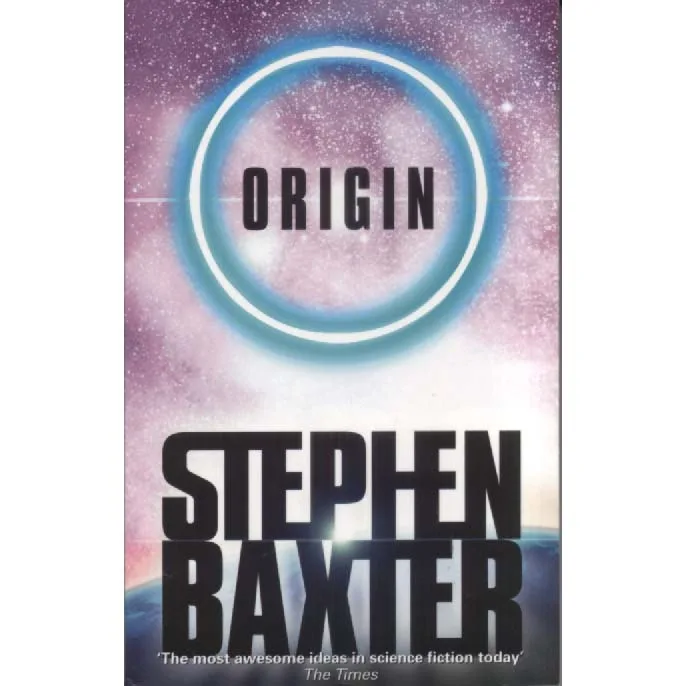
Publisher: HarperCollins
Format: Paperback
ISBN: 9780006511847
There are science fiction novels that quietly ask, "What if?" and then there are novels like Origin, which clear their throat, point at the entire history of the universe, and ask, "Yes, but what happens after all that?" Stephen Baxter has never been especially interested in thinking small. While many authors are content to save a city, a planet or, on a particularly ambitious afternoon, a galaxy, Baxter seems to regard the lifespan of the cosmos itself as a reasonable starting point for a story. Origin is what happens when someone looks at billions of years of cosmic history and decides there is still plenty left to write about.
Published in 2002, Origin continues Baxter’s grand exploration of humanity’s distant future, where civilisation has long since escaped the familiar concerns of mortgages, traffic jams and remembering where the television remote has gone. Instead, the questions become rather larger. What is humanity’s ultimate purpose? Is intelligence a cosmic accident or part of something far greater? Can the universe itself possess a destiny? These are not questions likely to arise while standing in the supermarket queue, but Baxter tackles them with the sort of confidence that suggests he has already done the maths on the back of an envelope.
Despite the intimidating scale, one of Baxter’s great talents is making the impossible feel strangely plausible. He fills the pages with speculative science, staggering engineering, alien mysteries and ideas so enormous they require the reader to occasionally stop, stare out of the window and remind themselves that the kettle still needs switching off. His future is not built on magic disguised as technology but on extrapolation—sometimes optimistic, sometimes unsettling, but always intellectually adventurous.
Naturally, this is not the sort of novel where somebody spends three hundred pages wondering whether they should text their ex. The drama here unfolds across incomprehensible distances and unimaginable timescales. Civilisations rise, transform and disappear while the universe itself carries on with admirable indifference. It is a refreshing reminder that, in cosmic terms, forgetting your password probably isn’t quite the catastrophe it feels like.
There is also a pleasing irony running through Baxter’s work. Human beings, who struggle to agree on where to have lunch, are imagined confronting the deepest questions of existence itself. We may never successfully organise a committee meeting without unnecessary emails, yet somehow Baxter convinces us that one day our descendants will wrestle with the ultimate architecture of reality. Optimism comes in many forms.
Readers who enjoy hard science fiction will find plenty to admire here. Baxter rarely underestimates his audience, trusting them to keep up with concepts that other writers might quietly remove for fear of frightening the horses. Yet beneath the physics, cosmology and speculative engineering lies a very human curiosity: the desire to know where we came from, where we are going, and whether the story has an ending at all.
This copy is in As New condition, presenting beautifully with only the faintest suggestion that anyone before you resisted the temptation to immediately contemplate eternity. The pages are clean, crisp and thoroughly readable, ready to accompany another traveller on a journey that stretches from humanity’s distant future to the very limits of imagination.
As sold by Crappy Old Books, where even books about the birth, evolution and possible fate of the universe still have to fit into an ordinary cardboard box and survive Royal Mail. It is strangely comforting that no matter how vast the cosmos becomes, someone still has to remember to stick the address label on the front.
Keep browsing: See more Science-Fiction books Other books by Stephen Baxter
