


Hawksmoor
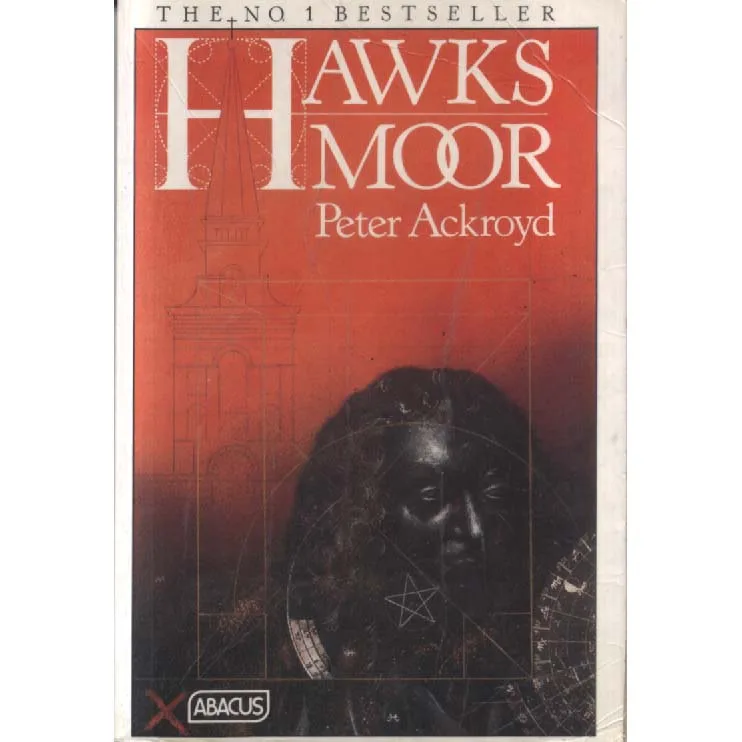
Publisher: Abacus
Format: Paperback
ISBN: 9780349100579
There are novels that take you gently by the hand and lead you through a neatly signposted plot. Hawksmoor by Peter Ackroyd does quite the opposite. It smiles politely, ushers you into the shadowy streets of London, extinguishes the lamps, mutters something unsettling about churches, murder and history, and then quietly disappears into the fog while you’re left wondering whether the city itself has been watching you all along.
Winner of the Whitbread Novel Award, Hawksmoor is one of the defining works of modern British literary fiction, weaving together two narratives separated by nearly three centuries. One follows the architect Nicholas Dyer, a man charged with building a series of London churches in the early eighteenth century. The other follows Detective Nicholas Hawksmoor as he investigates a sequence of mysterious murders occurring around those very same churches in the present day. As the stories begin to echo one another across time, the boundaries between history, superstition, architecture and the supernatural become delightfully—and deliberately—uncertain.
Peter Ackroyd has always possessed an extraordinary gift for making London itself the principal character. Streets remember. Buildings whisper. Stones appear to retain memories long after their builders have become dust. Reading Hawksmoor is rather like wandering through the capital at dawn before everyone else has woken, convinced that every alley conceals another secret and every church tower knows considerably more than it is prepared to admit.
Naturally, there is a magnificent irony at the heart of the novel. Churches are built to provide places of worship, comfort and salvation. Ackroyd cheerfully transforms them into ominous landmarks around which centuries of mystery quietly accumulate. One begins to suspect that if estate agents described London properties with complete honesty, "adjacent to an eighteenth-century church of profound architectural significance and possible occult implications" might not increase the asking price quite as much as hoped.
The novel is richly atmospheric, beautifully written and unapologetically demanding. This is not a thriller that rushes breathlessly towards neat explanations. Instead, Ackroyd invites readers to lose themselves in language, symbolism and the peculiar geography of London itself. The eighteenth-century sections are written in an authentic period voice, adding depth and texture while reminding us that the past really is another country—one where spelling, grammar and morality occasionally appear to have taken rather different routes.
What makes Hawksmoor so enduring is its refusal to answer every question. Is history repeating itself? Are the connections supernatural, psychological or merely coincidental? Is London simply a city, or something older and stranger disguised beneath brick, soot and commuter traffic? Ackroyd wisely leaves readers to wrestle with such matters themselves, proving that uncertainty can sometimes be far more unsettling than certainty.
This Fair condition Ex-Library copy, offered by Crappy Old Books, bears the expected signs of its previous working life. Library stamps, markings and general wear are all part of its history, but the text remains complete and entirely readable. In many ways, it feels strangely appropriate that a novel so preoccupied with the layers of history should itself arrive with evidence of many previous readers. After all, books—like old churches and old cities—often become more interesting for the lives they have already lived.
Keep browsing: See more Fiction books Other books by Peter Ackroyd
