


The World Of Venice
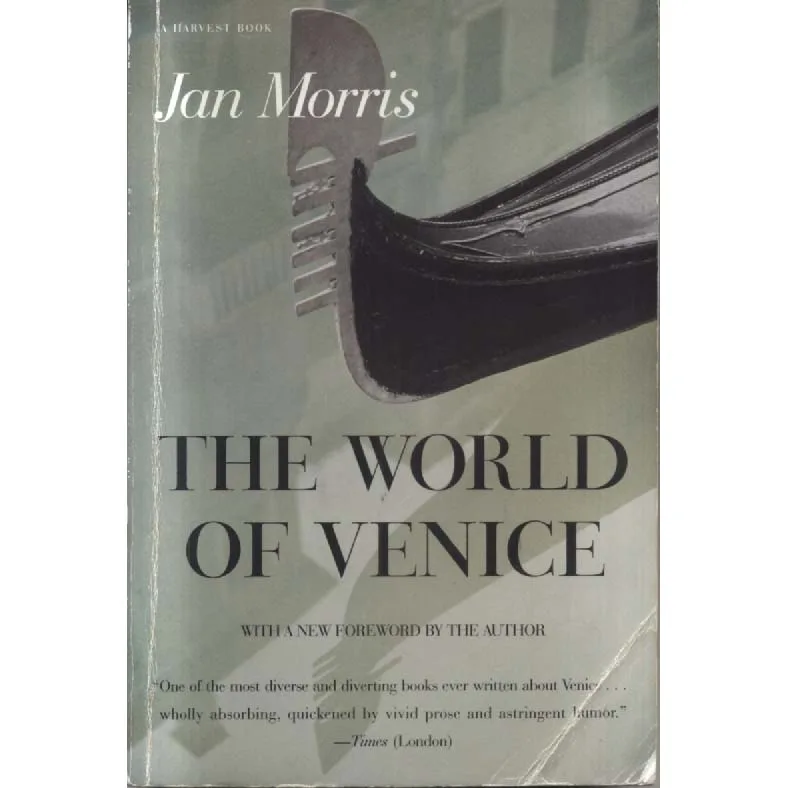
Publisher: Harcourt Brace
Format: Paperback
ISBN: 9780156983563
There are travel guides that tell you where to eat, where to stay and which queue to join first. Then there is The World of Venice by Jan Morris, a book that quietly ignores such practicalities in favour of explaining why one of the world’s most improbable cities has spent centuries convincing visitors that reality is overrated. Venice, after all, is a place that decided building on dry land was simply too conventional and instead opted to construct a glorious maritime masterpiece balanced delicately upon millions of wooden piles. Against all sensible engineering advice, it has remained there ever since, stubbornly refusing to sink just to prove a point.
Jan Morris was one of Britain’s finest travel writers, and this is far more than a guidebook. It is part history, part memoir, part cultural portrait and part love letter to a city that has inspired merchants, artists, composers, politicians, romantics and slightly bewildered tourists attempting to find Piazza San Marco without consulting a map. Morris understands that Venice is best appreciated not as a collection of famous landmarks but as a living, breathing organism where every alley promises another tiny square, another canal and another opportunity to become gloriously lost.
That, perhaps, is the city’s greatest trick. Modern life insists that we know exactly where we are at all times. Venice cheerfully disagrees. It offers hundreds of twisting lanes, countless bridges and street signs that occasionally appear to have been placed more for decoration than navigation. Getting lost is not a failure in Venice—it is practically part of the admission price.
The book explores every aspect of the city: its astonishing history as a maritime republic, its architecture, politics, commerce, traditions, churches, art, music and extraordinary ability to exist simultaneously as a world-famous tourist destination and an intensely personal place. Morris has the rare gift of making centuries of history feel conversational rather than academic, allowing readers to wander effortlessly from Byzantine splendour to Renaissance intrigue with the ease of someone crossing yet another canal.
Naturally, there is no shortage of irony. Venice became fabulously wealthy through international trade, banking and naval power, yet today many visitors appear determined to experience it almost entirely by photographing themselves standing in front of pigeons. The Doges built an empire stretching across the Mediterranean; modern tourists celebrate finding a café where the coffee costs slightly less than the national debt of a medium-sized country. Progress, it seems, has a curious sense of humour.
What makes this book endure is Morris’s affection for imperfection. Venice is magnificent precisely because it refuses to behave like a modern city. It floods occasionally, the streets make little logical sense, the buildings lean in unexpected directions and every journey takes slightly longer than anticipated. Yet these quirks become virtues, reminding us that beauty often flourishes where efficiency quietly gives up trying.
This Good condition copy, offered by Crappy Old Books, remains clean, sound and perfectly readable, with only the gentle signs of a previous life that one might reasonably expect from a well-travelled volume. Whether you are planning a visit, reminiscing about one, or simply enjoy travel writing at its finest, The World of Venice offers a rich and thoughtful portrait of one of civilisation’s greatest achievements. And unlike Venice itself, you can enjoy it without paying for an espresso that costs more than the book.
Keep browsing: See more Travel books Other books by Jan Morris
