


The Stars Like Dust
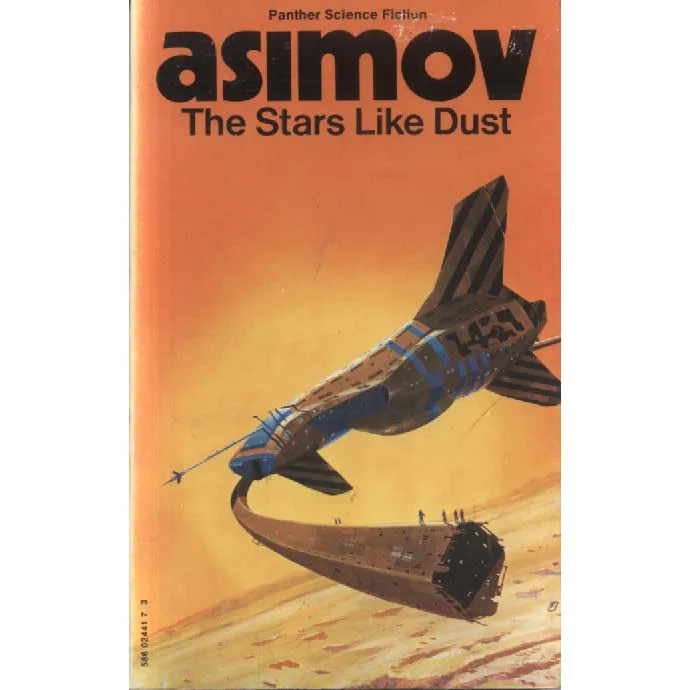
Publisher: Panther
Format: Paperback
ISBN: 0586024417
There are science fiction novels that begin with explosions, alien invasions or spaceships the size of continents. Isaac Asimov, being Isaac Asimov, begins with an idea. Then another. Then another. Before you know it, you’re caught in a sweeping tale of rebellion, political intrigue and galactic mystery, wondering how someone managed to make philosophy, revolution and starships feel like the most natural combination in the universe. The Stars, Like Dust is classic Golden Age science fiction—big in scope, rich in imagination and gloriously unconcerned with taking the easy route.
The story follows Biron Farrill, a young man whose comfortable life is abruptly shattered when he becomes caught in a conspiracy stretching across the Galaxy. Fleeing powerful enemies and searching for answers, he finds himself drawn into a secret resistance against a ruthless tyranny. Along the way come mysterious allies, dangerous enemies, ancient legends and the nagging suspicion that history may have left behind one rather important clue that everyone else has overlooked.
The irony is wonderfully familiar. Humanity has colonised countless worlds, spread civilisation across the stars and built a Galactic Empire beyond imagination... yet politics remains exactly what it has always been: people disagreeing passionately while convinced they alone possess the correct answer. Apparently, no amount of technological progress can prevent meetings from becoming unnecessarily complicated.
Unlike many modern space operas that rely on relentless action, Asimov places enormous faith in the power of ideas. Characters solve problems by thinking, questioning assumptions and following evidence rather than simply firing larger lasers. There are thrilling moments aplenty, but the greatest excitement often comes when another piece of the puzzle quietly clicks into place and the reader suddenly realises the story has been heading somewhere far more ambitious all along.
There is an effortless elegance to Asimov’s storytelling. His prose is clean, direct and wonderfully economical, allowing the imagination to do much of the heavy lifting. Instead of drowning readers in pages of technical detail, he sketches vast civilisations with remarkable efficiency, leaving you convinced that entire worlds continue living just beyond the edge of every chapter.
Published long before sprawling cinematic universes became fashionable, The Stars, Like Dust reminds us why Asimov became one of the architects of modern science fiction. His vision of the future is optimistic without being naïve, adventurous without abandoning intelligence, and filled with the quiet confidence that knowledge, curiosity and reason remain humanity’s greatest strengths. It’s the sort of novel that trusts readers to enjoy a good mystery as much as a good chase.
There is also something delightfully timeless about the central premise. Every generation believes it has finally understood history, only to discover that the past has been quietly keeping a few surprises in reserve. Asimov gently suggests that civilisations, like people, have an unfortunate tendency to forget the lessons they most desperately need to remember. The stars may endure for billions of years; human memory is considerably less reliable.
This 1973 Panther edition is itself a charming relic of science fiction’s golden paperback era, when wonderfully dramatic cover art promised impossible adventures from spinner racks and railway bookstalls. It’s the sort of edition that looks perfectly at home beside Clarke, Heinlein and Herbert—a reminder of the period when a paperback could transport you to the far side of the Galaxy for the price of a modest lunch.
This Good condition copy, offered by Crappy Old Books, has clearly travelled a respectable distance through previous readers’ hands but remains ready for another voyage across the stars. It bears the honest signs of a well-loved classic while retaining plenty of life in its pages. No ancient Galactic maps are tucked inside, no forgotten constitutions have been hidden between the chapters, and thankfully the only rebellion you’ll be leading is against the sensible idea of going to bed before finishing "just one more chapter."
Keep browsing: See more Science-Fiction books Other books by Isaac Asimov
