


Dune
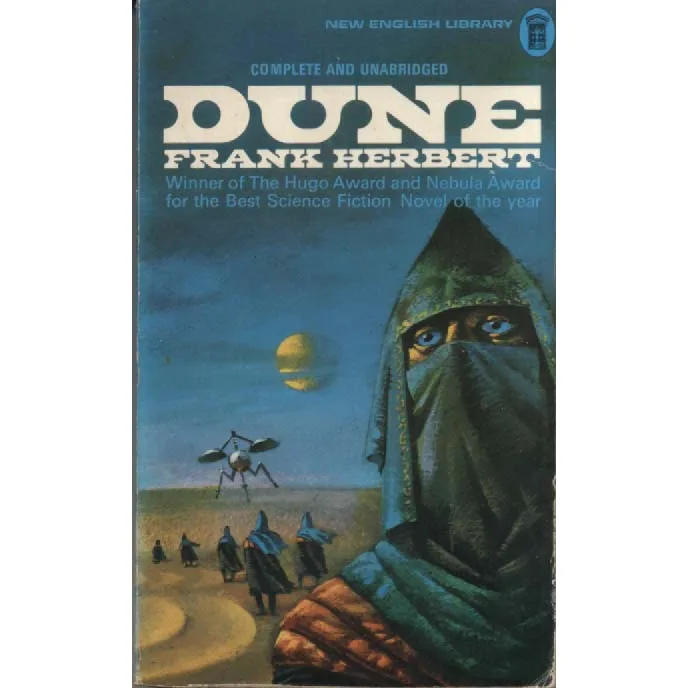
Publisher: New English Library
Format: Paperback
ISBN: 0450027279
There are science fiction novels, there are epic science fiction novels, and then there is Dune—the book that looked at the genre, politely nodded, and proceeded to terraform it into something altogether grander. Frank Herbert didn’t simply create a story; he created an entire civilisation complete with religions, politics, economics, ecology, philosophy and enough unfamiliar terminology to make the first fifty pages feel like you’ve accidentally wandered into an interstellar university lecture. Stick with it. Everyone else did, and there’s a reason.
Set on the harsh desert world of Arrakis, the story follows young Paul Atreides, heir to a noble House that has inherited stewardship of the only planet capable of producing the most valuable substance in the known universe: the spice melange. Unfortunately, everybody else wants it too. What begins as a tale of political betrayal steadily unfolds into something vastly larger, blending dynastic intrigue, messianic prophecy, survival, revolution and giant sandworms that have somehow become among the most beloved creatures in science fiction despite having all the charm of an underground freight train with teeth.
The irony is exquisite. Humanity has spread across the stars, mastered interstellar travel and built an empire spanning countless worlds, yet the fate of civilisation rests upon a barren desert where water is more valuable than gold and stepping carelessly on the sand is considered an excellent way of becoming someone else’s lunch. Progress, it seems, is wonderfully overrated.
Herbert’s greatest trick is making Arrakis itself the central character. The endless dunes, blistering heat, hidden ecology and fiercely independent Fremen people combine to create a setting so convincing that readers often emerge feeling slightly dehydrated. Long before environmentalism became fashionable in fiction, Dune explored how landscapes shape cultures, how scarce resources dictate politics, and how every action has consequences stretching far beyond the immediate horizon.
Of course, this isn’t simply an adventure about good triumphing over evil. Herbert delights in muddying the waters. Heroes make questionable choices, villains occasionally possess understandable motives, and prophecies have an awkward habit of becoming dangerous precisely because people believe them. The novel repeatedly asks whether charismatic leaders are really as wonderful as history remembers them. It is a surprisingly uncomfortable question wrapped inside one of the greatest adventures ever written.
Then there are the sandworms. Lesser authors might have been content with dragons, sea monsters or the occasional hostile alien. Herbert instead presents colossal subterranean creatures hundreds of metres long that can detect rhythmic footsteps across the desert and erupt from beneath the sands with astonishing enthusiasm. Somehow, readers universally conclude that these terrifying monsters are absolutely magnificent and secretly wish they could ride one. Human beings are wonderfully predictable.
Published decades before sprawling fictional universes became fashionable, Dune demonstrated just how intelligent, philosophical and ambitious science fiction could be. It has influenced countless writers, filmmakers and game designers, yet remarkably it still feels unlike anything else. Every return visit to Arrakis reveals another layer of symbolism, political commentary or ecological insight hidden beneath the shifting sands.
This 1975 New English Library edition is itself something of a classic, representing an era when science fiction paperbacks featured wonderfully evocative artwork and promised readers journeys to worlds unlike any they had previously imagined. It’s a lovely reminder that before streaming services and billion-dollar film adaptations, readers discovered Arrakis one well-thumbed paperback at a time.
This Good condition copy, offered by Crappy Old Books, has clearly survived its own passage through the desert. It shows honest signs of being read, which is exactly what a copy of Dune ought to do. The pages remain ready to transport another traveller to Arrakis, where the spice must flow, the worms remain unimpressed by your travel insurance, and you’ll never look at a handful of sand in quite the same way again.
Keep browsing: See more Science-Fiction books Other books by Frank Herbert
