


The Man Behind The Rosenbergs
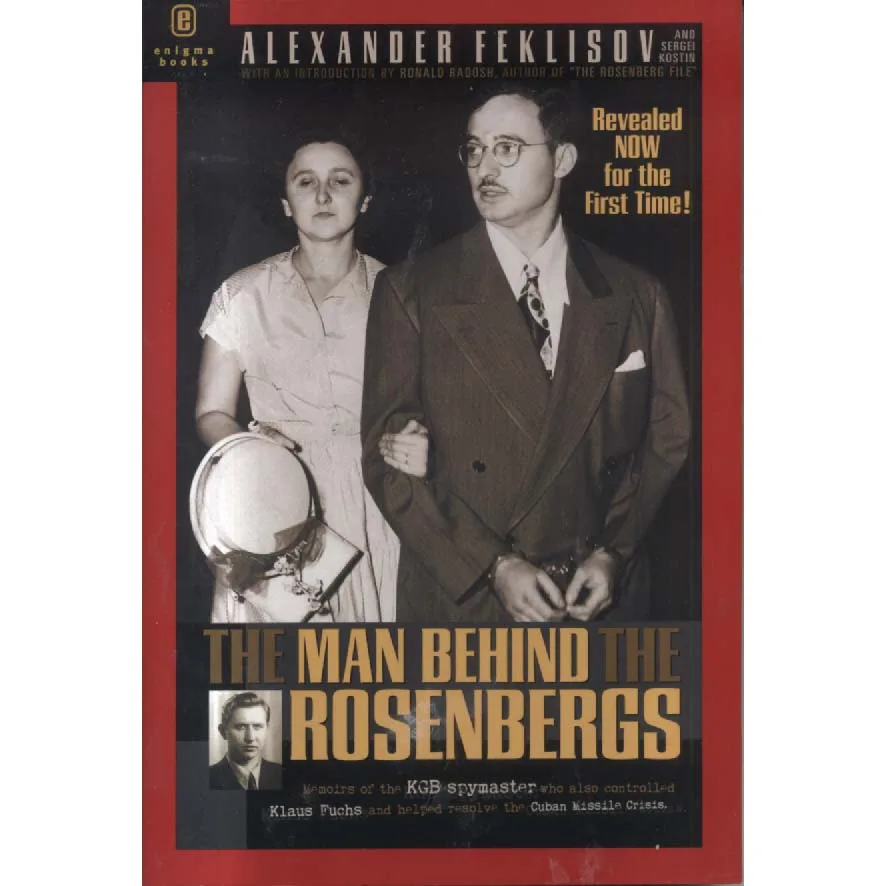
Publisher: Enigma Books
Format: Paperback
ISBN: 9781929631247
The Cold War produced many celebrated spies, several spectacular traitors and an almost limitless supply of men in raincoats standing beside park benches for reasons they were unwilling to explain. Alexander Feklisov was one of the people who knew what was actually going on—and, rather inconveniently for everyone concerned, eventually decided to write about it.
In The Man Behind the Rosenbergs, Feklisov recounts his career as a Soviet intelligence officer in the United States, where he served as the KGB case officer connected with Julius Rosenberg and other members of the Soviet espionage network. Rosenberg, an American electrical engineer and committed communist, helped obtain military and industrial information for the Soviet Union, becoming part of a story that would culminate in one of the most controversial espionage trials of the twentieth century. Julius and Ethel Rosenberg were convicted of conspiracy to commit espionage and executed in 1953, leaving behind decades of argument over guilt, evidence, punishment and exactly how much each participant had known.
Feklisov offers the perspective of someone operating from the other side of the supposedly impenetrable Iron Curtain. He describes clandestine meetings, coded messages, secret documents and the delicate business of recruiting people who believed they were assisting history rather than merely supplying confidential material to a foreign intelligence service. The account places Julius Rosenberg within a wider network of ideological sympathisers and professional agents, revealing espionage as an occupation combining international danger with an extraordinary amount of administration.
The book also explores Feklisov’s dealings with other important Soviet sources, including atomic spy Klaus Fuchs, whose transfer of nuclear information helped Moscow understand what the Americans had constructed at enormous expense behind barbed wire in New Mexico. For the Soviet Union, this was intelligence work of historic value. For the United States, it was the unsettling discovery that even the world’s most secret weapons programme apparently had the informational security of a parish newsletter.
Yet this is not simply another retelling of the Rosenberg case. Feklisov went on to play a fascinating role during the Cuban Missile Crisis of 1962, when nuclear war came sufficiently close for everyone involved to discover an urgent enthusiasm for informal communication. Serving in Washington under the name Alexander Fomin, he became part of the unofficial channel through which possible terms for ending the confrontation were explored. Humanity survived, although it remains slightly alarming to learn how much depended upon hurried conversations, personal judgement and officials communicating outside the usual machinery of government.
Written from Feklisov’s own recollections and inevitably reflecting his loyalties, interpretations and desire to correct the historical record, this memoir provides a rare first-hand view of Soviet intelligence operations in America. Readers are invited to consider the gap between popular espionage—with its ingenious gadgets, glamorous agents and expensive motorcars—and the real thing, which seems largely to have involved nervous meetings, ideological disputes and trying not to be noticed while carrying documents one was emphatically not supposed to possess.
This is compelling reading for students of the Rosenberg affair, Soviet espionage, atomic intelligence and Cold War history. It will also appeal to anyone who enjoys true stories in which nearly every character has an alias, every innocent-looking envelope contains something disastrous and the most important person in the room is often the one pretending not to know anybody.
This Enigma Books edition is in Good condition. A substantial memoir from the Soviet intelligence officer behind one of America’s most notorious espionage cases—and a useful reminder that when governments assure the public everything is entirely under control, several spies may already be discussing it over lunch.
Keep browsing: See more Non-Fiction books Other books by Alexander Feklisov
