


Eileen Gray
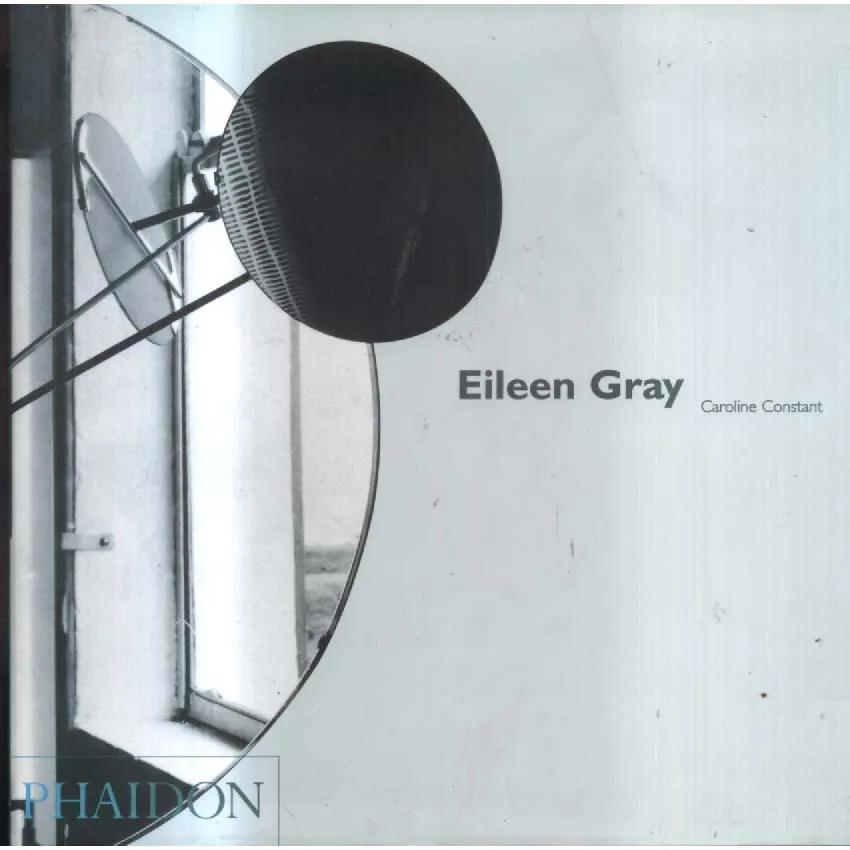
Publisher: Phaidon
Format: Hardback
ISBN: 9780714839059
Eileen Gray is a substantial, beautifully illustrated study of the Irish designer and architect who helped invent modernism, produced some of its most elegant furniture, designed one of its most celebrated houses—and was then conveniently misplaced by architectural history while various men stood in front of her work looking important.
Caroline Constant follows Gray’s career from her early experiments with lacquer and luxurious interiors to the tubular steel furniture and rigorously considered buildings for which she is now famous. This was not simply a matter of removing all decoration, painting everything white and declaring war on cushions. Gray combined modern materials with comfort, flexibility and a distinctly human understanding of how people actually inhabit rooms. Her furniture could fold, swivel, adjust and perform several jobs, making it considerably more adaptable than many of the architects discussing it.
Among her best-known creations are the voluptuous Bibendum chair, the elegant Transat chair and the adjustable E-1027 table—a piece of glass and chrome so apparently simple that generations of lesser designers have been staring at it ever since, wondering why they did not think of it first. Gray’s work moved confidently between Art Deco luxury and modernist restraint, proving that a chair could be practical, intellectually respectable and still look as though somebody might genuinely enjoy sitting in it.
At the centre of the book is E-1027, the seaside villa Gray designed at Roquebrune-Cap-Martin for herself and Jean Badovici. Every element was considered around movement, privacy, light and daily life, right down to its ingenious built-in fittings and adaptable furniture. Even the cryptic name joined their initials together, which was romantic at the time and presumably rather less charming after the relationship ended.
Le Corbusier later painted large murals directly onto E-1027’s walls without Gray’s permission, an intervention sometimes described as artistic homage and sometimes, more persuasively, as what happens when a famous man discovers that somebody else has designed a better house. For years the building was associated more readily with Badovici and Le Corbusier than with the woman who had actually conceived it, because architectural history has traditionally been very efficient at finding room for another heroic gentleman while temporarily losing the plans bearing a woman’s handwriting.
Constant restores Gray to the centre of her own career. She examines not only E-1027 but also Gray’s second house, Tempe à Pailla, her interiors, rugs, screens, furniture and architectural proposals. Detailed analysis and generous illustrations reveal an approach that was modern without being doctrinaire: Gray believed homes should serve their inhabitants, rather than forcing inhabitants to behave like obedient accessories in an architect’s enormous white sculpture.
Published by Phaidon in 2000, this 256-page monograph was the first extensive study to consider the full range of Gray’s work. It is both an architectural history and a long-overdue correction to the record, demonstrating that Gray was not merely an eccentric decorator who wandered briefly into the Modern Movement, but one of its most original and independent figures. Her reputation arrived late, but her furniture now commands extraordinary prices, proving that posterity will eventually apologise provided there is enough money in the auction room.
An excellent book for admirers of modern architecture, twentieth-century design, Art Deco, interiors and women whose careers were overshadowed by men with louder manifestos. It is also suitable for anyone who has looked at an adjustable side table and thought, quite reasonably, that its history might involve fewer arguments, affairs and territorial disputes.
This copy is in Good condition, showing some normal signs of previous ownership but remaining an attractive and highly informative design volume. It may not include an original Eileen Gray chair, unfortunately, although this has been reflected in the price. Sold by Crappy Old Books, where important works of modernism are stored in an environment Gray herself would almost certainly have redesigned.
Keep browsing: See more Architecture books Other books by Caroline Constant
