


Kirkeskuden
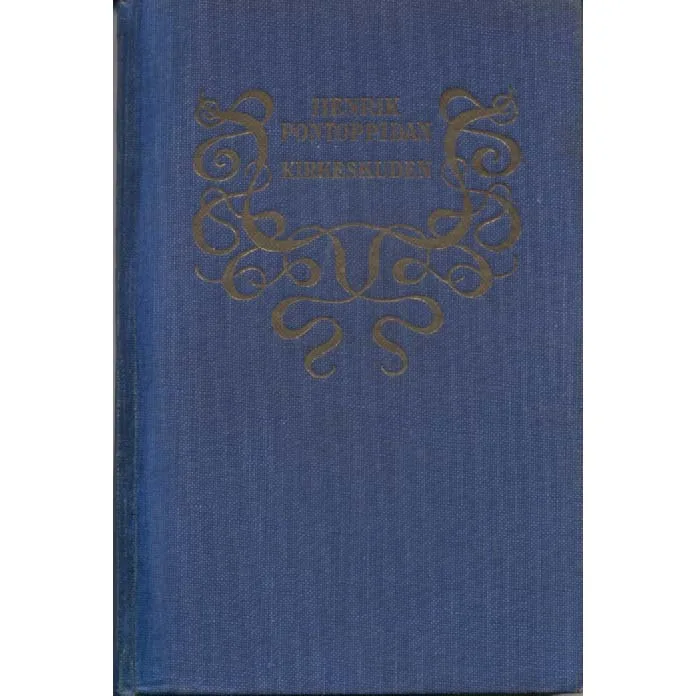
Publisher: Gutenberg Forlag
Format: Hardback
ISBN: none
Kirkeskuden is what happens when a future Nobel Prize winner looks at a respectable Danish village, notices that the schoolmaster is cunning, the pastor is useless, the parishioners are greedy and the most morally convincing person available has killed a man with a large stone.
That woman is Ane, an impoverished outsider who murders the sailor who raped her and is sent to prison for nine years. Her young son Ove is left behind, whereupon the parish authorities confront the tragedy with their customary mixture of Christian concern and accountancy. Somebody must look after the boy, but preferably somebody whose expenses do not appear in the municipal ledger. After a little sanctified manoeuvring, Ove is installed at the rectory, enabling the parish to save money and Pastor Østrup to experience the agreeable sensation of having performed a good deed.
The pastor’s wife comes to love Ove deeply. The pastor himself is less impressed. He prefers Christianity in its tidier form: sermons, catechisms, improving books and children who sit still while being grateful. Ove, unfortunately, is alive. He grows bored, rebellious and increasingly unimpressed by adults who preach compassion while behaving like members of a committee established to prevent it.
Suspended in the village church is a model sailing ship—the kirkeskude of the title—representing faith, voyage and perhaps mankind tossed upon the uncertain waters of existence. Ove steals it and launches it on actual water, where it promptly sinks. This is either a profound symbolic rejection of the church’s hollow spirituality or proof that ecclesiastical model-makers should not be asked to meet maritime safety standards.
For this and other failures to become conveniently obedient, Ove is eventually sent to sea himself. The result is a dark, winding tale of punishment, disappearance, remorse and return, populated by adults who repeatedly insist that everything is being done for the boy’s own good. As so often in literature, “for your own good” means that somebody older has made a dreadful decision and would now like the victim to improve his attitude.
Pontoppidan fills the village with schemers, hypocrites, sentimental fools and hard practical people who can calculate the cost of keeping a child but not the damage done by neglecting him. Nobody is wholly simple, nobody remains entirely innocent and religion is permitted to speak at considerable length while love quietly does the useful work. It is Danish realism with its sleeves rolled up: gloomy, humane, slyly funny and entirely unwilling to accept that respectability and goodness are the same thing merely because they attend church together.
Originally written in 1881 and later substantially revised, Kirkeskuden contains many of the themes Pontoppidan would return to throughout his career: the rebellious child, the suffocating rectory, the outsider crushed by village convention and the eternal contest between lofty ideals and people wondering who is going to pay for them. He went on to share the 1917 Nobel Prize in Literature, suggesting that persistent irreverence towards pastors, committees and rural moralists can eventually be recognised as an international cultural service.
This 1927 Gutenberg Forlag edition is in Good condition. The spine had split, but has been repaired and repainted with acrylic—an honest piece of restoration which has returned the book to service without claiming that 1927 has somehow happened again. The church ship may have sunk, but the book has been hauled from the water, patched up and made seaworthy. In Danish, naturally, so readers unable to manage the language may still place it on the shelf and look impressively Scandinavian.
Keep browsing: See more Danish books Other books by Henrik Pontoppidan
