


James I Of Scotland - The Kings Quair
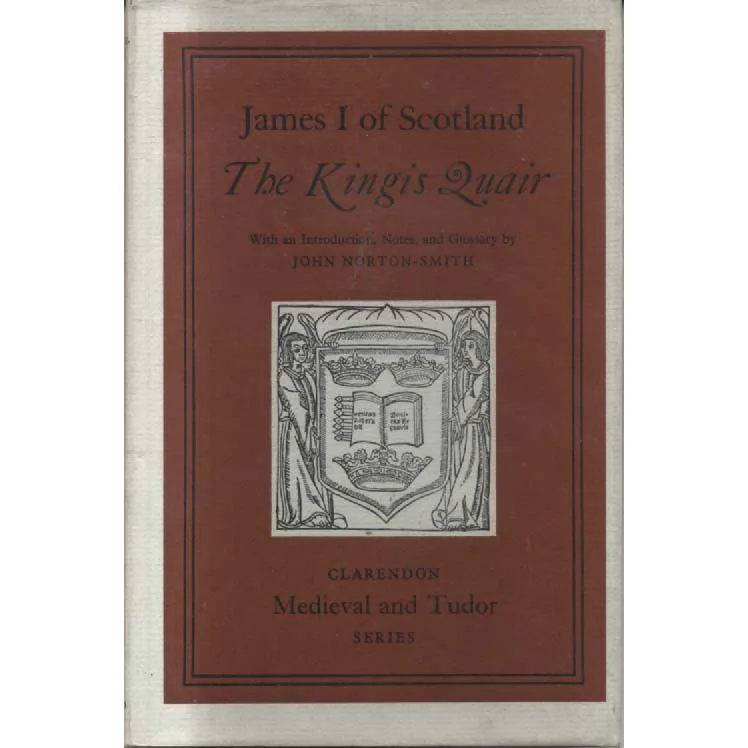
Publisher: The Clarendon Press
Format: Hardback
ISBN: none
The Kingis Quair—literally The King’s Book—is a fifteenth-century dream poem traditionally attributed to James I of Scotland, edited here with an introduction, notes and glossary by medieval scholar John Norton-Smith. It combines autobiography, romance, allegory and philosophy, because medieval poets rarely allowed a straightforward love story to proceed without first consulting several pagan deities and the complete works of Boethius.
James’s unusual courtship began in 1406, when he was sent towards France for safety and captured at sea by the English. Since he was the heir to the Scottish throne, his hosts recognised both his political importance and his potential value as a long-term involuntary guest. He remained in England for approximately eighteen years under Henry IV, Henry V and Henry VI, receiving an excellent education while being repeatedly reminded that accommodation expenses were accumulating.
The poem opens with its narrator awake at night, reading Boethius and contemplating Fortune, destiny and his own imprisonment. Looking from his window, he sees a beautiful woman walking in the garden below and immediately falls in love. The woman is generally identified as Lady Joan Beaufort, whom James eventually married in 1424. Thus an extended period of international detention produced one of medieval literature’s more successful instances of noticing someone from an upstairs window.
Naturally, the narrator cannot simply introduce himself. Instead he falls into a dream and is carried through a complex allegorical landscape, encountering Venus, Minerva and Fortune. Each offers instruction concerning love, virtue, reason and destiny, subjects which appear to require celestial administration before the young prisoner may proceed towards marriage. The medieval romantic imagination had little confidence in casual conversation.
Venus hears his complaint, Minerva teaches him that love must be governed by wisdom and Fortune reminds him that human happiness is subject to her notoriously unreliable wheel. The narrator learns that desire alone is insufficient: worthy love requires patience, moral discipline and the ability to survive several hundred lines of allegorical counselling. At last he wakes, receives an encouraging sign and commits himself to the beloved who may release him from both emotional and literal captivity.
Written in 197 rhyme-royal stanzas, The Kingis Quair shows the strong influence of Chaucer, whose combination of dream vision, courtly love and philosophical reflection provided James with both a literary model and an extremely demanding example to follow. The poem’s Middle Scots language can initially appear formidable, but its concerns remain familiar: loneliness, desire, uncertainty and the belief that one glimpse of the correct person may justify reorganising the entire universe.
The traditional attribution to James has been debated by scholars, since medieval manuscripts are not always considerate enough to include signed declarations from the author. Nevertheless, the close correspondence between the poem and the king’s captivity and marriage has sustained its reputation as one of the earliest substantial works of Scottish poetry associated with a named writer—and one of the very few royal autobiographies to include a guided tour by Venus.
John Norton-Smith’s edition provides the original text together with a substantial introduction, explanatory notes and a glossary. These are useful when the reader encounters unfamiliar Scots vocabulary, classical references or an allegorical figure whose professional responsibilities have not been made immediately clear. The result is a compact scholarly edition suited both to serious study and to readers curious about how a captive king turned political misfortune into courtly literature.
This 1971 Clarendon Press edition is in Good condition—a sound copy which has survived more than fifty years in considerably greater freedom than its royal author enjoyed in England. An appealing volume for students of medieval literature, Scottish history, Chaucerian poetry and romances in which the hero must overcome captivity, philosophy and the unstable Wheel of Fortune before being permitted to approach the woman in the garden.
Keep browsing: See more History books Other books by John Norton-Smith
