


The Pilgrims Progress And The Holy War
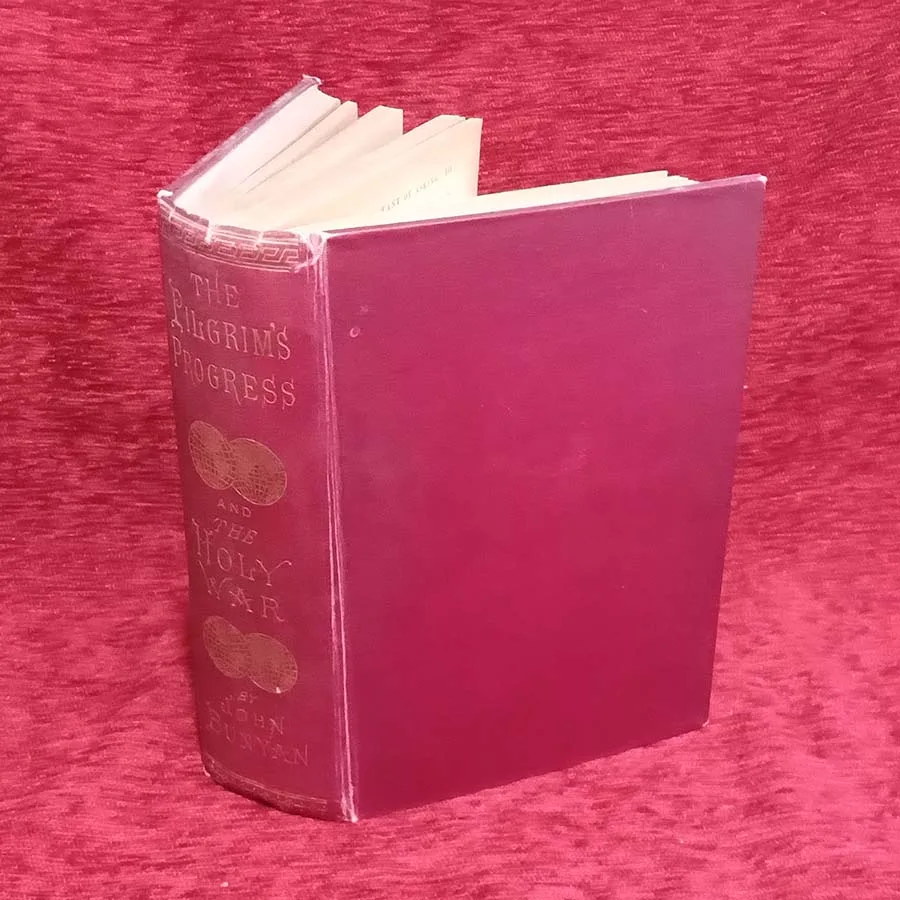
Publisher: Simpkin Marshall Hammilton Kent and Co
Format: Hardback
ISBN: none
John Bunyan’s The Pilgrim’s Progress and The Holy War together make a splendid old double-helping of Protestant allegory: two works in which the human soul is not allowed to sit quietly with a cup of tea, but must instead be marched through temptation, battle, danger, error, judgement, siege warfare, spiritual anxiety and a considerable number of capital-letter abstractions behaving as if they own property.
The Pilgrim’s Progress is Bunyan’s famous journey of Christian, who leaves the City of Destruction with a burden on his back and sets off toward the Celestial City, meeting on the way a population of moral hazards so clearly labelled they might as well be wearing sandwich boards. Obstinate, Pliable, Mr Worldly Wiseman, Faithful, Hopeful, Giant Despair, Vanity Fair — Bunyan does not hide his intentions under modern subtlety. If someone is called Talkative, one does not expect a silent minimalist.
The result is one of the great enduring classics of English religious literature: stern, vivid, strange, memorable and surprisingly dramatic. Christian’s road is full of traps, bad advice, false comfort, terrifying valleys, dodgy companions, hostile giants and fairs selling exactly the wrong things. It is basically the spiritual life rendered as a long hazardous walk through a country where every inn has theological consequences.
The Holy War then shifts the Bunyan machinery from journey to siege. The town of Mansoul becomes the battlefield, with Diabolus and Emmanuel contending over its gates, defences and loyalties. Here salvation is military architecture. The soul has walls, captains, rebels, treaties, alarms and internal treachery, because apparently the human condition was not already difficult enough without turning it into urban warfare. It is allegory in full armour, complete with spiritual strategy and moral bombardment.
There is a magnificent old irony in Bunyan’s directness. Modern books often spend four hundred pages hinting that someone may be spiritually dissatisfied. Bunyan simply names a place the Slough of Despond and throws the pilgrim in. No ambiguity, no workshop-polished restraint, no “liminal psychological space.” Just mud, burden, sin, redemption and a man trying very hard not to be eternally ruined.
This c.1900 Simpkin, Marshall, Hamilton, Kent & Co edition has the proper old devotional gravity: no ISBN, no modern fuss, just Bunyan doing battle with sin in the plain-speaking manner of a man who had absolutely no interest in making damnation sound tasteful. A good volume for collectors of religious classics, old bindings, English literature, Christian allegory, Victorian or Edwardian devotional books, or anyone whose shelf requires more giants, burdens, sieges and moral nouns.
Good copy, as sold by Crappy Old Books. A solid old survivor from around 1900, carrying two Bunyan classics in one volume and enough spiritual peril to make a modern self-help book look underemployed. Suitable for readers who enjoy their allegory direct, their temptation personified, and their roads extremely consequential.
Keep browsing: See more Literary Classics books Other books by John Bunyan
