


Air Power
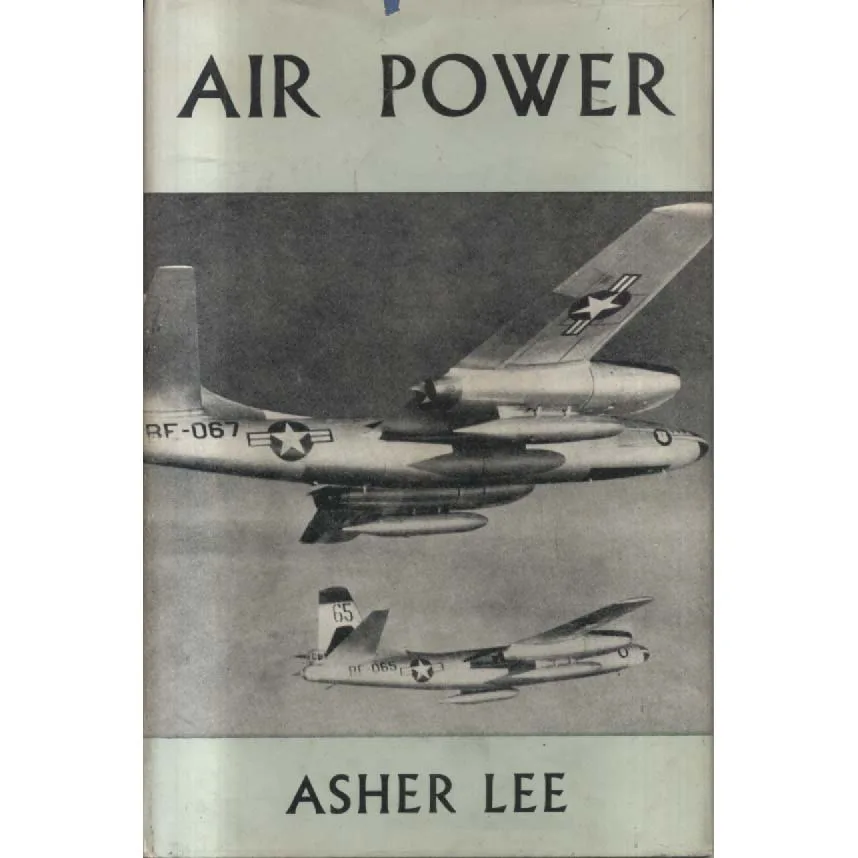
Publisher: Gerald Duckworth and Co
Format: Hardback
ISBN: none
This 1957 copy appears to be the second edition of a book first published in 1955.
By 1957, military aviation had advanced from canvas-covered machines firing pistols across the cockpit to jet bombers capable of delivering nuclear weapons across continents. This was impressive technical progress, although civilisation’s broader progress remained open to review. In Air Power, Wing Commander Asher Lee examines how aircraft transformed warfare and what their growing reach, speed and destructive capacity meant for the uneasy world of the 1950s.
Lee brought unusual authority to the subject. During and after the Second World War, he became a noted British expert on the German Air Force, studying its organisation, doctrine and failure with such intensity that he was reputed to know more about the Luftwaffe than some of the people running it. The standard was not necessarily as high as it sounds, but his knowledge was formidable.
The book surveys the development of military air power and the arguments surrounding its use. Aircraft began as reconnaissance tools, then acquired bombs, guns and increasingly confident supporters who predicted they would make armies and navies obsolete. Armies and navies responded by acquiring aircraft of their own and continuing to submit budget requests.
The First World War demonstrated the potential of aviation for reconnaissance, air combat and bombing, but it also encouraged theorists to imagine fleets striking directly at the enemy’s cities and industries. Air power appeared capable of leaping over trenches, fortifications and field armies to reach the centres of national life. Geography had not disappeared, but it had become increasingly nervous.
Between the wars, air-power advocates argued that bombing could break civilian morale and bring rapid victory. The bomber, they claimed, would always get through. This proposition was sufficiently alarming to encourage larger bomber forces, improved fighters, radar, anti-aircraft guns and civil-defence preparations—all of which complicated the original proposition without making anyone more relaxed.
The Second World War supplied the vast practical test. Air forces fought for control of the sky, supported armies and fleets, attacked transport and industry, defended cities and conducted strategic bombing on an unprecedented scale. Lee examines the lessons of these campaigns, including the uncomfortable distance between theoretical precision and the places where bombs actually landed.
The Battle of Britain demonstrated the value of fighters, radar, command systems and integrated air defence. The subsequent bombing offensives against Germany and Japan displayed both the immense power and the severe limitations of strategic air attack. Aircraft could devastate cities and industries, but predicting the political and military effect remained less exact than calculating the bomb load.
Air power at sea also changed the balance between aircraft and capital ships. Carriers extended aviation across oceans, while land-based aircraft threatened fleets previously accustomed to regarding the horizon as sufficient warning. Admirals discovered that armour designed to resist shells offered limited reassurance when the attack arrived from directly above.
Tactical aviation became indispensable to land warfare. Fighters and light bombers attacked troops, armour, communications and supplies, helping mobile armies advance and making movement in daylight increasingly hazardous. This required close cooperation between air and ground commanders, traditionally achievable after both had exhausted several alternatives and agreed upon terminology.
By the time of Lee’s second edition, the Korean War had further demonstrated the importance of air superiority, interdiction and close support in a limited conflict. Jet fighters met in combat, helicopters expanded their battlefield role and strategic bombers operated beneath the shadow of nuclear escalation. It was modern war conducted under rules designed chiefly to prevent it from becoming even more modern.
Nuclear weapons transformed every discussion. The atomic bomb appeared to make strategic air power decisive while simultaneously raising the possibility that a future great-power war would be too destructive to produce a meaningful victor. Air forces became central to deterrence: they existed to deliver weapons whose principal strategic purpose was never to be delivered. This was presented as stability and, compared with the available alternatives, perhaps was.
Long-range bombers stood at the centre of early Cold War nuclear strategy. Their range, readiness and ability to penetrate enemy defences were matters of national survival. Yet fighters, radar networks and surface-to-air weapons continually improved, ensuring that every expensive offensive system generated an equally expensive defensive response.
Guided missiles were also beginning to challenge the manned aircraft. Ballistic missiles promised extraordinary speed and range without requiring a crew to fly home, which military planners regarded as technically efficient if emotionally stark. The aeroplane had barely established its supremacy before the rocket appeared and began measuring the office furniture.
Lee considers air power as more than a collection of impressive machines. Aircraft require bases, fuel, maintenance, trained crews, communications, intelligence and industrial support. A sleek jet photographed against the sky is the visible tip of an organisation involving thousands of people, most of whom spend their working lives ensuring that it does not remain photographed on the ground.
The book is especially fascinating as a document of its moment. Written before intercontinental ballistic missiles, reconnaissance satellites and computerised warfare fully matured, it captures strategic thinking at the point where lessons from the Second World War met the emerging realities of the nuclear age. Some conclusions have dated; the anxieties have proved remarkably durable.
This will appeal to readers interested in RAF history, strategic bombing, Cold War defence and the development of air-power doctrine. It offers a contemporary rather than retrospective view, written when supersonic flight, nuclear bombers and guided missiles belonged not to history but to tomorrow morning’s newspaper.
This copy is in Good condition, showing ordinary signs of age and previous ownership but remaining ready for another operational assessment. Offered by Crappy Old Books, it is a thoughtful period study of military aviation at the dawn of the jet and nuclear age—when aircraft had finally conquered distance and governments immediately began searching for more distant things to worry about.
Keep browsing: See more War books Other books by Asher Lee
