


The Essential Turing
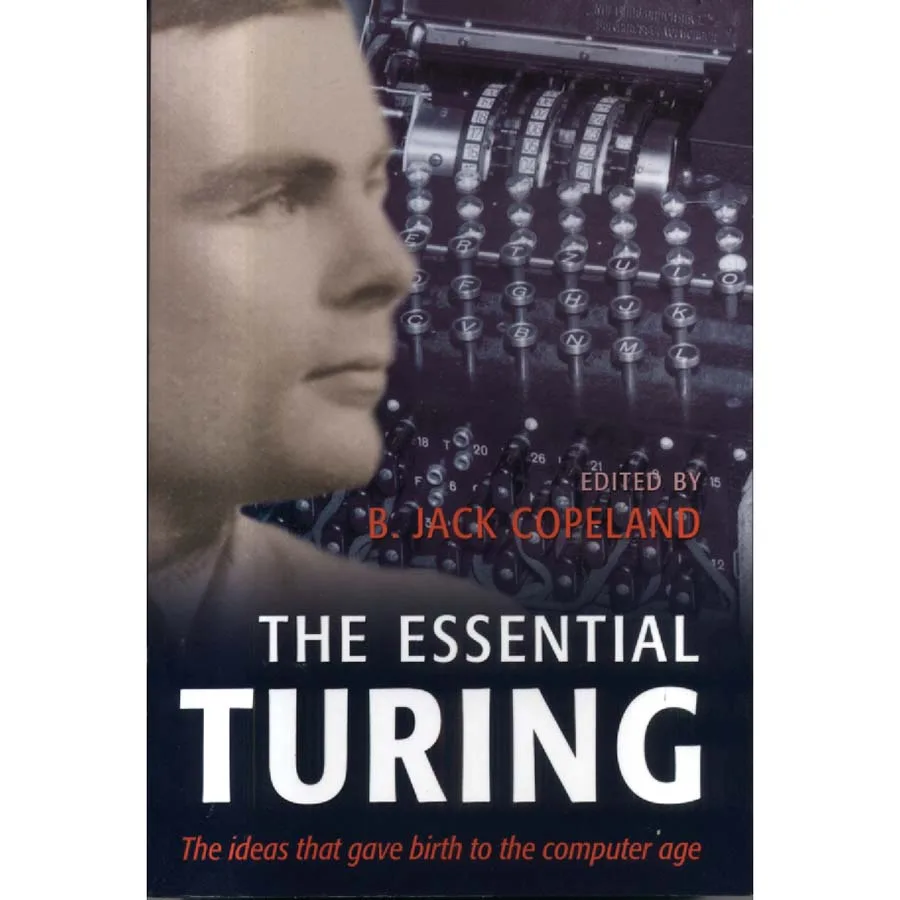
Publisher: Oxford University Press
Format: Paperback
ISBN: 9780198250807
Two listing notes: this is principally a collection of writings by Alan Turing, edited and introduced by B. Jack Copeland, rather than a book solely by Copeland. Also, Oxford records ISBN 9780198250807 as the paperback edition first published in 2004; your copy may be a 2013 reprint, so the impression page should settle the date.
Alan Turing helped invent theoretical computer science before electronic computers properly existed, played a decisive role in breaking German codes during the Second World War, designed an early stored-program computer, helped establish artificial intelligence and proposed a mathematical explanation for patterns in living organisms. He accomplished this before dying at forty-one, leaving subsequent generations the comparatively modest task of building the world he had already imagined.
The Essential Turing brings together his most important writings across mathematics, logic, computing, philosophy, codebreaking, artificial intelligence and artificial life. Edited by leading Turing scholar B. Jack Copeland, it allows readers to encounter Turing’s ideas in his own words, assisted by introductions and explanatory guides for those who do not ordinarily begin the day contemplating the limits of computability.
The collection includes Turing’s celebrated 1936 paper on computable numbers. In addressing a difficult problem in mathematical logic, he imagined an abstract machine that reads and writes symbols according to precise rules. The “Turing machine” was not a physical device awaiting a manufacturer; it was a conceptual model showing what computation itself means. Modern computers are vastly more colourful, expensive and prone to requesting software updates, but the underlying principle remains recognisably his.
His universal machine introduced the idea that one machine could perform any computational task if supplied with the correct instructions. Hardware and program could therefore be separated, allowing the same machine to calculate, process text, play games or display advertisements for items discussed privately five minutes earlier. Turing supplied the profound intellectual foundation; commercial civilisation attended to the refinements.
The book does not avoid the more demanding mathematics. Papers on logic, ordinal systems and computability show Turing working at the frontiers of formal thought, asking what can be calculated and whether some problems lie permanently beyond mechanical solution. Copeland’s commentary provides routes into this material, although readers may still occasionally discover that Turing has crossed an intellectual mountain while they are checking the map legend.
A major section concerns Enigma and Turing’s secret wartime work at Bletchley Park. As a leading member of Hut 8, he developed methods for attacking German naval Enigma communications and helped design procedures used with the cryptanalytic bombe machines. The battle of the Atlantic was fought by ships and submarines, but also by mathematicians examining letter patterns in Buckinghamshire.
Included are declassified materials relating to Enigma, together with correspondence and accounts of the codebreaking campaign. These reveal that breaking a cipher was not a single dramatic moment after which every German message became politely readable. Keys changed, procedures varied and analysts had to exploit repeated habits, technical weaknesses and the occasional assistance of an operator who had become bored with following instructions.
The volume also presents Turing’s post-war work on electronic computing. His design for the Automatic Computing Engine anticipated important features of high-speed stored-program computers. Government committees responded with the timeless institutional method of recognising a revolutionary proposal and then discussing it until somebody elsewhere built something.
Turing’s 1950 paper “Computing Machinery and Intelligence” asks whether machines can think. Rather than becoming trapped in definitions of “machine,” “thinking” and “can”—a philosophical meeting from which nobody would ever return—he proposed the imitation game, now commonly known as the Turing Test. If a machine could converse in a way indistinguishable from a human, perhaps the practical question mattered more than arguments about its inner essence.
He considered objections involving consciousness, creativity, mathematics, religion and the supposed uniqueness of the human mind. Decades before contemporary arguments about artificial intelligence, Turing had already anticipated many of them, presumably to spare the twenty-first century effort. The twenty-first century has shown little gratitude and is repeating the discussion at greater volume.
The collection also explores machine learning, chess-playing programs and Turing’s speculation that an intelligent machine might be educated rather than completely programmed in advance. This resembles modern approaches to AI closely enough to be unsettling, particularly since Turing developed the idea when computers possessed less memory than a modern kitchen appliance.
His interests eventually extended into biology. In his pioneering paper on morphogenesis, Turing used mathematical models to explain how chemical processes might produce patterns such as spots and stripes in living organisms. Having helped explain computing and machine intelligence, he evidently looked at leopards and decided their administrative arrangements also required attention.
Copeland’s introductions place each work in historical and intellectual context, connecting the technical papers to Turing’s broader career. The result is neither a straightforward biography nor a simplified popular-science account. It is a guided tour through the original documents from which several modern disciplines emerged, with the guide occasionally pausing while Turing disappears several decades ahead.
The book also inevitably carries the shadow of Turing’s treatment by the British state. After serving his country with extraordinary distinction, he was prosecuted in 1952 for a homosexual relationship and subjected to hormonal treatment. The government that had relied upon his intellect to preserve national security subsequently classified his private life as criminal, an achievement of moral and administrative stupidity difficult to reproduce accidentally.
This is an essential collection for readers interested in Alan Turing, computer history, artificial intelligence, cryptography, mathematical logic and the origins of the digital age. Some chapters are accessible to the general reader; others retain the formidable technical character of the original papers. “Essential” does not necessarily mean “easy,” particularly when the subject repeatedly invented new fields because the existing ones were insufficient.
This copy is in Fine condition, showing little evidence of previous computation, cryptanalysis or philosophical distress. Offered by Crappy Old Books, it is a substantial collection of writings by a man who imagined the modern computer, helped defeat Enigma and asked whether machines could think—before most machines had progressed beyond arithmetic and making the room uncomfortably warm.
Keep browsing: See more Non-Fiction books Other books by B Jack Copeland
