


American Prometheus - The Triumph And Tragedy Of J Robert Oppenheimer
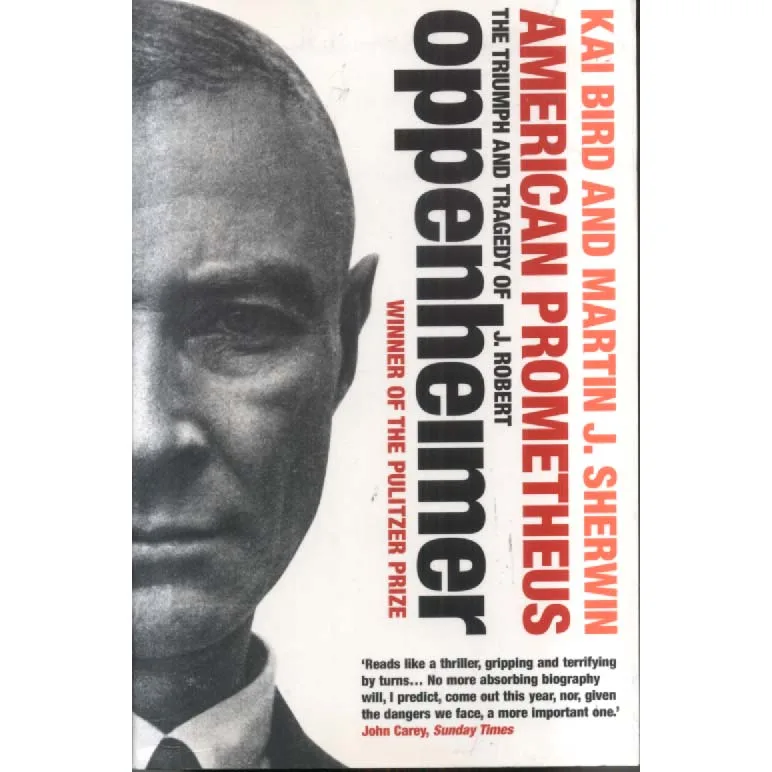
Publisher: Atlantic Books
Format: Paperback
ISBN: 9781843547051
J. Robert Oppenheimer was a theoretical physicist, intellectual prodigy, cultured conversationalist, occasional political naïf and administrator of the project that built the first atomic bomb. He could discuss Sanskrit poetry, quantum mechanics and French literature, although none of these accomplishments prevented the United States government from later deciding that it had serious doubts about his judgement. Nations are often most suspicious of their geniuses immediately after making full use of them.
In American Prometheus, Kai Bird and Martin J. Sherwin tell the extraordinary story of the man who became known as the father of the atomic bomb. The title invokes the Greek figure who stole fire from the gods and gave it to humanity, receiving a notoriously poor retirement package in return. Oppenheimer’s fire was nuclear, humanity already had several uses in mind, and the punishment arrived through committees, surveillance and a security hearing.
Born in New York in 1904 into a prosperous Jewish family, Oppenheimer displayed enormous intellectual gifts alongside a personality of almost competitive complexity. He studied at Harvard, Cambridge and Göttingen during the revolutionary development of quantum physics, joining a generation of scientists who discovered that matter was much stranger than it looked and then proceeded to explain this in mathematics that ensured the public would have to trust them.
At the University of California, Berkeley, he became a brilliant and influential teacher, helping establish theoretical physics in the United States. Students admired his speed of thought, elegance and ability to make difficult ideas appear briefly understandable. He cultivated literature, philosophy, languages and an exceptionally thin physical frame, creating the appearance of a man who subsisted mainly upon cigarettes and abstract concepts.
His social and political life placed him among left-wing friends, students and lovers during the 1930s, when fascism abroad, economic crisis at home and the Spanish Civil War drew many intellectuals towards radical politics. Oppenheimer contributed to causes associated with the Communist movement but never became easy to classify. Unfortunately, future security investigators preferred classifications, particularly those accompanied by folders.
With the United States entering the Second World War and fears growing that Nazi Germany might develop an atomic weapon, Oppenheimer was selected to direct the scientific laboratory of the Manhattan Project at Los Alamos. It was a surprising appointment: he had not won a Nobel Prize, had limited administrative experience and possessed a political background capable of making a security officer reach immediately for another form. Yet he proved exceptionally capable.
At Los Alamos, Oppenheimer brought together some of the world’s finest scientists and persuaded them to collaborate under intense secrecy and pressure. The project required theoretical physics, engineering, chemistry, metallurgy, explosives and enormous industrial resources. It also required the management of brilliant people accustomed to being the cleverest person in the building, several of whom now occupied the same corridor.
The work culminated in the Trinity test in New Mexico in July 1945, when the first nuclear device was detonated and a new historical period began before breakfast. Atomic bombs were subsequently dropped on Hiroshima and Nagasaki, killing vast numbers of people and contributing to Japan’s surrender. The scientific triumph could not be separated from the human catastrophe, although governments and ceremonies made determined attempts to emphasise whichever half was currently convenient.
Oppenheimer emerged from the war as a national celebrity and influential adviser on atomic policy. He became director of the Institute for Advanced Study at Princeton and chairman of the General Advisory Committee to the Atomic Energy Commission. Having helped create the bomb, he now argued for international control of nuclear weapons and expressed reservations about developing the vastly more powerful hydrogen bomb. This was regarded in some quarters as evidence that the architect of one apocalypse lacked sufficient enthusiasm for the improved model.
The Cold War transformed earlier associations into dangerous liabilities. Oppenheimer’s past connections, political judgements and personal contradictions were scrutinised by the FBI and his government enemies, notably Atomic Energy Commission chairman Lewis Strauss. In 1954, a security hearing examined his loyalty and reliability through testimony, intercepted conversations and old relationships. The proceedings possessed the outward form of due process and the inward direction of a train whose destination had already appeared on the board.
His security clearance was revoked, effectively removing him from government nuclear policy and publicly humiliating one of America’s most celebrated scientists. The case became a defining example of McCarthy-era suspicion, bureaucratic revenge and the difficulty of remaining useful to a state after questioning the direction in which it wishes to proceed.
Bird and Sherwin spent decades researching the biography, drawing upon archives, private papers, interviews and previously inaccessible material. Their Oppenheimer is neither saint nor simple victim. He could be vain, evasive, manipulative and politically careless; he could also be charismatic, courageous, perceptive and capable of extraordinary leadership. The book’s achievement lies in showing how all these qualities belonged to the same inconvenient person.
The narrative moves from the private worlds of family, friendships and love affairs to laboratories, cabinet discussions and the terrifying enlargement of destructive power. Oppenheimer’s personal tragedy becomes inseparable from the larger tragedy of the nuclear age: knowledge cannot be undiscovered, weapons cannot easily be uninvented and moral responsibility cannot be assigned solely to the person standing nearest the blackboard.
Winner of the 2006 Pulitzer Prize for Biography, American Prometheus later provided the principal biographical foundation for Christopher Nolan’s film Oppenheimer. The book naturally has more room for history, politics, science and contradiction, while supplying fewer dramatic close-ups of people staring meaningfully across hearing rooms.
This is an essential volume for readers interested in Oppenheimer, the Manhattan Project, nuclear weapons, Cold War politics and the uneasy relationship between scientists and governments. It asks what responsibility belongs to the creator of a weapon, what loyalty a democracy may demand and whether a nation can punish a man for having a conscience only after rewarding him for temporarily setting it aside.
This copy is in As New condition, showing virtually no evidence of having undergone fission, fallout or hostile security review. Offered by Crappy Old Books, it is a monumental account of triumph, tragedy and the man who helped give humanity the fire of the atom—after which humanity immediately began arguing about who should be allowed to hold the matches.
Keep browsing: See more Biography books Other books by Kai Bird and Martin J Sherwin
