


Seller ImageMore Images Spy Princess - The Life Of Noor Inayat Khan
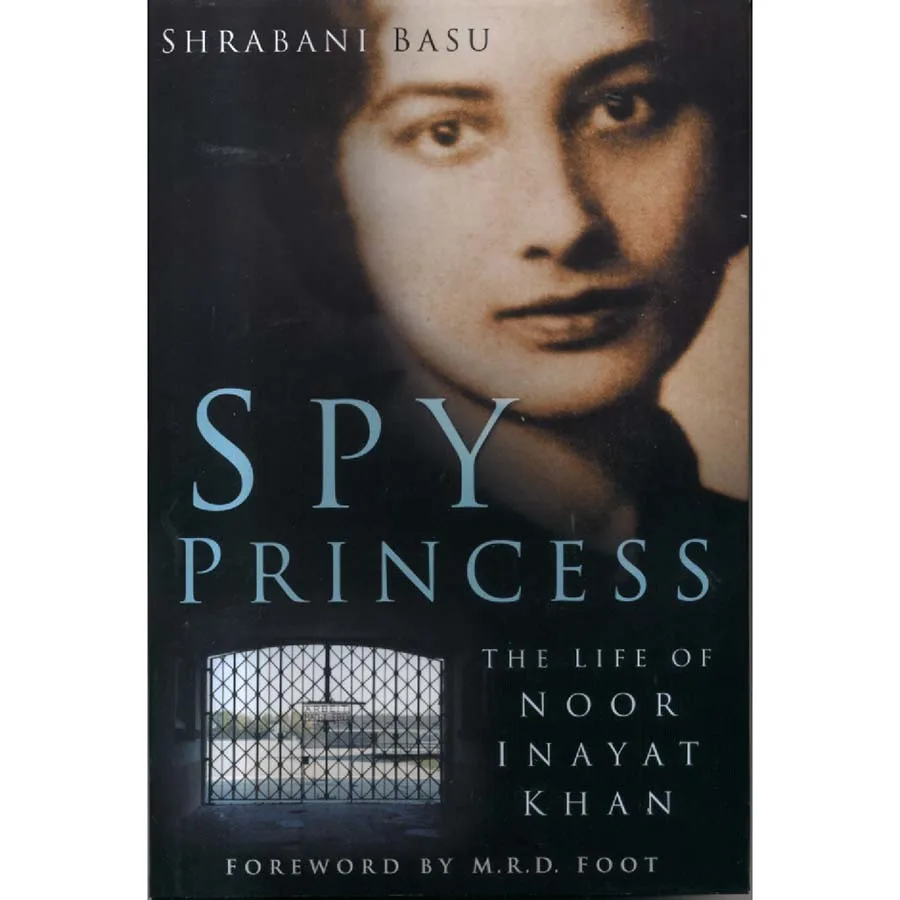
Publisher: Sutton Publishing
Format: Hardback
ISBN: 9780750939652
The stray words “Seller ImageMore images” look as though they have been copied from another listing, so I would leave those out of the title. The book is simply Spy Princess: The Life of Noor Inayat Khan.
Noor Inayat Khan seemed an improbable candidate for clandestine warfare. She was a quiet children’s writer, musician, committed pacifist and follower of Sufism, raised to believe in spiritual unity and non-violence. She was also a descendant of Tipu Sultan, the eighteenth-century ruler of Mysore who fought the British. History, having a taste for complicated family arrangements, eventually made her a British secret agent.
Born in Moscow in 1914 to the Indian Sufi teacher and musician Hazrat Inayat Khan and his American wife, Ora Ray Baker, Noor grew up principally in France. Her childhood was shaped by music, literature, mysticism and an international household rather than by military discipline. Before the war she studied music and child psychology, wrote stories for children and contributed to French radio. Nothing in this background obviously suggested that she would one day transmit coded messages from occupied Paris while the Gestapo searched for her.
When Germany invaded France in 1940, Noor and her family escaped to Britain. Although her religious convictions made violence deeply troubling, she believed that Nazi tyranny had to be resisted. She joined the Women’s Auxiliary Air Force and trained as a wireless operator, entering a military world whose approach to spiritual harmony generally involved shouted instructions and equipment inspections.
Her communications skills brought her to the attention of the Special Operations Executive, the secret wartime organisation established to conduct espionage and sabotage in occupied Europe. SOE needed wireless operators capable of maintaining contact between resistance networks and London. The work was exceptionally dangerous because radio transmissions could be detected, and operators were expected to survive only a matter of weeks before capture.
Noor was recruited into SOE’s French Section and trained in clandestine communications, coding, security and survival. Some instructors questioned whether her gentle temperament and conspicuous honesty suited secret work. Espionage traditionally favours people comfortable with deception, while Noor reportedly possessed the inconvenient habit of appearing exactly as sincere as she was.
Nevertheless, in June 1943 she was flown into France under the codename Madeleine, becoming the first female wireless operator sent by Britain into occupied France. She joined the Prosper resistance network in Paris, only to see it rapidly destroyed by German arrests. Agents disappeared, safe houses became dangerous and the organisation around her collapsed with alarming speed.
London offered to bring Noor home, but she refused to leave. With other operators captured, her wireless link had become critically important. She moved continually between addresses, carrying her transmitter and sending messages while German direction-finding teams attempted to locate her. Wireless sets were not especially discreet luggage, and occupied Paris lacked a category of public transport intended for young women carrying clandestine radio equipment.
For several months she maintained communications between London and the surviving resistance networks. Each transmission risked detection; every contact might be compromised. She altered her appearance, avoided surveillance and continued operating despite knowing that the Gestapo was closing in. Courage is sometimes imagined as an absence of fear, but Noor’s experience suggests something more difficult: understanding the danger perfectly and continuing because the work still has to be done.
She was eventually betrayed and arrested in October 1943. During interrogation she refused to reveal useful information. She also attempted to escape, not once but repeatedly, thereby correcting any remaining German assumption that gentleness and compliance were the same thing. After one escape attempt she was classified as highly dangerous, shackled and held in solitary confinement in Germany.
For nearly ten months Noor was kept in chains at Pforzheim prison. She was interrogated and harshly treated but did not cooperate with her captors. In September 1944 she was transferred with three other female SOE agents to Dachau concentration camp, where they were executed. Noor was thirty years old. Her final reported word was “Liberté”—a concise conclusion from someone whose enemies had spent months trying unsuccessfully to control her.
She was posthumously awarded the George Cross, Britain’s highest civilian decoration for gallantry, and the French Croix de Guerre. Yet for many years her story remained less widely known than those of other wartime agents. Women in intelligence have often been presented as glamorous assistants, couriers or romantic complications; Noor was the vital wireless link upon which an endangered network depended.
Shrabani Basu reconstructs Noor’s life from her unusual ancestry and artistic upbringing through recruitment, training, active service, imprisonment and death. The biography examines both her courage and the doubts surrounding her selection. It avoids turning her into a conventional action heroine, because the remarkable point is precisely that her strength emerged from convictions commonly mistaken for weakness.
Spy Princess is also a story of intersecting identities: Indian and American ancestry, Russian birth, French upbringing and British wartime service. Noor did not fit neatly into the patriotic categories of the period, yet she gave her life resisting fascism. The Empire that had fought her ancestor awarded her the George Cross, proving that history can achieve symmetry even when politics cannot manage consistency.
This is a compelling book for readers interested in SOE, women in wartime, espionage, resistance networks and overlooked figures of the Second World War. It tells the story of a pacifist who entered a secret war, a writer who became a wireless operator and a gentle woman whom the Nazis eventually considered highly dangerous. On that final assessment, at least, they were entirely correct.
This copy is in As New condition, appearing virtually untouched and considerably better preserved than most wartime secrets. Offered by Crappy Old Books, it is an inspiring and deeply moving biography of Noor Inayat Khan, whose life demonstrates that courage does not always arrive carrying a weapon; sometimes it carries a radio in a suitcase and refuses to stop transmitting.
Keep browsing: See more War books Other books by Shrabani Basu
