


The Sigint Secrets - The Signals Intelligence War 1900 To Today
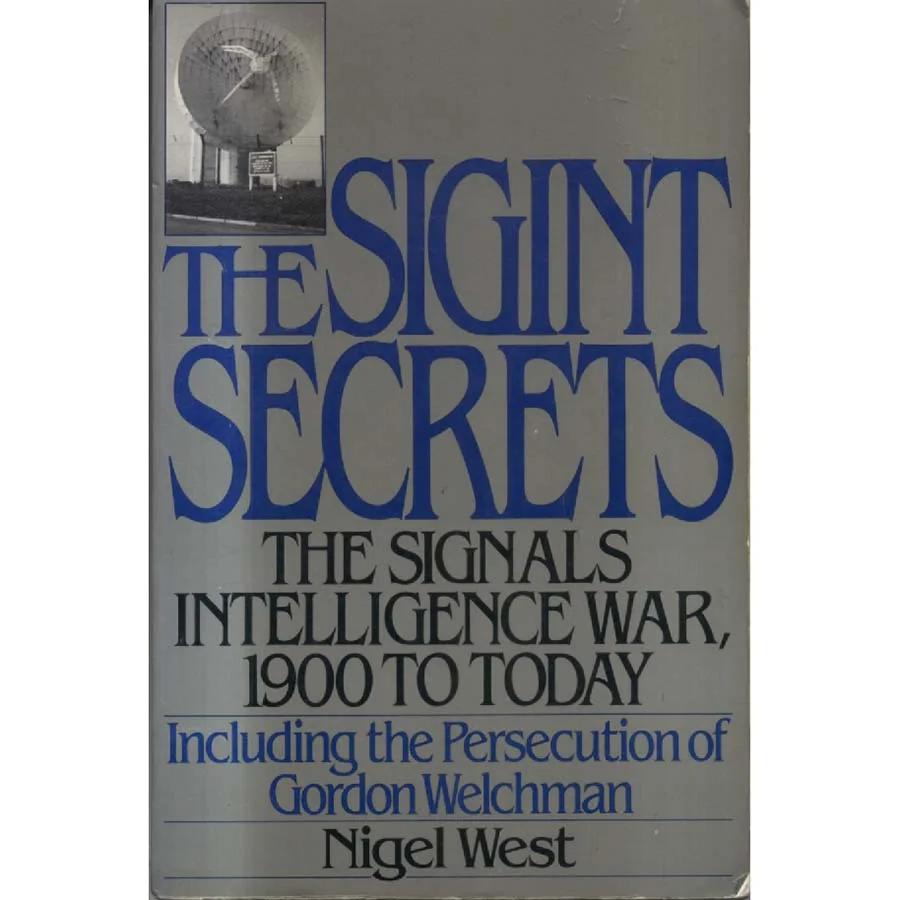
Publisher: Quill
Format: Paperback
ISBN: 9780688095154
At the beginning of the twentieth century, spies still carried invisible ink, wore questionable moustaches and occasionally concealed documents inside objects no customs officer wished to examine closely. Then governments discovered that vast quantities of secret information were travelling invisibly through the air, and espionage acquired headphones, aerials, codebooks and entire buildings filled with people listening to static.
In The SIGINT Secrets, Nigel West traces the development of signals intelligence from the early days of wireless communication to the electronic surveillance systems of the late Cold War. SIGINT—because even secrecy requires an efficient abbreviation—covers the interception and analysis of communications and other electronic signals. It is the art of learning what an opponent is doing by listening to messages he believed nobody else could understand.
The book begins around 1900, when radio promised to liberate communication from cables while inadvertently allowing anyone with suitable equipment to listen. Naval and military commanders embraced wireless because it was fast and flexible. Intelligence officers embraced it because the enemy had kindly begun broadcasting information in all directions.
West follows British signals intelligence through the First World War, when Room 40 of the Admiralty intercepted and decrypted German naval communications. The work contributed to operations such as the Battle of Jutland and produced the famous Zimmermann Telegram, whose revelation helped bring the United States into the war. A message intended to remain confidential had instead altered international history, establishing an enduring relationship between new communication technology and regrettable surprises.
Between the wars, British codebreaking became institutionalised within the Government Code and Cypher School. Cryptanalysts, linguists, radio operators and administrators developed the systems that would become indispensable during the Second World War. The organisation’s name sounded reassuringly like an educational establishment where one might be awarded a certificate; its actual purpose was to read other governments’ mail without requesting permission.
Bletchley Park naturally occupies an important part of the story. Here, British and Allied personnel attacked German cipher systems, including Enigma, while the wider network of intercept stations gathered the messages upon which the codebreakers depended. The popular image features a solitary genius solving an impossible puzzle; the reality involved mathematics, engineering, traffic analysis, thousands of operators and an industrial quantity of clerical work.
West explains that signals intelligence extends beyond breaking codes. Direction-finding could reveal the location of transmitters, traffic analysis could expose the structure and movements of enemy units, and patterns of communication could disclose information even when the messages themselves remained unreadable. Silence might also be significant. Intelligence analysts therefore became experts in extracting meaning from what was said, how it was said, where it came from and why somebody had suddenly stopped saying it.
The book challenges simplified versions of the Allied assault on Enigma, showing that success was neither immediate nor permanent. Codes changed, procedures improved and access to particular networks came and went. A cipher might be penetrated only for the enemy to alter a setting and restore darkness. Codebreaking was less like finding one magical key than operating a locksmith’s shop during an earthquake.
After 1945, the Government Code and Cypher School became Government Communications Headquarters—GCHQ—and the wartime alliance with American intelligence developed into an enormous Cold War partnership. The targets changed from Nazi Germany and Japan to the Soviet Union and its allies, while interception expanded across radio, telephone, radar and satellite communications. The listening posts became larger, the technology more sophisticated and the official public explanation remained approximately nothing.
West examines the procedures and institutions behind this secret world rather than offering a procession of glamorous agents stepping from sports cars. Signals intelligence is produced through receivers, aerial arrays, cryptographic machinery, computers and highly trained people studying columns of apparently meaningless material. It is espionage conducted largely while seated, proving that one can participate in international intrigue without ever becoming good at skiing.
A particularly important figure is Gordon Welchman, the brilliant mathematician who helped organise Hut 6 at Bletchley Park and played a central role in breaking German Army and Air Force Enigma traffic. His contribution extended beyond mathematics to the design of systems capable of turning intercepted messages into usable intelligence. Genius, in this case, included knowing how to organise the office.
The book also recounts Welchman’s later treatment after he published The Hut Six Story. Although his memoir revealed the achievements of Bletchley Park to a wider audience, British and American security authorities regarded his disclosures with considerable hostility. A man once trusted with some of the war’s greatest secrets found himself subjected to official suspicion for explaining history after the enemy concerned had ceased to exist. Secret organisations preserve secrecy partly through the sensible principle that yesterday’s secret must remain secret until everyone involved has become unavailable for questions.
Published in this Quill edition in 1990, the phrase “to Today” naturally means the closing years of the 1980s. There are no smartphones, internet metadata or social-media users voluntarily publishing their location and breakfast. Nevertheless, the foundations of modern electronic surveillance are plainly visible: mass interception, international intelligence sharing, computerised analysis and the continuing struggle between secure communication and those professionally determined to make it insecure.
This is a detailed and authoritative work for readers interested in espionage, cryptography, GCHQ, Bletchley Park, the world wars and Cold War intelligence. It is less a collection of spy anecdotes than a history of the machinery and methods that made secret intelligence possible. Readers may emerge with a new respect for codebreakers and a slightly reduced enthusiasm for transmitting anything electronically.
This copy is in Good condition, showing ordinary signs of previous ownership but containing no obvious evidence of interception, decryption or hostile traffic analysis. Offered by Crappy Old Books, it is a substantial history of the hidden war fought through signals—a conflict in which nobody needed to hear what you said provided you had been unwise enough to broadcast it.
Keep browsing: See more War books Other books by Nigel West
