


The Twelve Apostles - Michael Collins The Squad And Irelands Fight For Freedom
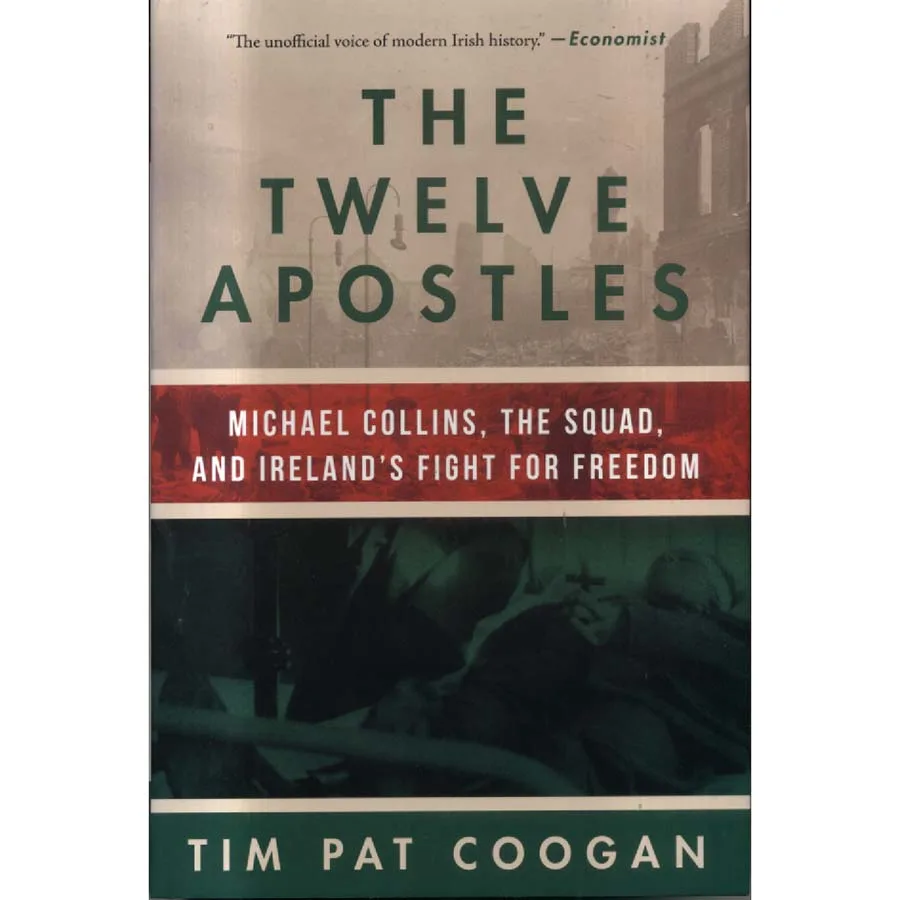
Publisher: Skyhorse Publishing
Format: Hardback
ISBN: 9781510732315
The Twelve Apostles in Tim Pat Coogan’s book are not the familiar biblical gentlemen equipped with sandals, parables and an uncertain long-term future. These were Michael Collins’s hand-picked gunmen: a small, secretive IRA unit created to identify and kill British intelligence agents and undercover police during the Irish War of Independence. Their gospel was independence, their preferred form of debate was the revolver and their meetings were unlikely to conclude with tea.
In 1919, Sinn Féin established Dáil Éireann as the parliament of an independent Irish republic. Britain declared it illegal, the Irish Republican Army began a guerrilla campaign and Dublin became the centre of a hidden struggle involving informers, spies, detectives, couriers and assassins. Officially, the British administration continued to govern from Dublin Castle. Unofficially, Michael Collins was constructing an intelligence organisation inside, beneath and all around it.
As the IRA’s director of intelligence, Collins understood that the British state’s greatest advantage was not simply soldiers or weapons but information. Detectives and agents identified republican organisers, followed suspects and penetrated revolutionary networks. Collins’s solution was brutally practical: discover who the agents were and remove them before they could dismantle the movement. Administrative efficiency had entered a rather severe phase.
The Squad—also known as the Twelve Apostles—was formed to carry out this work. Its members were lightly armed, operated in civilian clothes and depended upon secrecy, local knowledge and Collins’s remarkable network of informants. Against the machinery of the British Empire, they possessed revolvers, bicycles, safe houses and the useful fact that employees within the imperial machinery were quietly passing them its paperwork.
Coogan explores not only the gunmen but the intelligence system that enabled them to operate. Civil servants, policemen, railway workers, postal employees, sympathetic householders and messengers all contributed information. Collins assembled reports, studied movements and built files on the men pursuing him. Dublin Castle had departments, budgets and official seals; Collins had contacts, scraps of paper and an apparently inexhaustible ability to know what was being discussed inside Dublin Castle.
The campaign culminated on Bloody Sunday, 21 November 1920, when IRA teams attacked suspected British intelligence personnel at addresses across Dublin. Later that day, Crown forces opened fire on spectators at a Gaelic football match in Croke Park, killing civilians; further deaths followed that night in Dublin Castle. By the end of the day, the expression “Bloody Sunday” had acquired one of several terrible Irish meanings, and the conflict had entered a darker and more internationally visible stage.
The book follows the wider struggle through ambushes, reprisals, the arrival of the Black and Tans and Auxiliaries, and the mounting pressure that eventually helped bring the British government and Irish representatives to negotiations. Coogan argues that Collins’s intelligence campaign neutralised important parts of the British system and demonstrated that Ireland could not be governed by familiar methods without an increasingly unacceptable cost.
Yet victory did not produce the simple national conclusion for which everyone had supposedly been fighting. The Anglo-Irish Treaty divided the revolutionary movement and led to civil war. Former comrades became enemies, men who had operated outside British law became servants of the new Irish state, and the techniques developed against Dublin Castle were redirected against other Irish republicans. Revolution, having overturned the furniture, immediately began arguing over who owned the room.
At the centre remains Michael Collins: organiser, financier, intelligence chief, minister and military strategist, operating under extraordinary pressure while officially wanted by the authorities. Coogan writes with unmistakable admiration for him and regards the Squad as one of his most controversial but effective creations. This is not a coldly detached account pretending that every historical interpretation has been allotted identical seating; it is history told with conviction, personality and a clear sense of who Coogan believes drove events.
That perspective gives the book energy, though readers should expect an argument as well as a narrative. The morality of targeted assassination, the reliability of intelligence and the subsequent reputations of Collins and his gunmen remain disputed. Coogan enters these controversies with the confidence of a historian who has spent decades among the sources and has not emerged from them burdened by excessive indecision.
The Twelve Apostles is ideal for readers interested in Michael Collins, the IRA, Irish revolutionary history, intelligence operations and the shadow war conducted through Dublin’s streets, offices and boarding houses. It reveals a conflict in which the most dangerous weapon was often a name written on a page and the most valuable recruit might be the clerk nobody noticed.
This copy is in Good condition, having survived the years with considerably less controversy than its subjects. Offered by Crappy Old Books, it is an absorbing account of the secret unit that helped undermine British intelligence in Ireland—twelve men named after apostles, directed by a man called “the Big Fellow” and engaged in activities unlikely to feature in the average Sunday sermon.
Keep browsing: See more History books Other books by Tim Pat Coogan
