


Fanny Stevenson
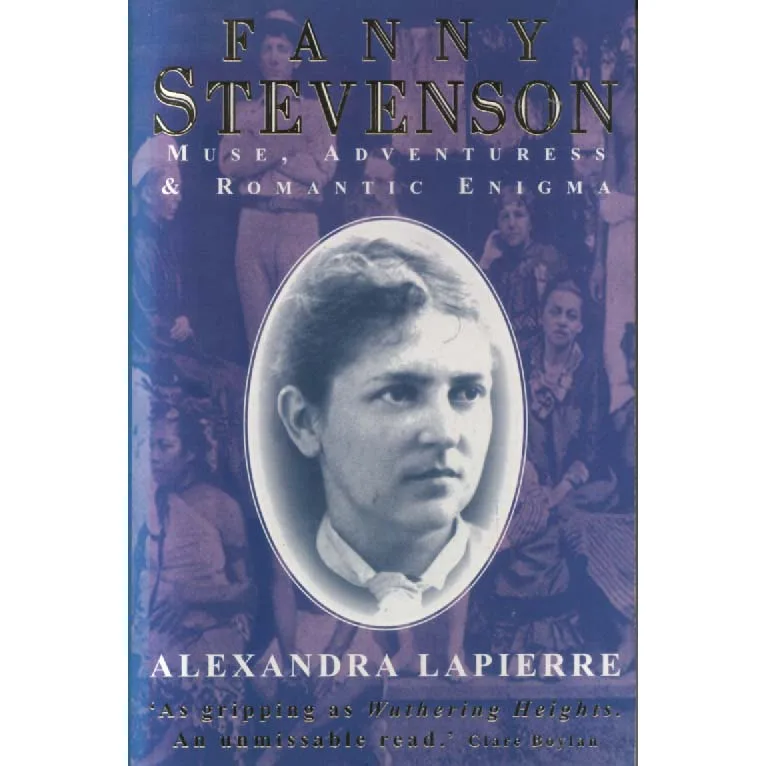
Publisher: 4th Estate
Format: Paperback
ISBN: 9781857024128
Before she became Mrs Robert Louis Stevenson—which is how history has generally labelled and filed her—Fanny Van de Grift Osbourne had already married, raised children, crossed America, endured mining camps, separated from an unfaithful husband and travelled to Europe to study art. She was not, in other words, sitting quietly in a drawing room waiting for a famous novelist to supply her with a biography.
In Fanny Stevenson: Muse, Adventuress and Romantic Enigma, Alexandra Lapierre restores Fanny to the centre of her own astonishing life. Born in Indiana in 1840, she followed her first husband, Samuel Osbourne, west during the restless years of mining camps and frontier hopes. Domestic respectability was theoretically available, but it kept being interrupted by poverty, infidelity, bereavement, travel and the inconvenient discovery that Fanny possessed ambitions and opinions of her own.
Taking her children to Europe, she pursued painting and encountered the young Robert Louis Stevenson at an artists’ colony in France. He was eleven years younger, chronically ill, not yet famous and equipped with the sort of romantic intensity that usually causes immediate concern among practical relatives. Fanny was married, older, American and accompanied by children. It was therefore an ideal Victorian courtship, provided one’s ideal courtship involved scandal, illness, transatlantic separation and widespread disapproval.
Their relationship developed amid emotional upheaval and Stevenson’s recurrent ill health. When Fanny returned to California, he followed her across the Atlantic and then across America, a journey later transformed into literature because Stevenson rarely encountered hardship without eventually finding a publisher for it. Fanny obtained a divorce, and the pair married in 1880, beginning a partnership that was devoted, tempestuous and rarely troubled by excessive calm.
Life with Stevenson involved constant movement in search of a climate that might improve his lungs. The family travelled through Europe, America and the Pacific, treating geography as an experimental medicine. Hotels, rented houses, ships and islands followed one another while Fanny managed households, nursed her husband, raised children, guarded his working conditions and confronted anyone who threatened the precarious machinery holding their lives together.
Eventually they settled at Vailima in Samoa, where Stevenson became a celebrated local figure and Fanny threw herself into plantation life with characteristic energy. She gardened, cooked, managed the estate, handled practical emergencies and adapted to an existence far removed from the Victorian idea of a literary wife. One suspects that “muse” was the least time-consuming of her duties.
Lapierre portrays a woman of formidable contradictions: nurturing and possessive, courageous and volatile, creative and self-sacrificing. Fanny could paint, write, garden, travel, nurse, argue and reportedly handle a gun, making her unusually well prepared for both marriage to a famous author and the occasional collapse of civilisation. She inspired Stevenson, collaborated with him and fiercely protected him, though the strength of that protection sometimes caused friends and biographers to regard her as less a guardian angel than a guardian with territorial instincts.
The book also examines the cost of Fanny’s devotion. Her own artistic and literary ambitions were repeatedly subordinated to Stevenson’s health and work. History has traditionally called this inspiration when performed by a woman and genius when performed by the man receiving it. Lapierre asks what Fanny contributed, what she surrendered and why such a vivid personality was subsequently reduced to a supporting role in somebody else’s legend.
After Stevenson’s sudden death in Samoa in 1894, Fanny’s life did not simply conclude out of narrative courtesy. She lived for another twenty years, returning to California and continuing to confound expectations. Widowhood made her the custodian of Stevenson’s memory, but it did not transform her into a tasteful monument. She remained energetic, unconventional and entirely capable of alarming those who preferred literary widows to behave like footnotes.
Lapierre’s biography is substantial, richly detailed and written with the momentum of a novel. Dialogue, atmosphere and reconstructed scenes give the story a romantic sweep, while the underlying research follows Fanny from the American frontier to European artists’ circles and finally to the South Pacific. The result is biography with its travelling clothes on: scholarly enough to inform, but unwilling to sit stiffly beside the archive while adventure is occurring elsewhere.
This is an absorbing choice for admirers of Robert Louis Stevenson, readers of women’s biography and anyone interested in lives too unruly for the labels attached to them. Fanny was a wife, mother, artist, writer, nurse, traveller, plantation manager and survivor. “Muse” seems rather inadequate, rather like describing a hurricane as an atmospheric assistant.
This copy is in Near Fine condition. The cover is somewhat faded, as shown in the scanned image, but otherwise the book is in nearly new condition. Offered by Crappy Old Books, it is a handsome and remarkably fresh copy of a biography devoted to a woman who crossed continents, oceans and social boundaries—and then suffered the final indignity of being remembered chiefly for whom she married.
Keep browsing: See more Biography books Other books by Alexandra Lapierre
