


Helicopter Gunships - Deadly Combat Weapon Systems
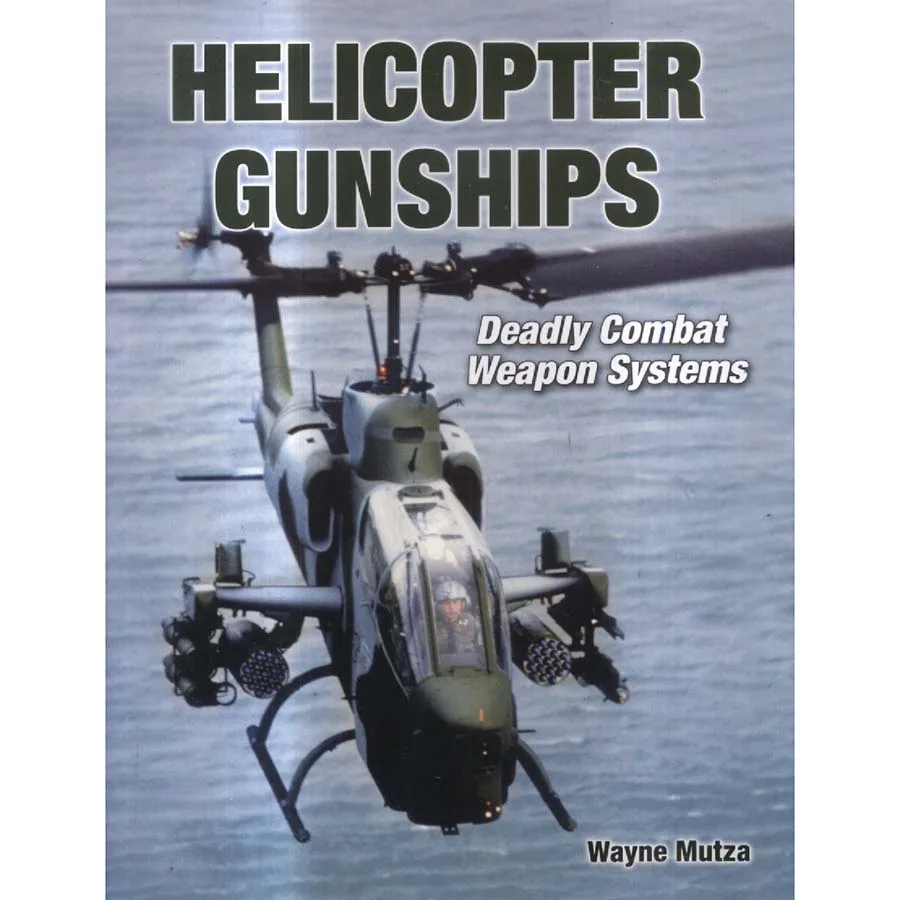
Publisher: Specialty Press
Format: Hardback
ISBN: 9781580071543
For most of its early existence, the helicopter was regarded as a useful airborne contraption for moving people, rescuing the injured and landing in places where a proper aeroplane would sensibly refuse to participate. Then somebody fitted one with guns, rockets and missiles, and the friendly flying utility vehicle became the helicopter gunship: still capable of hovering, but now with a considerably more forceful reason for doing so.
In Helicopter Gunships: Deadly Combat Weapon Systems, Wayne Mutza examines the development, machinery and operational use of these heavily armed aircraft. From improvised conversions to purpose-built attack helicopters, the book traces the transformation of the rotorcraft into one of modern warfare’s most distinctive weapons—part aircraft, part weapons platform and part extremely loud announcement that events on the ground are about to become complicated.
The gunship emerged from a simple military difficulty. Transport helicopters could deliver troops into dangerous territory, but hostile forces had an inconsiderate tendency to fire at them while they did it. Escorting helicopters therefore acquired machine guns, cannon and rocket pods, allowing them to suppress enemy positions and protect the troop carriers. The concept proved persuasive, particularly to the people being shot at, and increasingly elaborate armed helicopters followed.
The Vietnam War became the great proving ground for the helicopter gunship. Aircraft such as modified Hueys provided escort, close air support and rapid firepower over jungle terrain where conventional aircraft could struggle to identify or remain near their targets. The Huey’s familiar outline might suggest evacuation, reinforcement or rescue; the pods and guns attached to it suggested that the precise nature of the visit would depend upon which side one happened to be on.
Purpose-built machines such as the Bell AH-1 Cobra took the idea further. Narrow, fast and designed around its weapons, the Cobra dispensed with any remaining pretence that it was principally there to transport parcels. Pilot and gunner sat in tandem, presenting a smaller target while controlling cannon, rockets and missiles. The helicopter had evolved from battlefield taxi to airborne predator, although it still required mechanics, fuel and a heroic quantity of maintenance before becoming predatory each morning.
Mutza explores the variety of weapons carried by gunships, including machine guns, automatic cannon, grenade launchers, unguided rockets and anti-tank missiles. Each system was designed to solve a particular battlefield problem, usually by ensuring that the problem acquired several additional holes. Combined with increasingly advanced sights, sensors and fire-control equipment, these weapons allowed helicopters to locate, engage and destroy targets by day or night.
The book ranges across American and international designs, examining how different armed forces adapted the gunship concept to their own terrain, doctrines and budgets. Some produced sleek specialist attack helicopters; others attached whatever armament was available to an existing airframe and encouraged the crew to be inventive. Military innovation often begins with sophisticated engineering, but it also has a respectable secondary tradition of brackets, wiring and somebody saying, “That ought to hold.”
Alongside famous aircraft and major conflicts, the book considers experimental designs, unusual installations and less familiar gunship variants. Aviation history is full of machines that entered legendary service and machines that entered a hangar, frightened several accountants and were never mentioned again. Both varieties help explain how the modern attack helicopter developed.
Lavishly illustrated, Helicopter Gunships is particularly attractive to aviation enthusiasts and modellers who wish to examine airframes, camouflage schemes, weapon mounts and operational details. The photographs reveal the remarkable diversity of aircraft grouped beneath the term “gunship,” from workmanlike conversions bristling with hardware to specialised machines shaped by decades of battlefield experience.
It also offers a compact history of changing military technology. Early crews relied upon visual observation, simple gunsights and considerable courage; later aircraft gained thermal imaging, laser guidance and missiles capable of engaging armour from a safer distance. “Safer,” naturally, remains a comparative word when applied to hovering above a battlefield in a machine whose continued flight depends upon a large rotating component remaining attached.
This is an excellent choice for readers interested in military aviation, rotary-wing operations, Vietnam, attack helicopters or machines carrying far more weaponry than their original inventors probably imagined. It demonstrates how the helicopter’s ability to hover, manoeuvre close to terrain and operate from improvised bases made it uniquely useful—and uniquely vulnerable—in combat.
This copy is in Fine condition, suggesting that it has avoided hostile fire, forced landings and prolonged exposure to hydraulic fluid. Offered by Crappy Old Books, it is a detailed and visually impressive account of the helicopter gunship: a machine that began with the innocent ability to land almost anywhere and rapidly developed the less innocent ability to make everyone nearby wish it had landed somewhere else.
Keep browsing: See more War books Other books by Wayne Mutza
