


Voodoo Warriors - The Story Of The McDonnell Voodoo Fast-Jets
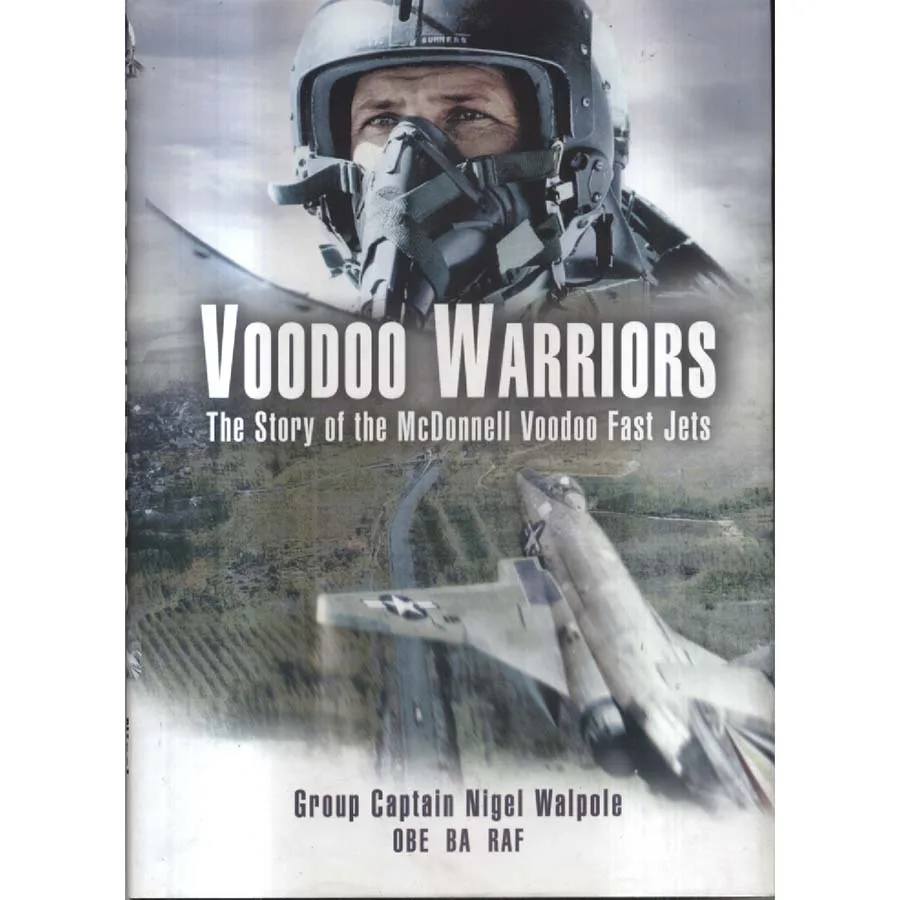
Publisher: Pen and Sword Aviation
Format: Hardback
ISBN: 9781844154142
The McDonnell F-101 Voodoo belonged to that wonderfully immoderate generation of Cold War aircraft designed when the principal requirements for a fighter were enormous engines, alarming speed and sufficient fuel to reach wherever the next international crisis happened to be. Sleek, powerful and faintly menacing even while parked, it looked exactly like an aeroplane built to intercept Soviet bombers before anyone had time to become philosophical about the consequences.
In Voodoo Warriors, Nigel Walpole tells the story of the Voodoo and the airmen who flew it, tracing the aircraft from its origins in McDonnell’s XF-88 project through its varied operational career with the United States and Canadian air forces. Conceived initially as a long-range escort fighter, the Voodoo entered service in several rather different roles, proving once again that military aircraft rarely spend their careers doing precisely what was written on the original order form.
The single-seat F-101A and F-101C served as fighter-bombers with Tactical Air Command, combining substantial range with the ability to travel at more than twice the speed of sound. This was an era when “tactical” might involve carrying a nuclear weapon across Europe at extremely low altitude, which rather stretched the ordinary meaning of the word. Pilots trained to arrive quickly, accurately and with no realistic expectation that the return journey would feature prominently in the proceedings.
The reconnaissance RF-101 became one of the most important versions of the aircraft. Its guns were replaced by cameras, allowing it to fly fast over places where cameras were not especially welcome. Voodoos undertook dangerous reconnaissance missions during the Cuban Missile Crisis and the Vietnam War, gathering the photographs upon which commanders and politicians depended. The aircraft was unarmed, but compensated by moving at a speed intended to make hostile objections arrive slightly too late.
Then there was the two-seat F-101B interceptor, built to defend North America against Soviet bombers. Operating within the elaborate machinery of continental air defence, these aircraft waited on alert with crews ready to launch at short notice, locate approaching bombers and fire nuclear or conventional air-to-air weapons. This was considered a reassuring defensive arrangement at the time, although the inclusion of nuclear rockets suggests that reassurance had acquired a specialised Cold War definition.
Canada also adopted the aircraft as the CF-101, using it for the defence of North American airspace. In Royal Canadian Air Force service, the Voodoo spent years guarding a country inconveniently large enough to make almost every interception a long-distance journey. Canadian machines acquired distinctive markings, loyal crews and an operational history that extended well beyond the type’s frontline American career.
Walpole places the men alongside the machinery, drawing upon the experiences of pilots and navigators who flew the Voodoo in Europe, North America and Southeast Asia. Their recollections capture the exhilaration of flying an immensely powerful fast jet as well as the less glamorous business of poor visibility, mechanical failures, difficult landings and discovering that the aircraft’s enormous performance did not exempt it from weather.
The Voodoo was formidable but not necessarily forgiving. Its high-mounted tail, powerful engines and demanding handling characteristics required attention and respect, two qualities sometimes difficult to maintain while crossing hostile territory at tremendous speed. Like many Cold War aircraft, it was designed around a particular set of strategic anxieties and then entrusted to young men expected to make the whole arrangement work in darkness, cloud and occasional enemy fire.
Illustrated with photographs and informed by first-hand accounts, Voodoo Warriors is both a technical history and an operational portrait. It explains the aircraft’s development and variants without losing sight of what it was like to climb into one, light the afterburners and convert large quantities of fuel into noise, acceleration and rapidly diminishing geography.
This is an excellent choice for aviation enthusiasts, Cold War historians, modellers and anybody who believes aircraft looked more exciting when designers were still willing to give them names such as Voodoo. It covers reconnaissance, nuclear strike, interception and air-defence operations—an impressive collection of duties for an aeroplane whose original purpose had already begun changing before it properly entered service.
This copy is in Good condition, showing ordinary signs of previous ownership but remaining perfectly suitable for another sortie. Offered by Crappy Old Books, it is a substantial tribute to an aircraft that was fast, versatile and unmistakably of its age—an age when the sky was full of strategic bombers, radar stations watched the horizon and subtlety was something supplied by the ground crew after the engines had been switched off.
Keep browsing: See more War books Other books by Nigel Walpole
