


The Word For World Is Forest
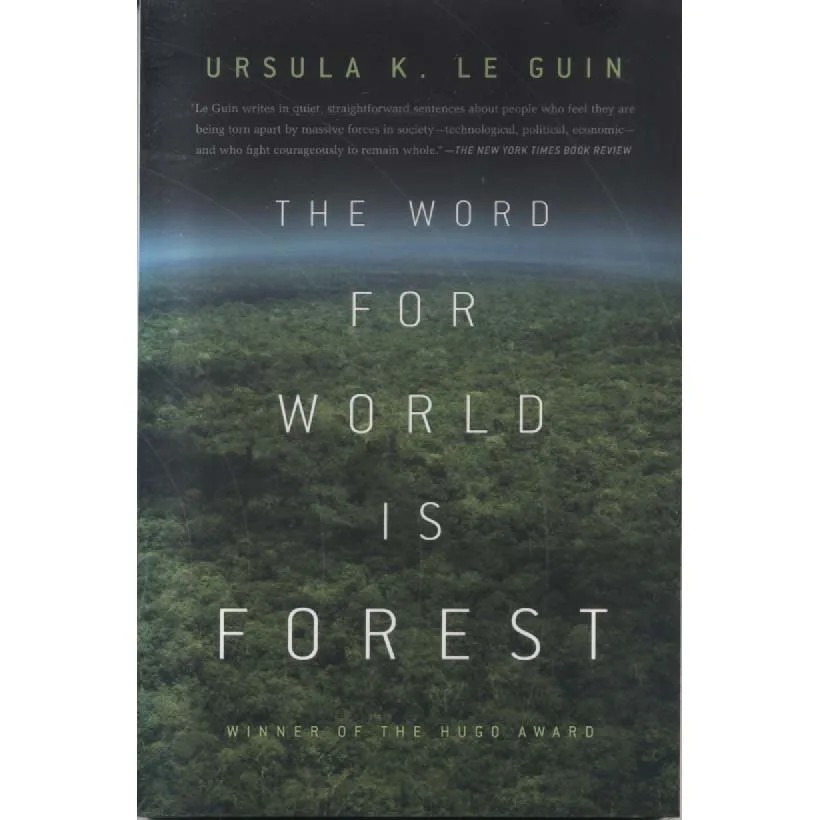
Publisher: Tor
Format: Paperback
ISBN: 9780765324641
On the planet Athshe, the word for “world” is also the word for “forest,” because forest covers the land, shapes the culture and sustains every form of life the inhabitants know. The human colonists from Earth interpret this as evidence that the planet contains an encouraging quantity of timber.
The Terrans have renamed Athshe “New Tahiti” and established logging settlements to supply wood to an Earth whose own forests have largely disappeared. Having exhausted one world, humanity has crossed interstellar space and discovered the considerable convenience of exhausting another. Progress is maintained, provided nobody asks why the advanced civilisation always arrives requiring resources from the supposedly primitive one.
The native Athsheans are small, green-furred people whose society is peaceful, decentralised and intimately connected with the forest. They practise conscious dreaming and move between waking and dream states with an ease the Terrans cannot understand. The colonists classify them as inferior, force them into labour and use a derogatory name for them, because exploitation proceeds more smoothly once its victims have been linguistically reduced to something that does not require sympathy.
Captain Davidson embodies the colonial attitude at its most confident. He regards the forest as wasted land, the Athsheans as subhuman and violence as evidence of masculine competence. His belief in human superiority survives largely because he defines every human crime as necessary and every act of resistance as barbaric. Civilisation, in his usage, means that the people carrying out the destruction possess paperwork.
Raj Lyubov, the colony’s anthropologist, recognises the intelligence and complexity of Athshean culture and attempts to understand it. Yet his knowledge does not give him the power—or always the courage—to stop what is happening. Le Guin is unsparing about the limits of benevolent observation: correctly describing oppression is not the same as preventing it, however admirable the field notes.
The Athshean Selver is driven into resistance after suffering devastating personal violence at the hands of the colonists. To defend his people, he introduces them to deliberate killing on a scale their culture has never known. The Terrans can eventually be expelled, but the knowledge of murder cannot be uninvented. Victory saves the forest while permanently altering those who fought for it.
Le Guin’s central tragedy is therefore not simply the destruction of an ecosystem or the brutality of colonial rule. It is the transmission of violence from the invader to the invaded. The Athsheans learn how to wage war from the people who insist they are too primitive to understand civilisation, one of imperial history’s more dependable educational programmes.
First published in 1972 in Harlan Ellison’s anthology Again, Dangerous Visions, the novella was written in the shadow of the Vietnam War. Its helicopters become aircraft flying above an alien forest; its military occupation becomes planetary colonisation; and its language of racial superiority and economic necessity is moved just far enough into the future to become embarrassingly visible. Le Guin later acknowledged the story’s anger and unusually direct polemical force.
Part of her Hainish sequence, The Word for World Is Forest won the Hugo Award for Best Novella in 1973. It is brief, fierce and considerably less comforting than its lyrical title might suggest. Readers of The Left Hand of Darkness and The Dispossessed will recognise Le Guin’s interest in anthropology, language and competing social systems, here sharpened into an ecological and anti-colonial accusation.
This 2010 Tor edition is in Good condition. It shows the ordinary evidence of previous reading but remains sound, complete and printed on paper whose ancestral forest cannot now be identified. An excellent reading copy of one of Le Guin’s most forceful works.
Sold by Crappy Old Books, where worlds are not renamed for marketing purposes and all forests are treated as more than unprocessed shelving.
Keep browsing: See more Science-Fiction books Other books by Ursula K le Guin
