


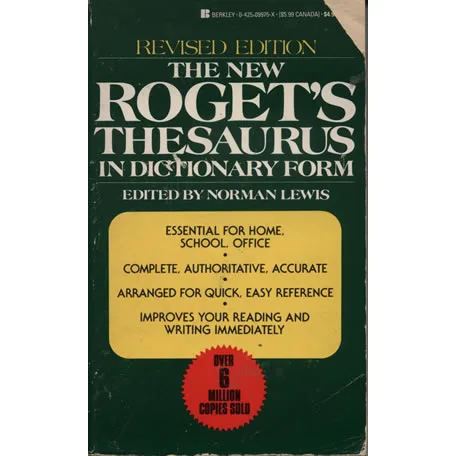
The New Rogets Thesaurus Of The English Language In Dictionary Form
Publisher: Putnam
ISBN: 042509975
Ah, the enigmatic allure of "The New Roget’s Thesaurus of the English Language in Dictionary Form," a title that practically shouts "I am sophisticated yet approachable!" This 1978 wonder, brought to life by Norman Lewis and published by Putnam, is a veritable cornucopia of synonyms, antonyms, and the occasional existential crisis. As you leaf through its pages, you may find yourself pondering not just the right word for “happy,” but the very essence of happiness itself. Or perhaps you’ll simply be overwhelmed by the sheer volume of ways to say “dreadful.” Who knew your mundane adjectives could feel so fancy?
In an era when “groovy” was still an acceptable descriptor and disco balls hung low over everything from living rooms to weddings, this thesaurus emerged like a bespectacled librarian at a raucous party—utterly out of place yet strangely intriguing. It’s like having a scholarly sidekick that persists in suggesting words you never knew you needed, all while wearing a tweed jacket that hasn’t been fashionable since the last time someone mistook “rave” for a literary event.
Opening this book is akin to stepping into a literary time capsule, one where "hip" and "rad" are still in the running for best compliment. But don’t be fooled; this isn’t just a dry collection of entries. Each synonym serves as a door to a different world where “big” can become grandiose, gargantuan, or even titanic—all depending on your mood and the audience. If you find your vocabulary has been stifled by the inadequacies of modern language, rejoice! Here dwells a veritable treasure trove of alternatives that could elevate your grocery list into a Shakespearean soliloquy.
Let’s not overlook the practicalities. Imagine the sheer delight of flipping to “defeated” and discovering “vanquished,” “subdued,” and “overwhelmed.” Each entry becomes a mini-adventure, a choice between befuddlement and enlightenment. You may even find that your email correspondence with your boss transforms from mundane to majestic with just a few carefully chosen replacements—after all, asking for a “slight extension” to a deadline could easily morph into a request for an “expansion of the temporal parameters.”
- Discover the thrill of redundancy—why say "very good" when "exceedingly proficient" exists?
- Impress your friends (or bewilder them) with your newfound lexicon.
- Perfect for those awkward dinner parties where conversation runs dry.
- Ideal for anyone trying to sound intellectually superior while discussing the merits of tea.
- Use it as a conversation starter when all else fails—everyone loves a good thesaurus story!
Condition: This copy is used, which means it carries that delightful patina of history—much like a well-loved armchair or a vintage vinyl record. Expect some bent corners, the occasional coffee stain (a battle scar from its previous owner’s caffeine-fueled creativity), and possibly a few pages that have been creatively dog-eared in moments of inspiration. It wears its age with pride, like a badge of honour for the literary enthusiast who revels in the notion that this book, despite its quirks, is still chock-full of vocabulary gems waiting to be rediscovered.
So, whether you are a budding wordsmith, a seasoned scholar, or simply someone in need of a good laugh while trying to articulate your feelings about that last soggy biscuit, “The New Roget’s Thesaurus of the English Language in Dictionary Form” promises to deliver. It sits patiently on your shelf, ever ready to lend a hand—or a word—when you find your expressive capabilities in a state of emergency. Grab it from Crappy Old Books, and let your language soar with the grandiosity of a thousand synonyms.
Keep browsing: See more Academic books Other books by Norman Lewis
