


Moonshots
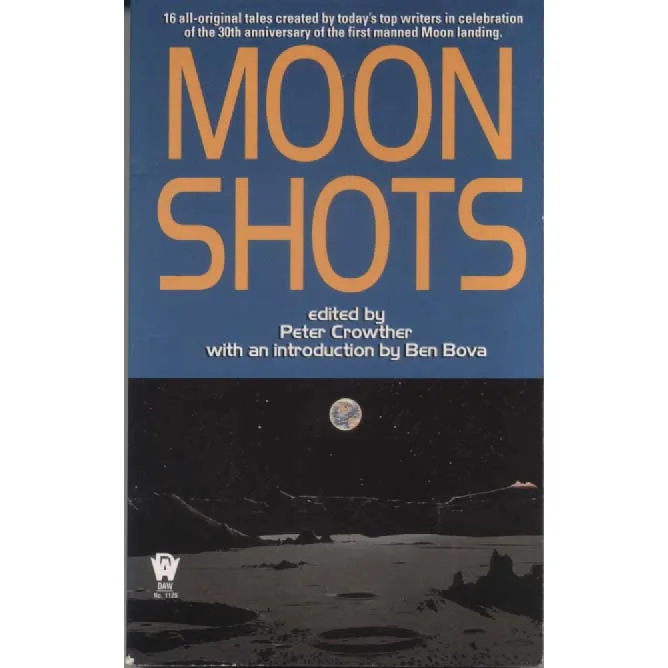
Publisher: Daw
Format: Paperback
ISBN: 0886778484
In July 1969, human beings first walked on the Moon, proving that an undertaking of astonishing scientific complexity could be completed using computers less powerful than a modern kitchen appliance. Thirty years later, editor Peter Crowther invited sixteen science-fiction writers to return to the Moon and consider what humanity might do there next, once reality had finished leaving the equipment behind.
Moon Shots is an anthology of original stories published to mark the thirtieth anniversary of Apollo 11. Introduced by Ben Bova, it brings together writers including Brian W. Aldiss, Gene Wolfe, Brian Stableford, Alan Dean Foster, Stephen Baxter, Robert Sheckley, Paul J. McAuley, Paul Di Filippo and Ian McDonald. Crowther is the editor rather than the sole author, although the cover may encourage catalogues to place every lunar excursion under his command.
The stories approach the Moon as colony, workplace, memorial, scientific opportunity and repository of human longing. Some imagine permanent settlement; others consider the political, commercial and emotional consequences of converting the great silver object of myth and poetry into somewhere people live, argue, work shifts and complain about maintenance. Humanity can cross 240,000 miles of space, but it will still expect somebody else to empty the bins.
Brian Aldiss opens proceedings with “An Apollo Asteroid,” while Gene Wolfe contributes the characteristically elusive “Has Anybody Seen Junie Moon?” Brian Stableford’s “Ashes and Tombstones” and Scott Edelman’s “The Last Man on the Moon” examine the lunar landscape as a place of memory and mortality. On a world without air, weather or biological decay, even the past may remain inconveniently well preserved.
Stephen Baxter’s “People Came from Earth” turns towards the cultural distance that may develop between lunar settlers and their ancestral planet. Once people are born on the Moon, Earth ceases to be home and becomes the bright, heavy world in the sky from which visitors arrive with opinions. Colonial independence has rarely been improved by a thirty-eight-million-square-mile parent planet visible overhead.
Robert Sheckley supplies “Visions of the Green Moon,” while Paul J. McAuley offers “How We Lost the Moon, a True Story by Frank W. Allen,” a title suggesting that responsibility for misplacing an astronomical body has already been allocated to one unfortunate employee. Paul Di Filippo goes one better with “The Man Who Stole the Moon,” because where public administration fails, private enterprise will generally attempt collection.
Elsewhere, Alan Dean Foster attends to “The Little Bits That Count,” James Lovegrove carries the Moon in his pocket, and Ian McDonald concludes the anthology with “Breakfast on the Moon, with Georges.” The tones range from comic and satirical to melancholy and visionary, reflecting the Moon’s peculiar position as both an actual lump of rock and one of humanity’s longest-running imaginative properties.
Published by DAW in 1999, Moon Shots captures an interesting moment when Apollo had become history but the prospect of returning still belonged largely to fiction. These stories ask what the Moon might mean after the flags, footprints and televised triumph: not merely a destination reached once, but a world that could acquire inhabitants, industries, legends and the usual collection of administrative difficulties.
This copy is in Near Fine condition, showing only the faintest evidence of terrestrial handling. It remains clean, attractive and considerably less battered than the lunar surface, although unlike the Moon it has spent the past quarter-century protected by an atmosphere.
Sold by Crappy Old Books, where all moonshots are dispatched by conventional post and may take slightly longer than Apollo 11.
Keep browsing: See more Science-Fiction books Other books by Peter Crowther
