


Eisenbahn In Oberbayern Band 2
Publisher: Bufe-Fachbuch-Verlag
Format: Hardback
ISBN: 3922138179
Upper Bavaria is generally advertised through mountains, lakes, onion-domed churches and strategically positioned cows. Siegfried Bufe’s Eisenbahn in Oberbayern Band 2 points out that somebody also had to connect all this scenery together with rails, stations, locomotive depots, branch lines and an organisational system capable of determining exactly where the 10.43 ought to be at 10.44.
Published in 1984 by Bufe-Fachbuch-Verlag, this substantial German-language volume continues Bufe’s detailed survey of railway development in Upper Bavaria. Across 255 generously illustrated pages, it examines the main lines, local railways, industrial connections and forgotten routes that spread through the region, transforming isolated communities into places where people could arrive late because the train had been delayed rather than because the mountain pass was blocked.
The book begins with railway centres and locomotive depots before moving out along the great through routes. These were the arteries which carried passengers and freight across the region, linking Munich and the larger towns to the broader German and European networks. Bufe then turns to the principal lines that opened up the countryside, demonstrating that economic development often arrived behind a locomotive and brought a timetable with it.
Separate sections consider former local railways absorbed into the S-Bahn system, branch lines still carrying passengers, routes surviving only through goods traffic and lines that had already passed into memory. Railways have a peculiar afterlife: even when the track is lifted, the embankment remains, the station becomes somebody’s house and local residents continue referring to “the railway” several decades after the last train departed.
Private and industrial railways are also included, giving attention to the less glamorous work of moving raw materials, factory goods and assorted objects never likely to feature on a romantic railway poster. The passenger express may receive the admiration, but industry was largely sustained by locomotives spending their lives shunting wagons beside buildings of determinedly practical appearance.
Bufe combines historical explanation with numerous photographs and illustrations, including both monochrome and colour material. Stations, locomotives, rolling stock and railway landscapes are documented with the seriousness expected by enthusiasts who can identify an engine class from a partially visible wheel and become troubled when a photograph has been captioned with the wrong year.
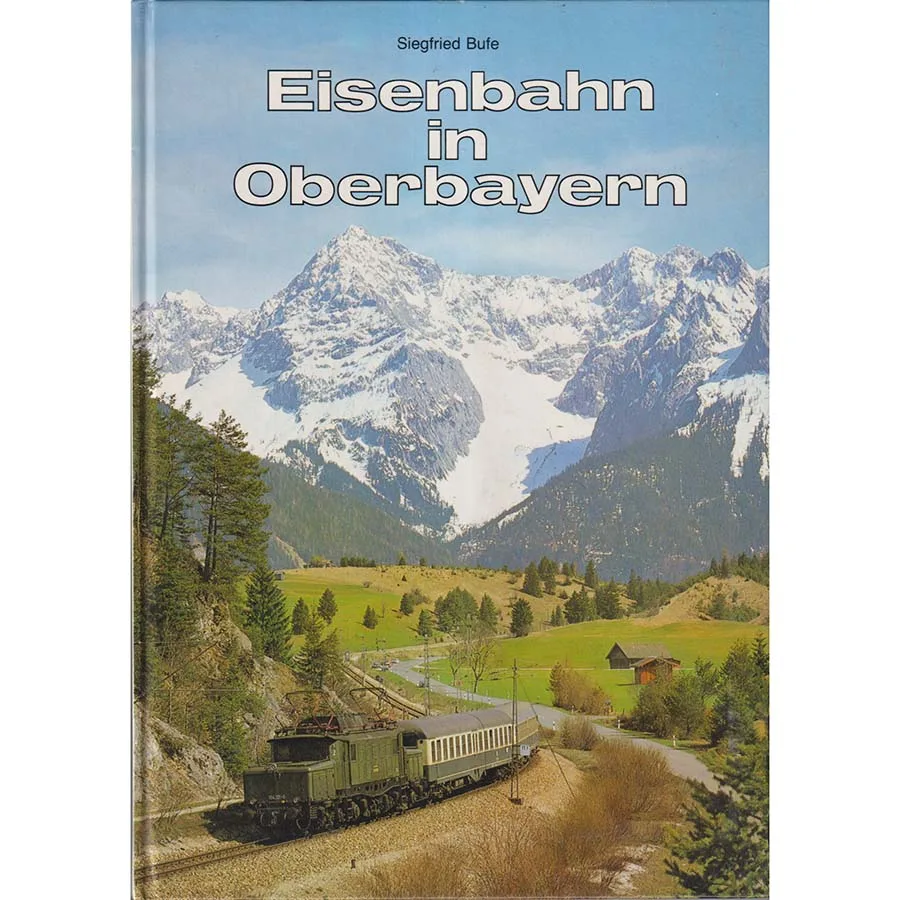
The cover itself is an excellent declaration of intent. On the front, locomotive 194 121 travels along the Karwendelbahn near Klais, surrounded by the sort of Alpine landscape which suggests that railway engineering was invented principally to improve the composition of mountain photographs. The rear features a Class 141 passing the church at Volkmannsdorf towards Landshut, demonstrating the traditional Bavarian partnership of railway, village and architecture with an onion on top.
This is a specialist history rather than a general picture book, but the abundance of images makes it rewarding even for readers whose German railway vocabulary does not yet extend confidently to Bahnbetriebswerk. Those who do read German will find a carefully organised regional account; those who do not can still enjoy the photographs while gradually discovering that Nebenbahn means considerably more to railway enthusiasts than “a smaller train somewhere over there”.
The book is also an evocative record of the railway landscape as it existed in and before the early 1980s. Some lines shown were already disappearing, others had changed purpose and still others were being incorporated into modern suburban transport. It captures the point at which steam-era infrastructure, traditional local services and newer electric operations could still be considered within the same living network.
This copy is in Good condition, with the ordinary light signs of age and previous ownership but remaining sound, complete and well suited to reference or collection. It is a sizeable, properly produced railway volume rather than one of those insubstantial modern books in which a large locomotive photograph is spread across two pages and most of the engine disappears into the binding.
Ideal for collectors of German railway books, enthusiasts of Bavarian transport history, model railway planners seeking authentic detail or anybody who believes that a beautiful Alpine valley is improved by the appearance of several hundred tonnes of electrical machinery.
A Good 1984 first-edition copy sold by Crappy Old Books—255 pages of depots, main lines, branch lines, forgotten lines and convincing evidence that even the Bavarian Alps require a thoroughly documented railway service.
Keep browsing: See more Transport books Other books by Siegfried Bufe
