


Martin Pippin In The Apple Orchard
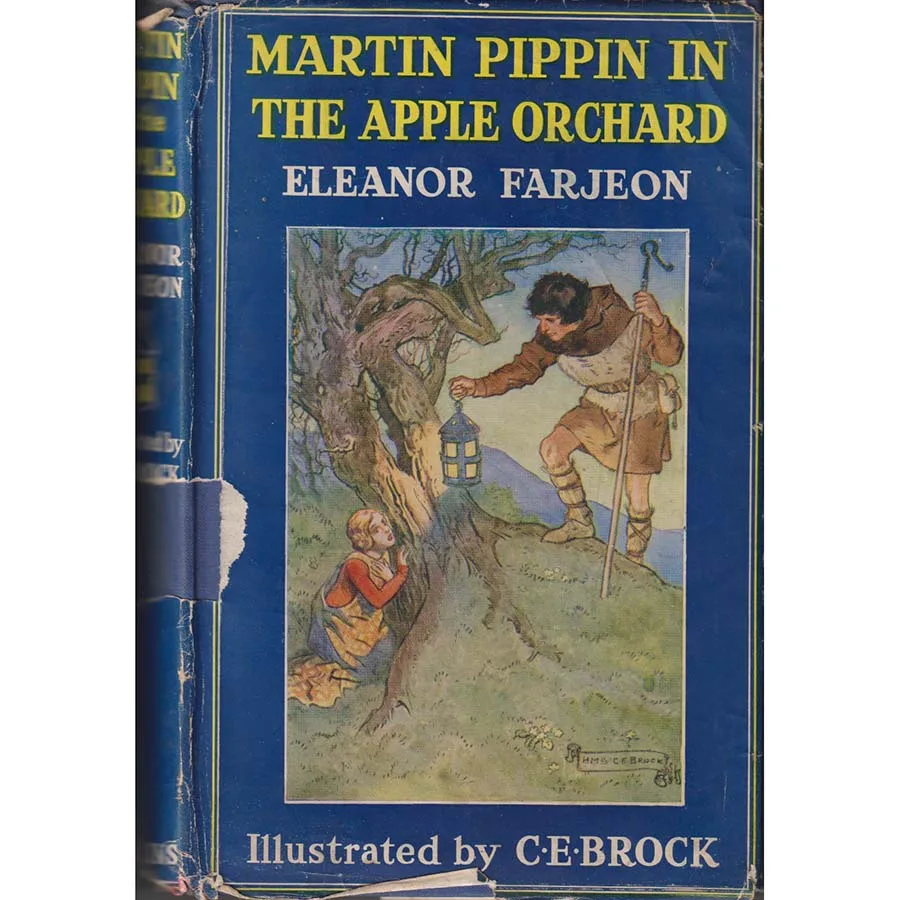
Publisher: Collins Clear-Type Press
Format: Hardback
ISBN: none
Martin Pippin is a wandering minstrel, an occupation which conveniently permits him to enter orchards, interfere in private romances and survive without any obvious arrangement for regular wages. One day he encounters Robin Rue, a young ploughman in despair because his beloved Gillian has been locked inside a well-house by her disapproving father. Gillian is guarded by six milkmaids, each possessing a key and all solemnly opposed to men, marriage and presumably minstrels approaching with suspiciously charming expressions.
Martin decides to rescue her. Since there are six locks and six guardians, this requires considerably more finesse than simply forcing a window. He enters the orchard and sets about winning the confidence of Jane, Joan, Jennifer, Jessica, Joscelyn and Joyce through songs, games, riddles, conversation and six elaborate tales of love. It is less a prison break than an exceptionally leisurely literary campaign.
Each of Martin’s stories draws upon fairy tale, folklore, romance and the Sussex countryside. Kings, lovers, ordinary working people and magical possibilities mingle in a world where love may be concealed, delayed, misunderstood, betrayed or believed lost forever. Nothing proceeds directly when it can instead take a lyrical detour through enchantment, longing and at least one surprising reversal.
Between the tales, Martin and the milkmaids tease one another, make wagers, dance, argue over meanings and discuss love with the mock gravity of philosophers who happen to be sitting beneath apple trees. The guardians begin the book sworn against men, but Martin has the tremendous strategic advantage of being witty, musical and fictional. Their resistance is therefore subjected to pressures against which no sensible orchard security system could reasonably have been designed.
Although frequently classified as a children’s book, Martin Pippin in the Apple Orchard was written with considerable adult feeling beneath its fairy-tale surface. Its stories explore separation, loyalty, disappointment, desire and the peculiar ingenuity with which human beings complicate their own happiness. Children can enjoy the magic; adults may recognise the emotional damage concealed beneath the blossom.
Farjeon fills the book with flowers, birds, fields, hills, fruit and the scents and sounds of rural England. The Sussex landscape feels at once real and enchanted, as though every village lane might lead to an old song, a king in disguise or a romantic crisis requiring intervention by a passing minstrel. Her prose is lyrical and playful, sweet without becoming entirely innocent and whimsical without losing sight of sadness.
This 1938 Collins Clear-Type Press edition is illustrated by C. E. Brock, whose pictures give visible form to Farjeon’s romantic, pastoral world. The dust jacket retains its striking deep-blue design and coloured front illustration, making it an attractive period edition even after many decades of less-than-fairy-tale treatment. Publishers once considered “Clear-Type” a notable selling point, which now seems modest, but legible printing has certainly aged better than many innovations.
The book itself is in Good condition, while the surviving dust jacket shows definite wear. There is a substantial horizontal tear through the jacket at the spine which continues onto the back, and a section is missing from the spine area, plainly visible in the scan. There is roughly a similar amount of loss at the corresponding rear portion of the jacket. The edges and corners also show the general rubbing and wear expected of a dust jacket that has spent nearly ninety years attempting to protect somebody else.
Despite this damage, the jacket remains present, recognisable and remarkably decorative. It has not achieved the immaculate survival preferred by very serious collectors, but neither has it disappeared altogether, as dust jackets of this age have an unfortunate habit of doing. What survives still supplies the book with considerable period character and gives C. E. Brock’s illustration its proper place on the front.
This is therefore a pleasing reading and display copy rather than a pristine collector’s specimen. The jacket has endured its own episode of rough treatment, but the volume remains sound, complete and quite collectable as an illustrated pre-war edition. Anyone requiring an untouched jacket will need a time machine; anyone who enjoys genuine old books with visible histories may find this considerably more appealing.
Ideal for collectors of Eleanor Farjeon, admirers of C. E. Brock, lovers of literary fairy tales or readers who believe that every successful rescue should involve six stories, six keys and several afternoons beneath the apple blossom.
A Good 1938 illustrated copy sold by Crappy Old Books—with a wounded but surviving dust jacket, six highly questionable security arrangements and one minstrel who proves that storytelling is more effective than bolt cutters.
Keep browsing: See more Kids books Other books by Eleanor Farjeon
