


Canciones
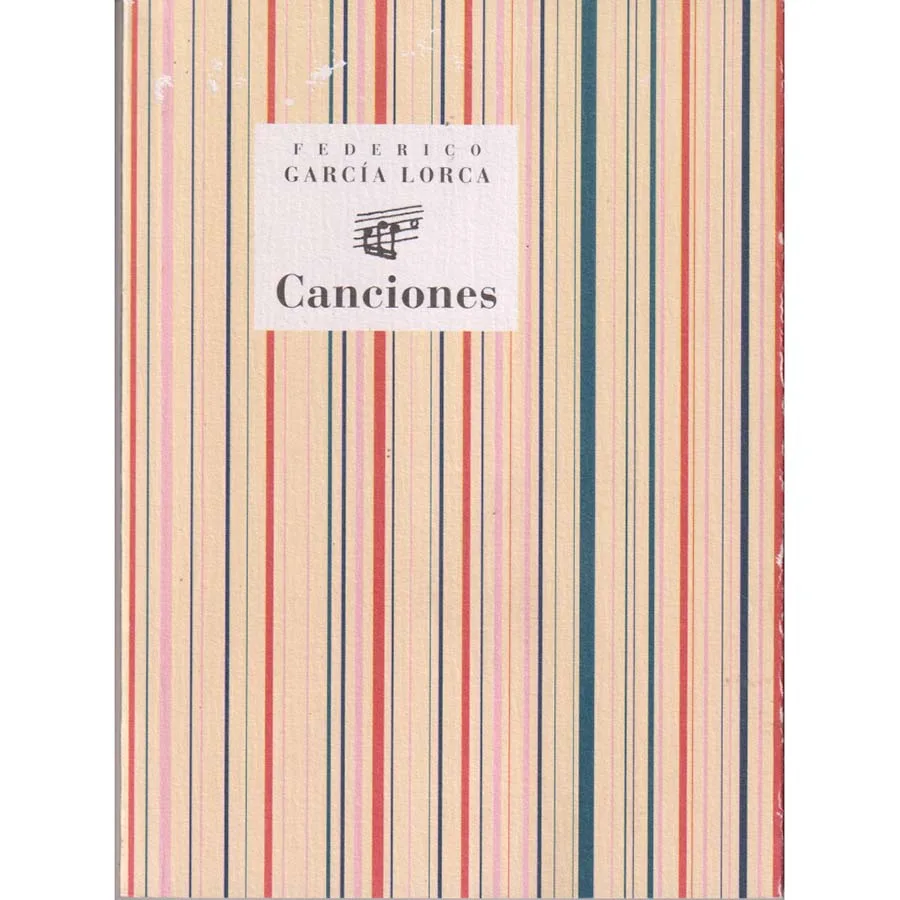
Publisher: Editorial Comares
Format: Paperback
ISBN: 9788481516524
Canciones (1998) by Federico García Lorca. Editorial Comares. ISBN: 9788481516524. Text in Spanish. Condition: Good.
Some poetry politely requests your attention.
Federico García Lorca’s poetry simply begins singing, whether you understand every word or not.
Appropriately enough, this collection is titled Canciones—Songs—and that is precisely how these poems should be approached. They are not merely verses arranged into tidy columns on a page. They are lyrical, musical, rhythmic creations, alive with the sounds of the Spanish language itself. Read aloud, even hesitantly, they possess a cadence that seems almost impossible to silence.
Lorca knew that poetry should be heard as much as read.
The rest of us are still catching up.
This 1998 Editorial Comares edition is presented entirely in Spanish, making it an ideal volume for readers of the language, students of Spanish literature or anyone who has discovered that translated poetry, however accomplished, is rather like admiring a flamenco performance through frosted glass. You still perceive the beauty, but some of the movement, colour and rhythm inevitably remain just out of reach.
With Lorca, those rhythms are half the magic.
Published originally in 1927, Canciones belongs to an important period in Lorca’s career, before the darker shadows that would later define both his life and much of his legacy. These poems are often playful, dreamlike and musical, yet beneath their apparent simplicity lie the same emotional depths that make all of Lorca’s writing so enduring.
He had an extraordinary talent for making the ordinary seem enchanted.
A child.
A bird.
The wind.
The moon.
Especially the moon.
If celestial bodies were paid royalties, the moon would have retired comfortably thanks to Spanish poetry alone.
Lorca draws deeply upon Andalusian folklore, traditional songs, nursery rhymes and popular culture, yet transforms them into something uniquely his own. His poems seem at once ancient and startlingly modern. Images drift in and out like fragments of dreams. Nature refuses to behave merely as scenery, becoming instead a participant in the emotional life of every poem.
Trees appear to remember things.
Water seems capable of mourning.
Even silence occasionally feels occupied.
There is an extraordinary economy to Lorca’s writing. Many of the poems are remarkably brief, yet somehow contain entire emotional landscapes. This is poetry that understands the value of restraint. Lorca rarely explains. He suggests. He hints. He allows symbols to linger just long enough before quietly stepping aside.
Readers are expected to do a little of the work themselves.
A scandalous concept in an age of instructional videos explaining absolutely everything.
For those learning Spanish, Canciones offers another particular pleasure. Lorca’s language, while richly poetic, rewards slow reading. Individual words begin revealing unexpected shades of meaning. Familiar vocabulary suddenly acquires emotional weight. You may find yourself reaching for a dictionary, only to discover that the dictionary explains the word but not quite the poem.
That is not the dictionary’s fault.
Poetry has always enjoyed keeping a few secrets.
Editorial Comares presents the collection in a clean, accessible edition that allows Lorca’s words to take centre stage. There are no unnecessary distractions, no elaborate embellishments, simply one of Spain’s greatest poets speaking directly through the language that shaped every rhythm and every image.
There is something quietly satisfying about reading Lorca in Spanish. Even when one understands only ninety percent of the text, the remaining ten percent has a curious habit of announcing itself through sound rather than logic. The music carries meaning long before the intellect fully catches up.
Which may explain why his poetry continues travelling so effortlessly across generations.
This copy remains in good condition, making it an excellent acquisition for collectors of Spanish literature, students, lovers of poetry or anyone wishing to experience Lorca as he intended to be read. It is not simply a Spanish edition of a famous poet; it is the authentic voice itself, unfiltered and wonderfully alive.
From Crappy Old Books—because there is something deeply reassuring about finding a well-loved Spanish poetry collection sitting quietly among the thrillers and gardening manuals. Books like Canciones remind us that literature has never required passports. It merely asks for curiosity, patience and perhaps the occasional dictionary balanced precariously beside a cup of coffee. Somewhere, years ago, another reader opened this very volume and found themselves listening to Lorca’s extraordinary music. Now it waits for its next performance. The notes have never changed. Fortunately, neither has their ability to leave readers wondering how so much beauty can fit so comfortably between two modest paperback covers.
Keep browsing: See more Poetry books Other books by Federico Garcia Lorca
