


Why Brownlee Left
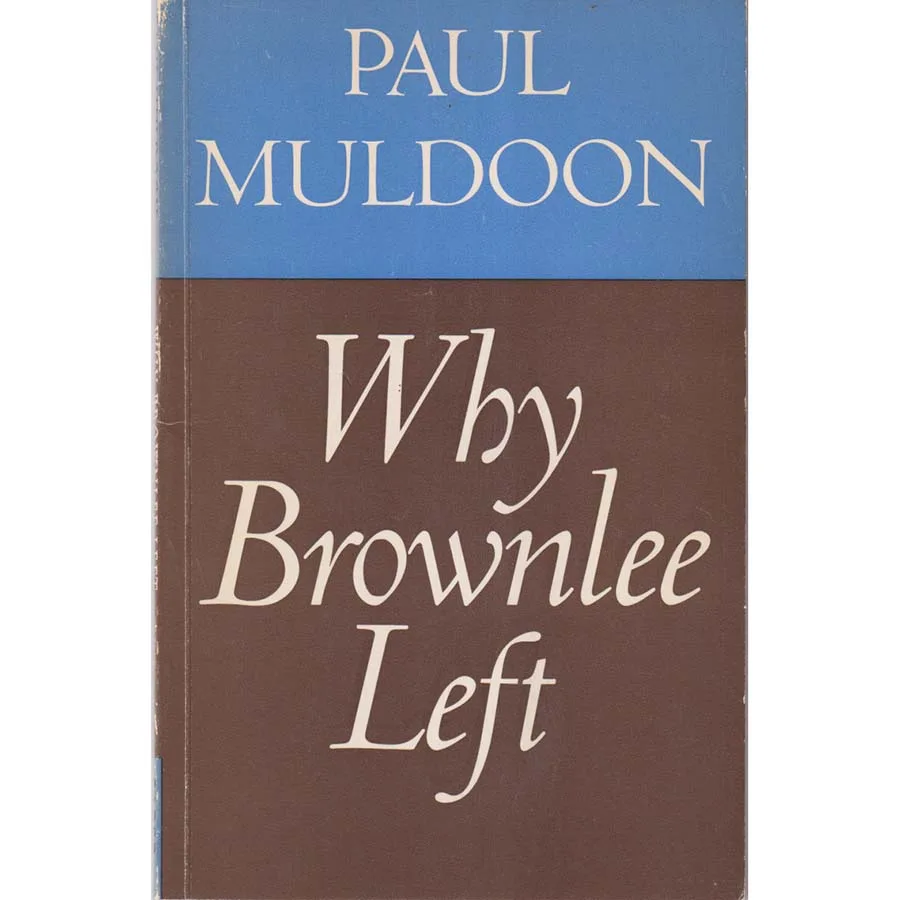
Publisher: Faber and Faber
Format: Paperback
ISBN: 0571115926
Why Brownlee Left (1980) by Paul Muldoon. Faber and Faber. ISBN: 0571115926. Condition: Good.
Some poetry collections ask enormous questions about life.
Others ask much smaller questions that somehow turn out to contain the enormous ones all along.
For example:
Why did Brownlee leave?
Paul Muldoon, in his wonderfully enigmatic second collection, offers a title that sounds almost disappointingly practical, as though one is about to read the minutes of a parish council meeting or the findings of an internal disciplinary inquiry.
One half expects Brownlee to have accepted a better offer in accounting.
Instead, one enters the dazzling, playful and endlessly surprising world of one of the finest poets ever to emerge from Northern Ireland.
Published by Faber and Faber in 1980, Why Brownlee Left marked Muldoon out as a poet who had absolutely no intention of writing predictable verse. His poems slip effortlessly between history and myth, humour and melancholy, everyday conversation and linguistic fireworks. They possess the unnerving quality of seeming perfectly straightforward until, halfway through, they quietly shift sideways and reveal an entirely different landscape.
It is rather like following someone down an ordinary country lane only to discover that it has somehow become an ancient fable.
Muldoon has always delighted in language itself. Words are not merely tools in his hands; they are toys, puzzles, historical artefacts and occasionally practical jokes. Rhymes appear where you least expect them. Narratives begin confidently before wandering off into glorious ambiguity. Images arrive from unexpected directions and somehow fit together with impossible precision.
Reading him can be gloriously disorientating.
In the best possible way.
This was also a significant moment in Muldoon’s career. While later collections would earn him international acclaim—including, eventually, the Pulitzer Prize—Why Brownlee Left already displays the qualities that made him such an extraordinary poet: intellectual playfulness, emotional subtlety, dazzling technical control and an abiding fascination with the strange ways stories are told.
Or perhaps misremembered.
Or invented altogether.
One of the pleasures of Muldoon is that he never seems remotely interested in offering neat conclusions. His poems trust the reader to live quite happily with uncertainty, contradiction and mystery. Brownlee’s departure, after all, matters less than the questions it provokes. The title becomes almost philosophical. Why does anyone leave? A house, a country, a relationship, a version of themselves?
Before long you have forgotten you were ever asking about Brownlee.
You are asking about everyone.
The collection is also quietly funny. This sometimes surprises newcomers, who approach contemporary poetry expecting solemn pronouncements delivered in hushed tones. Muldoon understands that wit and seriousness are perfectly compatible companions. A clever turn of phrase may raise a smile one moment before exposing something unexpectedly profound the next.
It keeps the reader delightfully alert.
Published by Faber and Faber, whose poetry list has long resembled a roll call of literary greatness, this edition preserves an important early work by a poet whose reputation has only continued to grow. It remains one of those collections that rewards repeated reading. The first visit introduces the landscape. The second begins to reveal the hidden paths. By the third, you start noticing that Muldoon quietly rearranged the furniture while you weren’t looking.
This copy remains in good condition, making it an ideal addition for collectors of modern poetry, admirers of Irish literature, or readers who enjoy books that are considerably cleverer than they initially pretend to be.
From Crappy Old Books—because poetry collections often suffer the indignity of being described as "challenging," a word publishers employ with the same enthusiasm estate agents reserve for "compact." Why Brownlee Left certainly asks something of its readers, but what it asks is curiosity rather than obedience. It invites you to linger over language, to enjoy not always knowing exactly where a poem is heading, and to appreciate that mystery is sometimes more satisfying than explanation. As for Brownlee himself, perhaps it is best that Muldoon never really settles the matter. Had he done so, we’d have one fewer literary mystery to ponder—and one less reason to keep returning to this remarkable little book. Sometimes the unanswered question is the one that stays with you longest.
Keep browsing: See more Poetry books Other books by Paul Muldoon
