


White Coolies
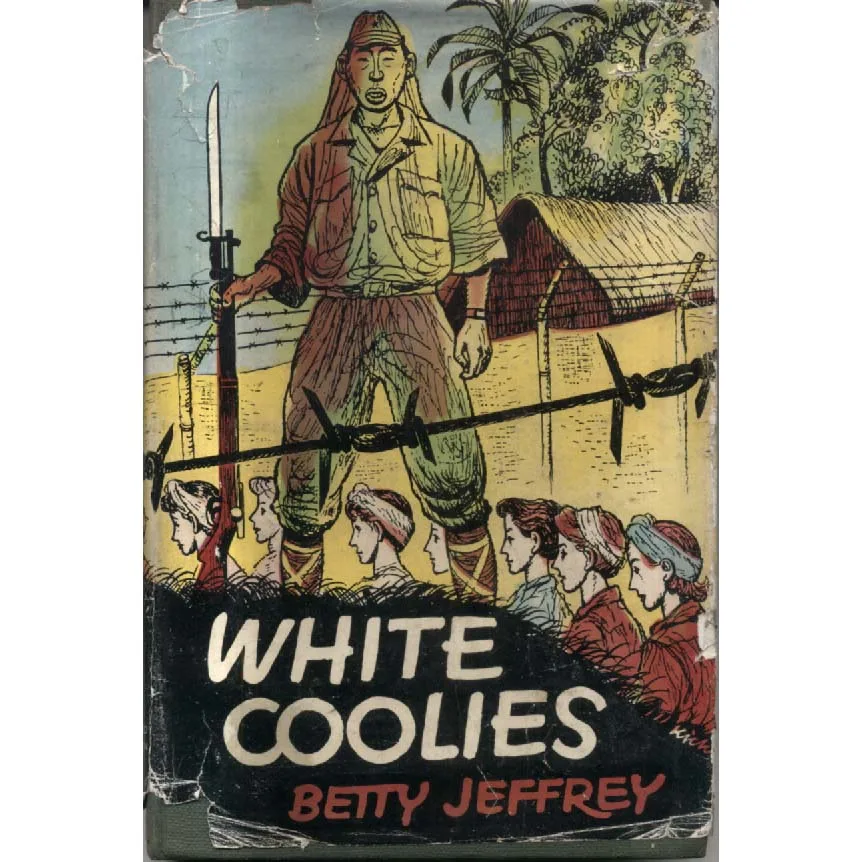
Publisher: Angus and Robertson
Format: Hardback
ISBN: none
Some books announce themselves with quietly dignified titles. Others stride onto the shelf, clear their throat and ensure you notice them immediately. White Coolies belongs emphatically to the latter category. Its title reflects the language of the 1950s and the period it describes, capturing the shocking reality experienced by Allied women imprisoned by the Japanese during the Second World War. It remains a powerful historical memoir whose title should be understood in its historical context, while the story inside continues to stand as a remarkable testament to courage and survival.
Published in 1954 by Angus & Robertson, this first edition sees Betty Jeffrey recount her own experiences as one of the Australian Army nurses captured after the fall of Singapore in 1942. Alongside hundreds of fellow prisoners, she endured years of internment under conditions marked by hunger, disease, deprivation and relentless uncertainty. Yet this is not merely a catalogue of suffering. Jeffrey’s greatest achievement is her ability to reveal the resilience, humour and friendship that somehow survived behind the barbed wire, even when almost everything else had been taken away.
Her writing is refreshingly direct. There is little melodrama, no unnecessary embellishment and no attempt to turn herself into a larger-than-life heroine. Instead, she records daily existence with remarkable honesty—the endless search for food, the struggle against illness, the ingenuity required to make something from almost nothing and the extraordinary importance of companionship. These were women who discovered that morale could be sustained by sharing stories, staging impromptu entertainments or simply refusing to surrender their sense of dignity.
There is a quiet irony woven throughout the memoir. The prison camps were designed to strip people of individuality, independence and hope. Yet, time and again, the women responded not with surrender but with remarkable resourcefulness. Their captors could ration food, restrict movement and impose hardship, but kindness, humour and determination proved considerably harder to imprison. The greatest acts of resistance were often the smallest—keeping spirits alive, caring for one another and believing that one day the gates would finally open.
Reading the book today also offers an intriguing glimpse into the immediate post-war years. Written less than a decade after liberation, Jeffrey’s memories retain a vividness that later historical accounts sometimes soften with hindsight. She was not writing with the benefit of decades of reflection or access to archives; she was writing because these events were still fresh, raw and deserving of remembrance. That immediacy gives the memoir much of its enduring power.
This is a first edition in Fair condition. The book shows slight splaying to the boards and text block from years of honest use and shelving, while the original dust jacket remains present with a little edge wear, several small nicks and general tattyness exactly as shown. Far from detracting, the jacket carries the honest appearance of a volume that has lived an interesting life rather than spending seventy years sealed away in immaculate isolation. There is something rather reassuring about a wartime memoir looking as though it has actually been read.
Whether you collect first editions, wartime memoirs, Australian military history or the literature of the Far East campaign, White Coolies remains an essential work. It is both a deeply personal account and an invaluable historical document, ensuring that the experiences of these remarkable women continue to be remembered by new generations of readers.
Sold, as always, by Crappy Old Books—because some books earn every rubbed corner, every tiny nick and every hint of shelf wear, and the stories inside are all the richer for having travelled through time with them.
Keep browsing: See more War books Other books by Betty Jeffrey
