


On The Trail Of Ancient Man
Publisher: Star Books
Format: Hardback
ISBN: none
There are travel books that recommend pleasant villages, charming cafés and comfortable hotels. Then there is On the Trail of Ancient Man, in which Roy Chapman Andrews cheerfully heads into some of the most remote and inhospitable places on Earth in search of creatures and ancestors that inconveniently died millions of years before anyone thought to leave signposts. It is part travelogue, part scientific memoir and part adventure story, written by a man who seemed to regard armed bandits, mechanical breakdowns and endless deserts as little more than occupational hazards.
First published in 1926, this classic captures the golden age of exploration, when vast stretches of Central Asia remained largely unknown to Western science and every expedition carried the tantalising possibility of changing humanity’s understanding of prehistory. Andrews, leading expeditions on behalf of the American Museum of Natural History, ventured deep into the Gobi Desert in search of fossil evidence that might illuminate the origins of mankind and the ancient creatures that once shared the Earth with our distant ancestors.
The title is irresistible. On the Trail of Ancient Man suggests a determined explorer following a neatly marked path left by prehistoric humanity. The reality, naturally, proved rather less convenient. Ancient man had neglected to leave forwarding addresses, maps or even particularly helpful skeletons. Instead, Andrews and his team relied upon geological instinct, relentless perseverance and a willingness to spend weeks crossing landscapes where the next water source was considerably more reliable than the next conversation.
It is impossible not to admire the sheer confidence of explorers from this era. Today, an expedition often begins by checking satellite imagery, GPS coordinates and weather forecasts accurate to the nearest hour. Andrews, by contrast, set off across deserts by camel and motor vehicle, frequently with little more than maps of questionable accuracy and an unwavering belief that somewhere beyond the next horizon lay another astonishing discovery. One suspects modern risk assessments would have suffered a complete nervous breakdown.
Although the book focuses on the search for humanity’s ancient past, it is equally a portrait of exploration itself. Andrews writes of dramatic landscapes, remarkable wildlife, local cultures and the constant uncertainties of scientific fieldwork with infectious enthusiasm. Along the way, readers gain a fascinating glimpse into a world where palaeontology still possessed the excitement of genuine exploration and where every fossil unearthed might overturn long-established ideas about life on Earth.
There is also a delightful historical charm in reading Andrews today. Some of the scientific interpretations naturally reflect the knowledge of the 1920s and have since been refined by later discoveries, yet the spirit of inquiry remains timeless. His curiosity, optimism and determination continue to leap from every page, reminding us that science advances not merely through laboratories but through people willing to travel extraordinary distances in pursuit of a few ancient bones.
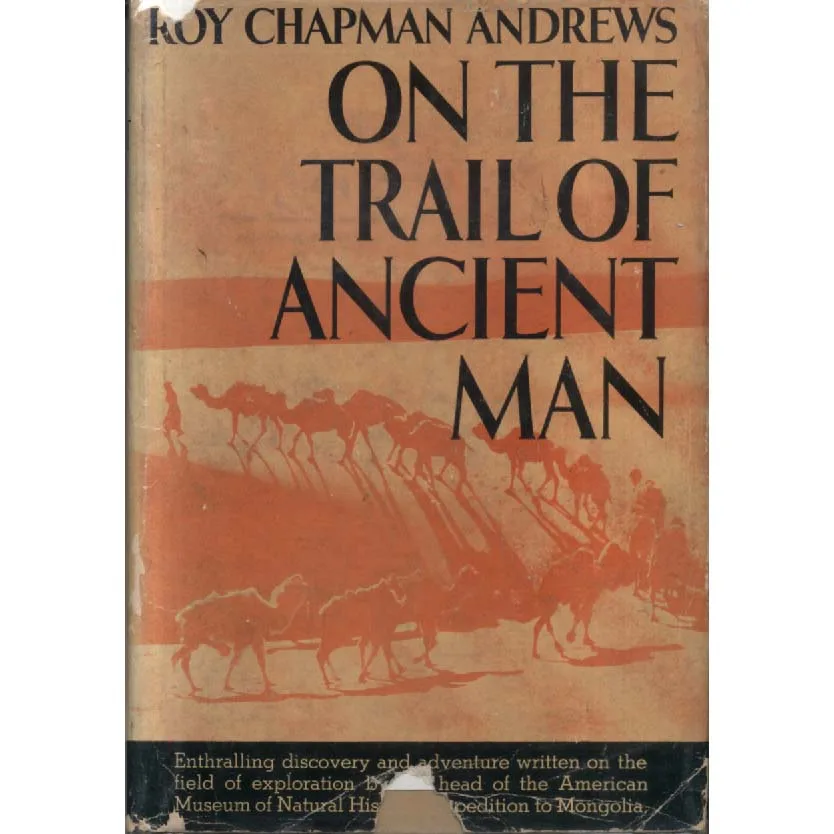
This copy is in very well preserved condition, particularly impressive for a book approaching its centenary. The original dust jacket has been protected in a clear sleeve, helping it survive remarkably well over the decades. There are a few minor niggles, as shown in the accompanying scan, but overall this is an exceptionally handsome example that has clearly spent far more of its life being carefully looked after than being bounced around the Gobi Desert. It remains a wonderfully collectible copy of a genuine exploration classic.
As always, Crappy Old Books delights in rescuing books whose own survival stories are almost as appealing as the adventures they contain. On the Trail of Ancient Man is more than a tale of fossils and forgotten worlds; it is a celebration of curiosity itself. Before archaeology became a television programme and before expeditions came with drones, laptops and satellite phones, there were explorers like Roy Chapman Andrews, armed with notebooks, determination and an almost unreasonable willingness to disappear into the wilderness in pursuit of history. Reading his account today is rather like stepping into an age when the map still contained blank spaces—and someone was brave enough to go and fill them in.
Keep browsing: See more History books Other books by Roy Chapman Andrews
