


The Symbolic Species
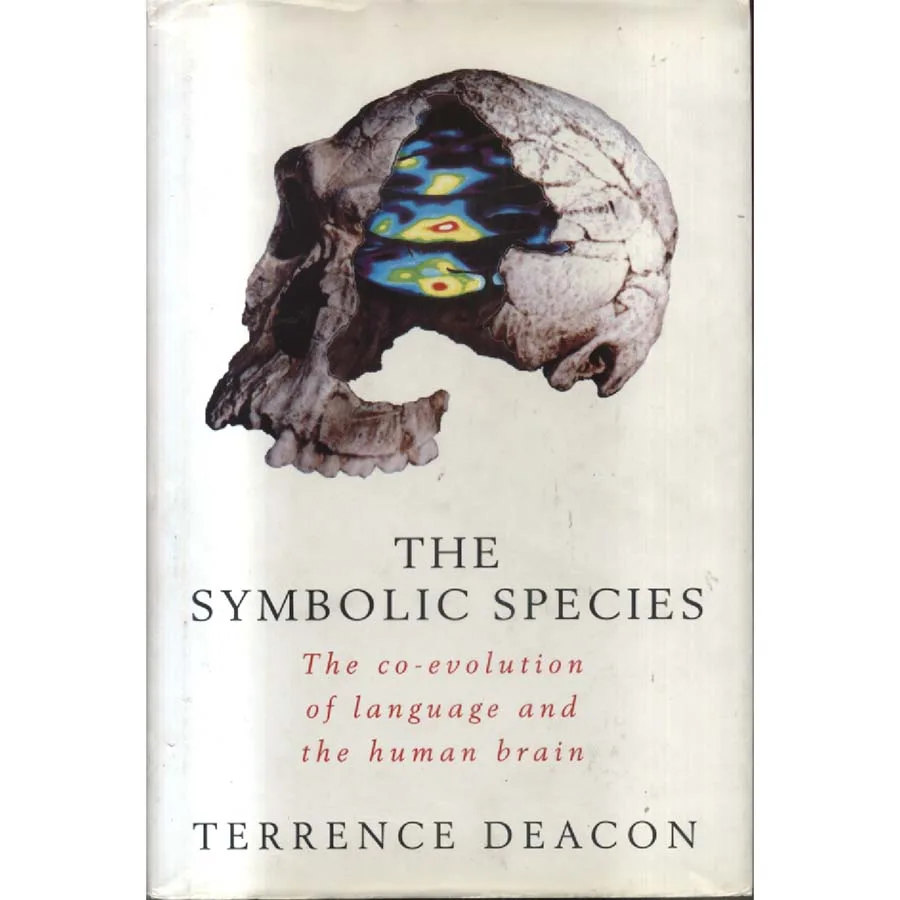
Publisher: Penguin
Format: Hardback
ISBN: 9780713991888
Some books ask whether humans are different from other animals. Others confidently answer "yes" and move on. The Symbolic Species does something far more interesting: it asks why. Why do humans possess language, culture, mathematics, religion, art and the peculiar ability to invent tax returns, instruction manuals and online comments sections? According to Terrence Deacon, the answer lies not simply in having bigger brains, but in our extraordinary capacity for symbolic thought.
Published by Penguin in 1997, this influential and wonderfully ambitious work tackles one of the great questions of science and philosophy: how did language evolve, and how did it, in turn, reshape the human brain? Rather than treating language as a curious add-on to intelligence, Deacon argues that it is woven into the very fabric of what makes us human. It is an argument that draws together neuroscience, evolutionary biology, anthropology, psychology, linguistics and enough fascinating ideas to keep even the most curious reader happily occupied for weeks.
The title itself has a marvellous air of quiet confidence. The Symbolic Species sounds almost like the scientific name we forgot to give ourselves. It reminds us that while many creatures communicate, only humans routinely assign meaning to arbitrary symbols. A few squiggles on a page become Shakespeare. A handful of notes become Beethoven. Three small letters become "DOG," causing millions of people to picture an entirely different animal despite none of them actually seeing one. It is simultaneously astonishing and so commonplace that we barely notice we’re doing it.
One of the book’s greatest pleasures is that Deacon refuses to settle for easy explanations. Human evolution, he argues, was not simply a matter of growing ever larger brains until someone eventually invented conversation. Instead, language and the brain evolved together in a remarkable feedback loop, each shaping the development of the other over countless generations. The result is a picture of evolution far richer—and considerably more intriguing—than the simplistic image of a line of increasingly upright ancestors marching confidently towards modern civilisation.
This is also one of those rare academic books that manages to be intellectually adventurous without becoming hopelessly inaccessible. Deacon writes with the enthusiasm of someone genuinely captivated by his subject, inviting readers into debates that remain central to our understanding of human origins. Along the way he explores animal communication, child development, fossil evidence and the nature of consciousness itself, all while encouraging readers to question assumptions they may never have realised they held.
Of course, this is not the sort of book one casually flicks through while waiting for the kettle to boil. It asks for patience, curiosity and the occasional willingness to pause and think. In return, it offers the deeply satisfying feeling that your brain is being gently but persistently stretched in entirely new directions. There are no miracle conclusions or fashionable soundbites here—just thoughtful scholarship tackling some of the oldest questions humanity has ever asked about itself.
This copy is in good condition, bearing the honest signs of having been read by someone who was probably more interested in the origins of language than in keeping books imprisoned behind glass. The binding remains sound, the pages are clean, and it is perfectly ready to inspire another reader to contemplate the remarkable journey from primate calls to poetry, philosophy and politely worded parking appeals.
As always, Crappy Old Books delights in rescuing books that remind us how extraordinary ordinary life really is. Every sentence you have ever spoken, every story you’ve ever told and every thought you’ve ever committed to paper depends upon the symbolic abilities explored in these pages. The Symbolic Species won’t teach your dog to discuss existentialism or persuade the pigeons outside to quote Aristotle, but after reading it you may never look at human conversation in quite the same way again.
Keep browsing: See more Academic books Other books by Terrence Deacon
