


The Variation Of Animals And Plants Under Domestication - Volume 2
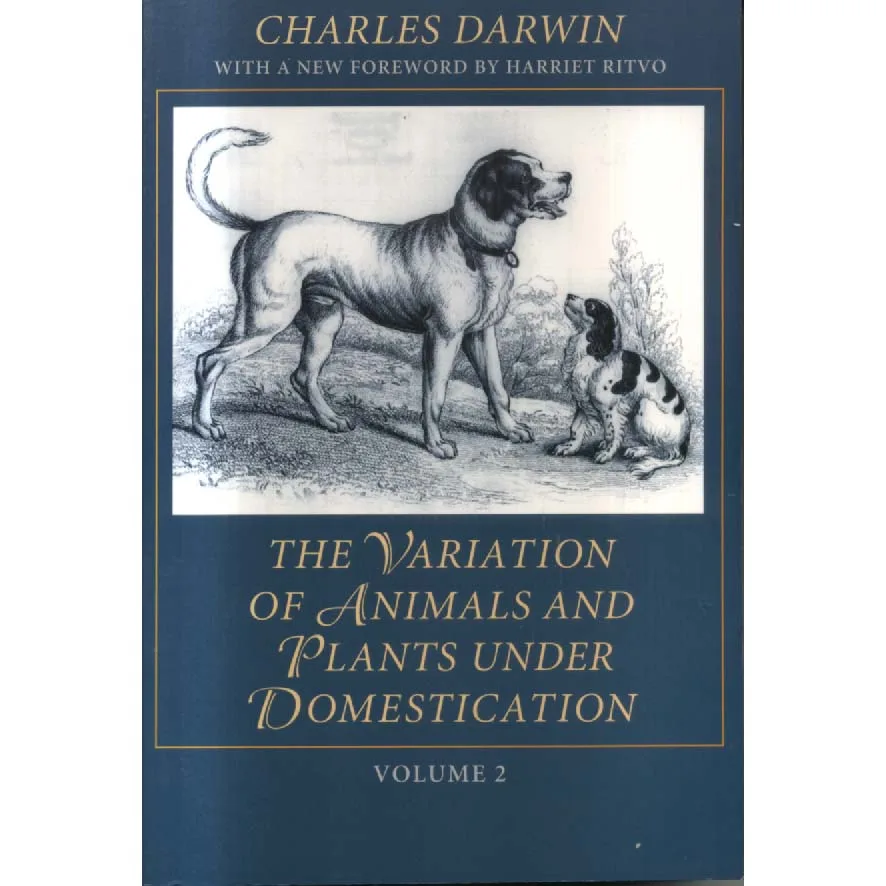
Publisher: Johns Hopkins
Format: Paperback
ISBN: 9780801858673
There are books that change the way you look at the world, and then there are books by Charles Darwin, who somehow managed to change the way the world looked at itself. The Variation of Animals and Plants Under Domestication is one of those extraordinary Victorian works in which Darwin calmly sets about explaining why your prize-winning pigeon, your neighbour’s suspiciously fluffy sheep and your grandmother’s exceptionally determined roses all have far more to tell us about evolution than anyone had previously imagined.
This is Volume 2 of Darwin’s monumental study, reissued by Johns Hopkins University Press in 1998, and it represents the continuation of one of the great scientific investigations of the nineteenth century. If On the Origin of Species introduced the revolutionary idea of evolution by natural selection, this companion work demonstrates Darwin rolling up his sleeves and assembling mountains of evidence from the everyday world. Breeders, farmers, gardeners and pigeon enthusiasts all unexpectedly become contributors to one of science’s greatest detective stories.
The title possesses a marvellous Victorian confidence. The Variation of Animals and Plants Under Domestication sounds reassuringly straightforward, almost as though Darwin intends to spend a pleasant afternoon discussing particularly well-behaved cows. In reality, he embarks upon an astonishingly detailed exploration of heredity, selective breeding, inheritance and variation, laying foundations for ideas that would eventually become central to modern genetics—even though the mechanism of genes themselves was still entirely unknown.
One cannot help admiring Darwin’s astonishing curiosity. Where most people looked at fancy pigeons and saw... well, fancy pigeons... Darwin saw evidence capable of explaining the diversity of life itself. He examined dogs, rabbits, horses, cattle, flowers, fruit trees and countless other domesticated species with the enthusiasm of someone who regarded every barnyard as a potential scientific laboratory. It is a comforting reminder that groundbreaking discoveries do not always require billion-pound laboratories; sometimes they merely require an exceptionally observant naturalist and an alarming quantity of notes.
Being Volume 2, this book continues Darwin’s detailed arguments with the same patient, methodical style that characterises all of his great works. There are no dramatic plot twists, no cliff-hangers involving particularly argumentative cabbages and certainly no chapters entitled "Ten Evolutionary Secrets Breeders Don’t Want You to Know!" Instead, Darwin proceeds with quiet confidence, accumulating evidence piece by piece until readers find themselves persuaded almost before they’ve realised the argument has been made.
Reading Darwin today is also an oddly humbling experience. Many of his conclusions have stood the test of time remarkably well, while others have naturally been refined by more than a century of subsequent research. Yet what shines through above all is his method: careful observation, relentless curiosity and an almost heroic refusal to jump to conclusions without evidence. It is science performed with extraordinary patience, written in prose elegant enough to remind us that Victorian scholars often considered style almost as important as substance.
This copy is in good condition, showing the gentle signs of having been appreciated by readers interested in ideas rather than merely decoration. The binding remains sound, the pages are clean, and it has weathered the decades considerably better than many of the breeds and plant varieties discussed within its covers.
As always, Crappy Old Books delights in finding books that prove the greatest adventures can take place entirely within the pages of careful scholarship. The Variation of Animals and Plants Under Domestication – Volume 2 is more than a scientific classic; it is a window into the remarkable mind of Charles Darwin as he patiently assembled the evidence that helped transform biology forever. It may forever change the way you look at pigeons, pigeons may never notice, but that somehow feels entirely in keeping with the evolutionary process.
Keep browsing: See more Academic books Other books by Charles Darwin
