


A Mind So Rare
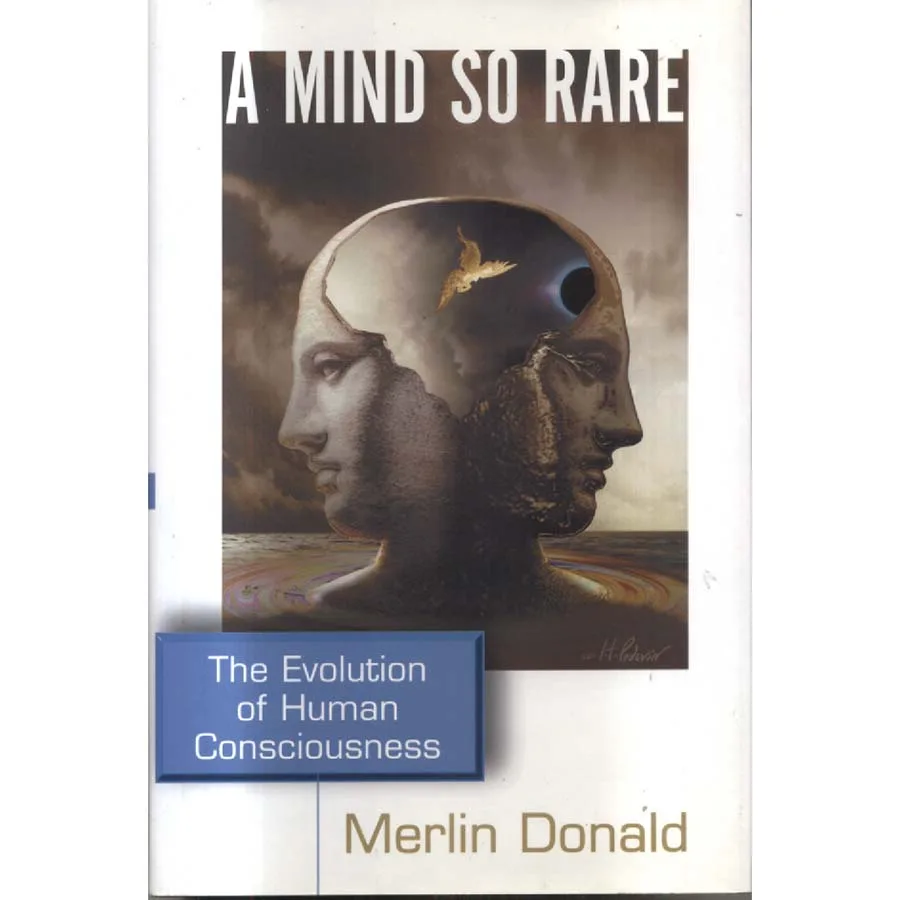
Publisher: Norton
Format: Hardback
ISBN: 9780393049503
Every so often a book arrives that asks one of humanity’s biggest questions: What makes the human mind different? Most of us answer by pointing to art, language, science or civilisation. Merlin Donald responds by writing several hundred fascinating pages exploring precisely how we ended up with brains capable of wondering why we walked into the kitchen in the first place.
Published by Norton in 2001, A Mind So Rare is one of those gloriously ambitious books that refuses to stay in a single academic pigeonhole. It wanders happily through psychology, neuroscience, anthropology, evolutionary biology, philosophy and cognitive science, occasionally pausing to remind the reader that the most extraordinary object in the known universe is currently sitting between their ears wondering whether they’ve remembered to lock the front door.
Donald argues that human intelligence isn’t simply a matter of having a bigger brain than other animals. Instead, our minds have developed unique ways of storing knowledge outside ourselves, building cultures, creating language, sharing memories and accumulating ideas over countless generations. In other words, your ability to complain about Wi-Fi is indirectly connected to someone inventing storytelling around a campfire thousands of years ago.
What makes the book especially enjoyable is that it never treats consciousness as a solved problem. Quite the opposite. Every answer opens three more questions, each somehow more intriguing than the last. The deeper Donald digs into the mechanics of thought, the more miraculous ordinary thinking begins to seem. Reading becomes a pleasantly unsettling experience in which your brain spends several hours attempting to understand itself while simultaneously wondering whether it’s succeeding.
This is popular science in the best possible sense. It is serious without becoming forbidding, scholarly without descending into incomprehensible jargon, and intellectually demanding without requiring a PhD or a laboratory full of expensive scanning equipment. Donald has the enviable ability to explain complex ideas with clarity while never talking down to his audience, a talent considerably rarer than many of the cognitive abilities discussed within these pages.
There is also a delicious irony at the heart of the whole enterprise. Here is a human brain producing an entire book about the uniqueness of human brains, which another human brain then attempts to understand using the very mechanisms under discussion. It is a little like writing a detailed manual explaining how instruction manuals work. Fortunately, unlike most instruction manuals, this one is genuinely interesting.
Twenty-first-century readers may also find themselves quietly amused by how many questions explored here remain very much alive. Artificial intelligence, collective knowledge, memory, language and the relationship between biology and culture have become some of the defining conversations of our age. Donald was asking many of these questions before they became regular dinner-table topics and before every household appliance threatened to become "smart."
Our copy is in fine condition, which feels particularly appropriate for a book celebrating one of nature’s finest engineering achievements. It is clean, crisp and ready to challenge, entertain and occasionally leave its next owner staring thoughtfully into the middle distance while contemplating consciousness.
Whether you have an interest in psychology, neuroscience, evolution, philosophy or simply enjoy books that leave you feeling slightly cleverer than when you started, A Mind So Rare is an absorbing companion. It asks enormous questions with refreshing humility, rewards curiosity at every turn, and serves as an elegant reminder that the greatest mystery most of us will ever encounter is the one quietly doing the reading.
Exactly the sort of thought-provoking volume that Crappy Old Books is delighted to rescue from the shelves, proving once again that the oldest and most complicated technology most of us own requires neither charging cable nor software update.
Keep browsing: See more Non-Fiction books Other books by Merlin Donald
